


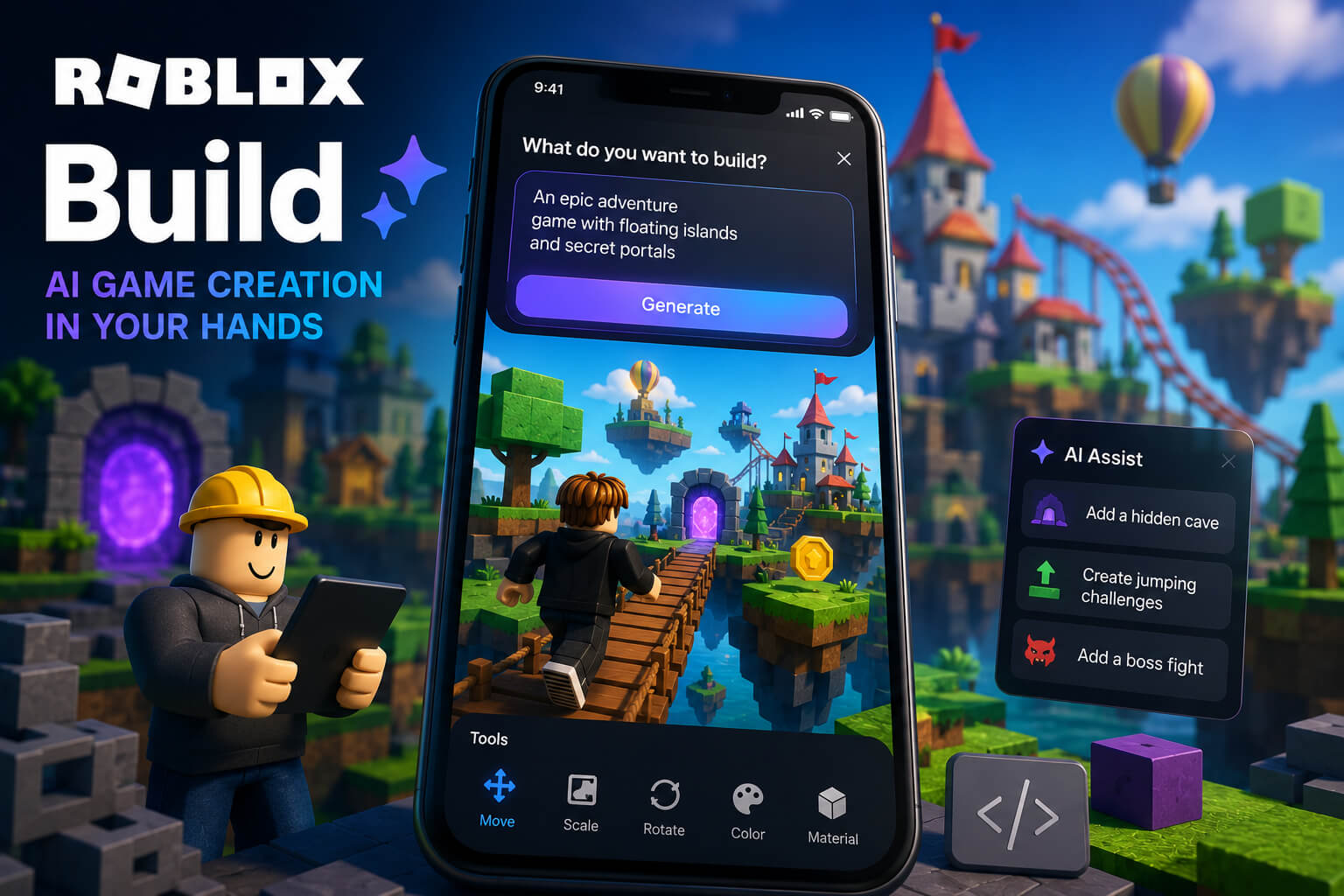
Roblox is making game creation feel a lot less like traditional development and a lot more like typing an idea into your phone. The company has introduced Build, a new AI-powered creation feature inside the Roblox mobile app. The basic idea is simple: users describe the kind of game they want, and Roblox’s AI tools generate a starting version that can be edited, tested, shared, and eventually published.
That sounds small at first. It is not. For Roblox, this could turn millions of players into casual creators. For the wider gaming industry, it raises a bigger question that keeps coming back lately: what happens when making games becomes much easier, much faster, and maybe a lot messier?
Roblox Wants Game Creation to Start With a Prompt
Build lets users create a basic Roblox game from a simple text prompt. Someone could type an idea like a cozy adventure game in a dense forest, and the system would generate an early playable version from that description.
The feature is designed for mobile first, which matters. Roblox is not only targeting professional creators sitting inside Roblox Studio on a desktop. It is going after the much wider group of users who have game ideas but no coding background, no 3D modeling skills, and no patience for a full development workflow.
Roblox says Build is powered by a mix of open-source AI models and proprietary Roblox models. These tools can help handle gameplay mechanics, environments, characters, visual style, sound, and other parts of the game-building process. In plain terms, Roblox is trying to make “I have an idea” feel closer to “I made something.”
The Public Alpha Starts in New Zealand
Roblox plans to begin public alpha testing for Build on July 28, 2026, starting in New Zealand. During the alpha phase, the feature will be available to age-checked users aged 9 and older. Users aged 16 and above will be able to publish eligible creations to a global audience, provided those games pass Roblox’s safety checks.
A basic version of Build will be free, while paid options will be available for power users. That pricing detail is worth watching. AI creation tools often begin as helpful entry points, then slowly become part of a larger creator economy. Roblox already has a massive ecosystem around user-generated games. Build could expand that pipeline, but it could also make competition even tougher for creators trying to stand out.
Roblox Says AI Slop Will Not Take Over the Homepage
Here is the obvious concern: if anyone can generate a game quickly, Roblox could get flooded with low-effort experiences. The company knows that criticism is coming. It is already pushing back.
Roblox says AI-generated games will be ranked through the same retention-based discovery system used for other games on the platform. In other words, if players do not stick around, the game should not rise in visibility. That is the clean version. The real test will be harder.
AI tools can produce a lot of content fast. Some of it will be experimental. Other creations may feel fun. However, many outputs could still feel repetitive, unfinished, or almost identical to everything else. Roblox is betting that player behavior will filter out the weak stuff before it becomes a discovery problem. Maybe that works. Maybe creators still end up fighting through a much noisier platform.
Developers Are Already Nervous About Generative AI
The gaming industry has not exactly welcomed generative AI with open arms. A Game Developers Conference survey cited by TechCrunch found that 52% of game industry professionals believe generative AI is having a negative impact on the industry. That says a lot. Developers are not only worried about tools. They are worried about jobs, originality, quality, ownership, and the value of creative labor.
Roblox’s Build feature sits directly inside that debate. For younger users and casual creators, this could be exciting. A child with an idea could prototype a game in minutes. A small creator could test concepts without building everything from scratch. A hobbyist could finally move beyond imagination.
For experienced developers, the picture is less clean. If AI-generated content becomes common, discovery may get more crowded. Original games may have to compete with quickly produced experiences that borrow familiar mechanics, styles, and trends. The tool is impressive. The consequences are not fully settled.
Roblox Is Building More AI Tools for Creators
Build is not the only AI move Roblox is making. The company is also developing AI agents for playtesting, analytics, and experimentation. These tools could help creators find bugs, understand player behavior, and test ways to improve engagement, retention, and monetization.
Roblox has also been working on AI models for 3D asset generation and scene creation. Its broader direction is clear enough now. The company does not just want AI to help users decorate a game. It wants AI involved in the actual structure of creation, from objects to scenes to gameplay support. That is a very different version of Roblox than the one many users grew up with.
Why This Matters for Roblox and AI Gaming
Roblox has always sold itself on the idea that anyone can create. Build pushes that idea into a more aggressive AI era. The company is no longer only saying users can make games with accessible tools. It is saying users may soon be able to make games through conversation, prompts, agents, and automated systems that handle large parts of the process.
For Roblox, this could bring more creators into the ecosystem. More creators means more games, more experiments, more time spent on the platform, and potentially more revenue. For gaming, it adds pressure to a shift that is already happening. AI is moving from concept art and asset generation into playable experiences. The line between player, creator, and developer is getting blurrier.
Roblox Build may begin as a mobile feature in public alpha. But the bigger story is this: game creation is starting to look less like a specialist skill and more like a prompt-driven activity. That will excite a lot of people. It will annoy a lot of people too.
