


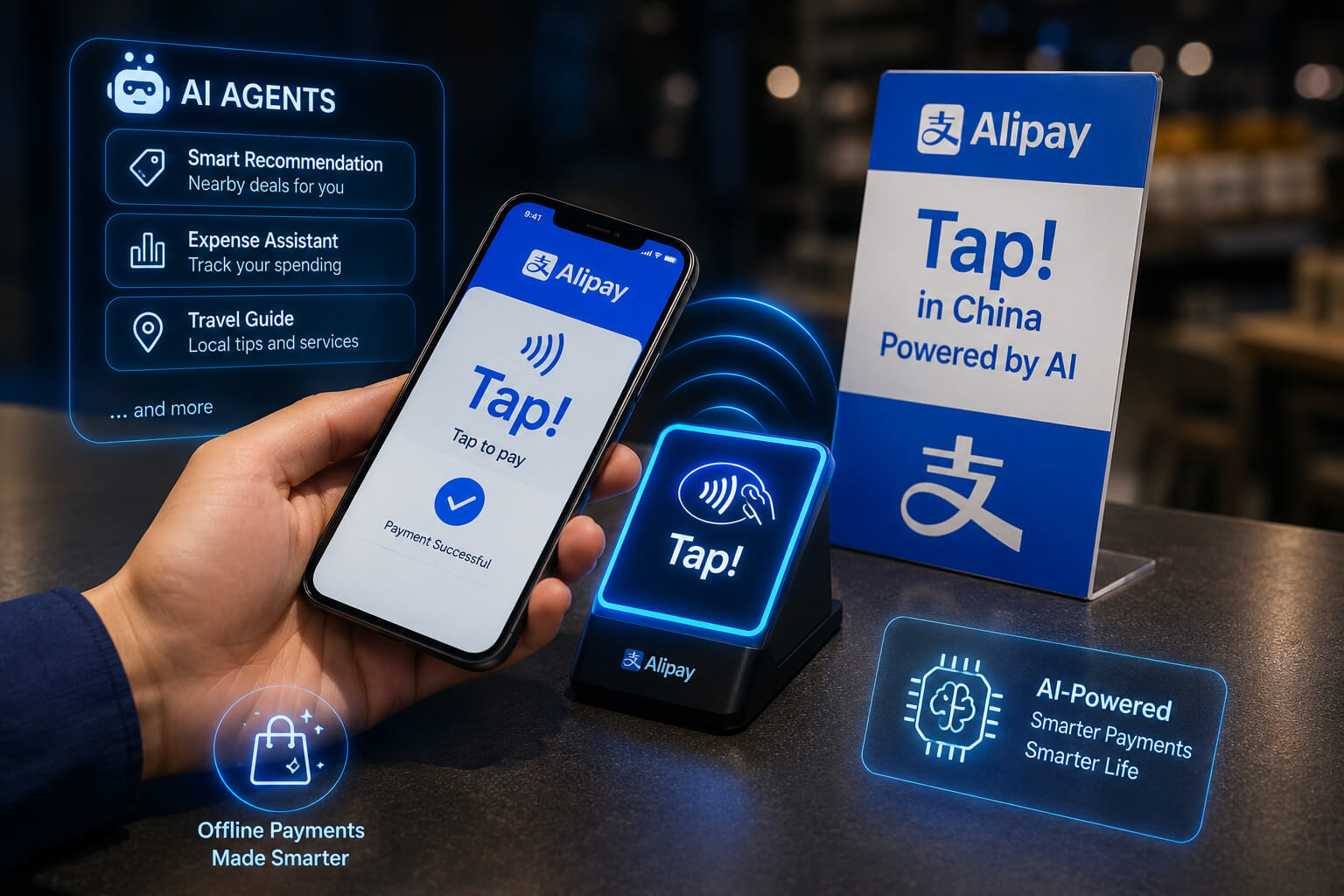
Alipay is pushing its Tap! ecosystem further into AI territory, and this time the focus is not only on faster payments. It is about giving offline merchants something closer to an intelligent business assistant sitting inside their payment setup.
The company has connected its AI agent, Xiaoyu, to Alipay Tap! devices, allowing merchants to use AI-powered services through the same terminals already used for customer payments and engagement. The move expands Alipay’s AI agent services into more offline businesses, including small and medium-sized merchants that may not have large digital teams behind them.
Alipay Tap! Moves Beyond Simple Contactless Payment
Tap-to-pay is already familiar. What Alipay is trying to build around Tap! is different.
Alipay Tap! started as a contactless payment and customer engagement solution. Since its launch two years ago, it has served 400 million users and millions of merchants through 30 million Tap! devices. That is a huge base to plug AI into, and it gives Alipay a direct route into shops, restaurants, service counters, kiosks, and other everyday offline business settings.
The idea is simple enough: payments are no longer just the final step of a transaction. They can become a doorway into customer insights, store operations, marketing, loyalty, and service automation.
Xiaoyu Brings AI Agent Support to Merchants
The new AI agent connection gives merchants access to Xiaoyu through Alipay Tap! devices. Instead of relying only on dashboards, spreadsheets, or manual checks, merchants can use AI to support digital operations more directly.
For a small shop owner, that could mean asking for business updates, checking sales patterns, improving membership campaigns, or getting help with customer engagement. Not every merchant has time to study analytics. Many just want to know what is selling, what is slowing down, and what they should do next.
That is where AI agents start to matter. Not because they sound futuristic. Because they may remove some of the daily guesswork from running a physical business.
AI-Powered Payments Are Becoming Part of the Checkout Layer
Alipay has also been moving quickly in AI-powered payment services. Earlier in 2026, Ant Group said Alipay AI Pay surpassed 100 million users during the Chinese New Year period, showing how quickly AI-assisted payment experiences are being tested and adopted in China.
This matters because AI payments are not only about replacing a button with a voice command. They change who, or what, is allowed to start a transaction.
In traditional checkout, the person chooses, confirms, and pays. In agentic commerce, an AI assistant may help search, decide, order, and eventually complete the payment under user-approved rules. That creates a new kind of commerce flow, one where the payment system has to understand AI agents, permissions, spending limits, and trust.
Why This Matters for Small Businesses
A large retailer can build custom AI systems. A small merchant usually cannot.
That is why Alipay’s Tap! strategy is interesting. If AI agent services are built into payment devices already sitting in stores, smaller businesses may get access to digital tools without needing to build their own platforms from scratch.
It could help merchants manage loyalty programs, understand customer behavior, launch offers, and handle operations with less technical friction. The payment terminal becomes less like a machine on the counter and more like a business interface.
Not glamorous. Very useful.
Alipay Is Building for the Agentic Commerce Era
Alipay’s wider push shows how payment companies are preparing for a world where AI agents do more than answer questions. They may shop, compare, book, recommend, and pay.
The company has already introduced AI payment infrastructure, including AI Wallet and Token Pay, to support transactions in what it calls the agentic economy. These services are designed to give users more oversight of payments carried out by AI agents while also giving AI companies and merchants a payment layer built for automated commerce.
That is the bigger picture behind this Tap! update. Alipay is not treating AI as a separate feature parked inside an app. It is trying to place AI inside the physical payment network, inside merchant tools, and inside the transaction flow itself.
The Checkout Counter Is Becoming an AI Touchpoint
The old version of digital payments was mostly about speed. Scan faster. Tap faster. Confirm faster.
Now the race is changing. Payment companies want the checkout layer to become smarter, more personalized, and more automated. Alipay’s latest Tap! expansion shows how that shift may reach offline businesses first, not just online stores.
For merchants, the promise is better operations without complicated software. For customers, it may mean smoother service, more relevant offers, and payments that feel less separate from the rest of the shopping experience.
The uncomfortable question is also there: how much decision-making should AI agents be allowed to handle when money is involved?
Alipay seems to be betting that the answer is not “none.” It is building the tools now, and Tap! gives it a massive offline network to test what AI-powered commerce looks like in real life.
