


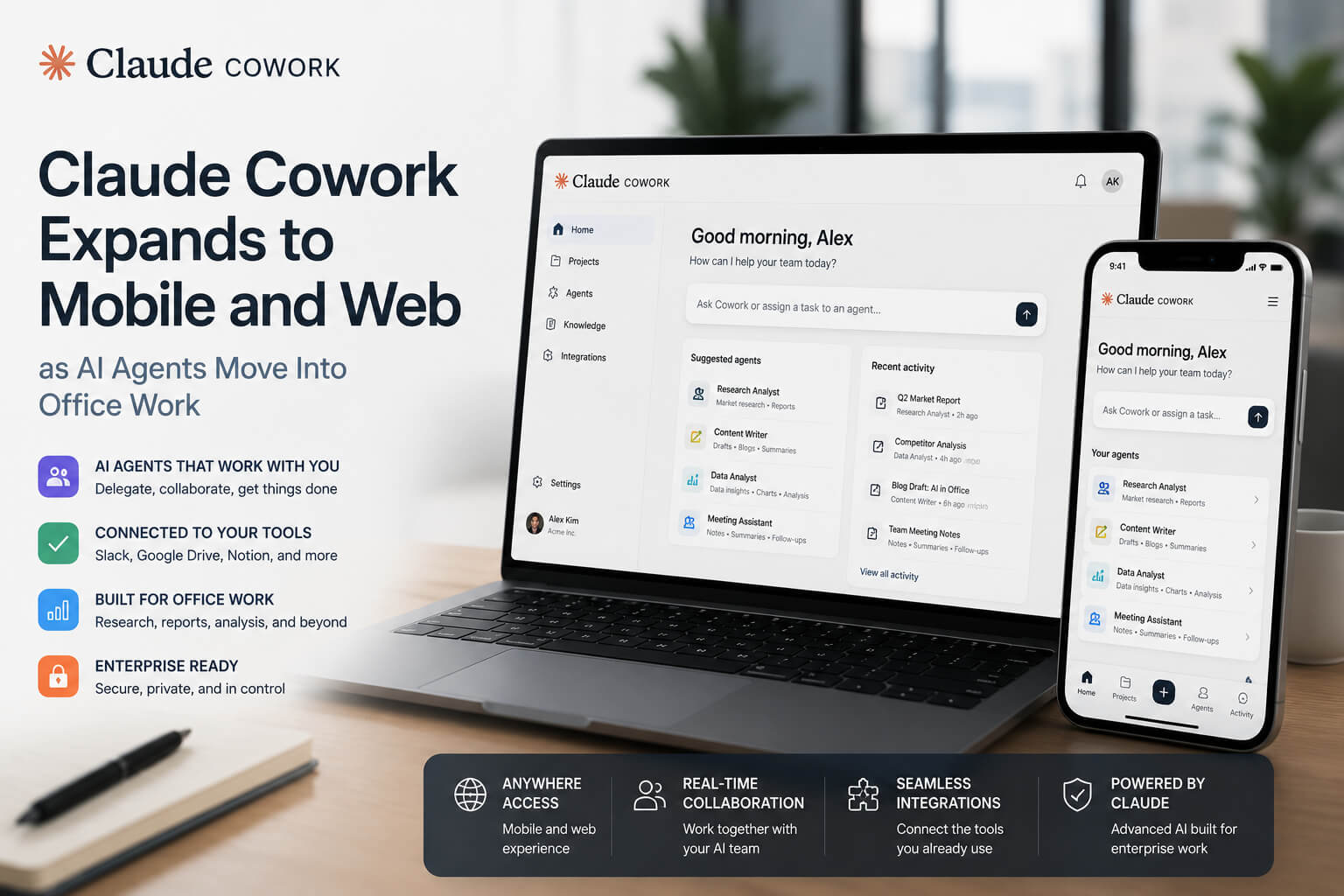
Anthropic is taking Claude Cowork out of the desktop-only box. With the new release, Claude Cowork mobile and web experiences will be available for even more flexible collaboration.
The company’s Claude Code-style agent for general work is now expanding to mobile and web, giving Max subscribers a way to start tasks at a desk, check progress from a phone, and return later to finished work, even if the laptop is closed. That sounds small at first. It is not. It changes where the AI agent lives. Not just inside a coding terminal. Not just inside a desktop app. More like an always-near office assistant that follows the user across devices.
Claude Cowork Is No Longer Just a Desktop Experiment
Claude Cowork first launched as a desktop app in January. The idea was simple enough: take some of the power behind Claude Code and make it usable for non-developers.
Now Anthropic is pushing it further. With web and mobile access, Cowork can run tasks in the background, give updates, and wait for human input when needed. The desktop app will still handle deeper work involving local files and browser access, but the new expansion makes Cowork easier to use for people who do not want to install another app just to test an AI agent.
That matters because workplace AI adoption often fails in boring places. Login friction. File access. Device switching. A task started on one screen and forgotten on another. Anthropic seems to be trying to remove those tiny blockers before they become big excuses.
The Coding Agent War Is Becoming an Office War
This is where the story gets more interesting.
Claude Cowork is part of a wider shift where AI coding agents are no longer staying inside software development. OpenAI has also been pushing Codex beyond coding, with non-developers using these agentic tools for reports, spreadsheets, presentations, research, data analysis, and other office tasks.
So the competition is not only about who writes better code anymore.
The bigger fight may be about who controls the place where everyday work gets done. Emails. Briefing documents. Meeting notes. Follow-up drafts. Spreadsheets that nobody wants to clean. Slide decks that should have been finished yesterday.
That is the real office battlefield.
Anthropic Wants Claude to Handle the Work Around the Work
Anthropic’s early Cowork data gives a useful clue about where people are actually using the tool.
The company sampled 1.2 million anonymized and aggregated Cowork sessions from more than 600,000 organizations during the last two weeks of May. The biggest category was business process operations at 33.4%, including tasks such as pulling scattered updates into reports, building onboarding checklists, and reconciling spreadsheets. Content creation and copywriting came next at 16.4%, covering drafts, slide decks, social posts, proposals, and communications work. Software development accounted for only 8.7% of Cowork usage.
That number says a lot.
The loudest AI agent conversation may still be about developers, but the larger commercial opportunity could sit inside ordinary office work. The messy stuff. The half-admin, half-thinking work that falls between roles and eats up the day.
Mobile Access Makes AI Agents Feel More Real
Putting Cowork on phones is not just a convenience update.
For AI agents to become useful, they need to work when the user is not staring at them. Anthropic gives the example of Claude preparing a Monday client briefing at 6 a.m. by going through email threads, transcripts, and recent news, then leaving a follow-up email drafted but unsent for review.
That last part matters: drafted but unsent.
It shows the current shape of office AI. Not fully autonomous. Not completely passive either. More like a junior teammate that can prepare the work, but still waits before doing anything risky or final.
The Bigger AI Shift Is Quiet, Not Flashy
There is no giant robot here. No dramatic “AI replaces office workers” moment.
Instead, the change looks smaller and more practical. Claude Cowork can help with reports, admin prep, summaries, checklists, content drafts, and scattered business tasks. That is exactly why it could matter. AI does not need to take over the whole job to become deeply embedded in the workday.
The next stage of AI competition may not be won by the chatbot with the cleanest answer. It may be won by the agent that quietly finishes the annoying task before the user opens their laptop.
