


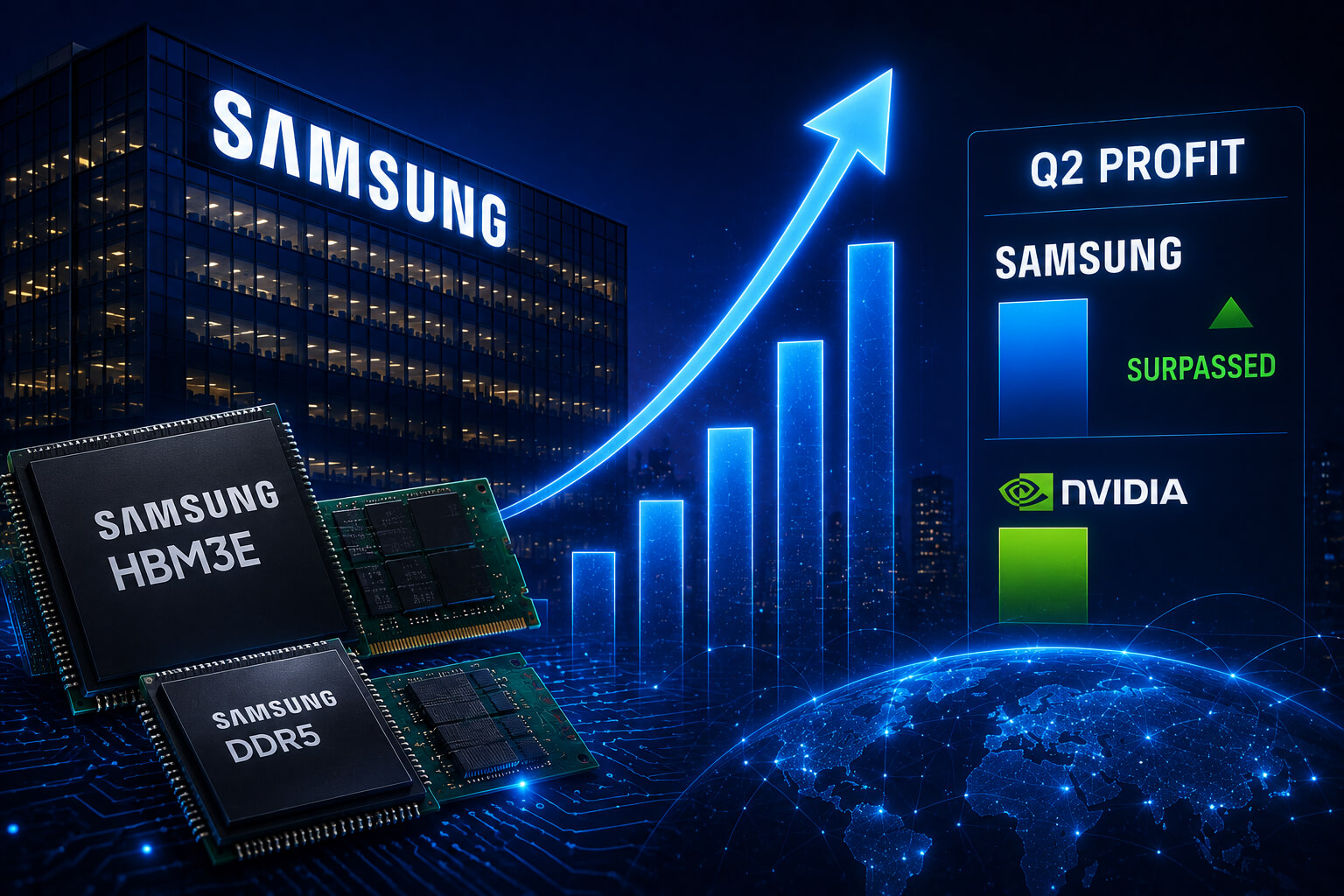
Samsung is suddenly back in the center of the AI hardware story. Recently, headlines have noted that Samsung surpasses NVIDIA quarterly profit, marking a significant moment in the tech industry.
For months, NVIDIA has been treated as the obvious winner of the artificial intelligence boom. GPUs, data centers, massive model training, enterprise AI spending — almost every conversation pointed back to NVIDIA. But Samsung’s latest quarterly performance shows another side of the market that is just as important, and maybe less flashy.
Memory.
Samsung Electronics is expected to post a major jump in operating profit for the April-to-June quarter, with some reports saying the company has surpassed NVIDIA in quarterly operating profit. That is not a small headline. It suggests that the AI boom is no longer only rewarding the companies selling advanced processors. It is also lifting the companies supplying the memory chips needed to keep AI systems running.
Samsung Rides the AI Memory Chip Boom
The reason behind Samsung’s profit surge is not complicated. AI data centers need huge amounts of high-performance memory. As companies build larger AI infrastructure, the demand for memory chips keeps rising.
That has been good news for Samsung.
The company is one of the world’s biggest memory chip makers, and the current AI spending cycle has given it fresh pricing power. When demand is high and supply is tight, chipmakers can push prices higher. Samsung appears to be benefiting from exactly that situation.
This is where the AI economy gets less glamorous but more real. Everyone talks about the model. Everyone talks about the GPU. But behind every AI system are layers of hardware, memory, storage, servers, cooling, and supply chain decisions. Samsung sits deep inside that stack.
And right now, that position matters.
Why Samsung Passing NVIDIA Matters
NVIDIA is still one of the biggest winners of the AI era. That has not changed. Its GPUs remain central to training and running advanced AI models.
But Samsung reportedly surpassing NVIDIA in quarterly profit changes the conversation a little.
It shows that AI demand is spreading across the semiconductor industry. The money is not only flowing toward GPU makers. It is also reaching suppliers of high-bandwidth memory and other advanced chips used inside AI systems.
That is important because memory has become one of the biggest pressure points in the AI infrastructure race. Data centers cannot scale on processors alone. They need memory capacity to handle massive workloads, fast data movement, and increasingly complex AI applications.
Samsung’s performance is a reminder that the AI boom has many winners, and some of them are not always the loudest names in the room.
AI Infrastructure Is Becoming a Bigger Market Story
The bigger story here is infrastructure.
AI companies are spending heavily on data centers. Cloud providers are buying hardware at a massive pace. Enterprises are preparing for more AI workloads. Governments are also looking at compute capacity as a strategic asset.
All of that creates demand for chips beyond GPUs.
Samsung’s rise shows how memory chips are turning into a critical part of the AI supply chain. If AI adoption keeps expanding, companies that control key hardware components may continue to see strong demand.
This also puts Samsung in an interesting position. The company is not only exposed to AI through memory chips. It also has consumer electronics, mobile devices, chip manufacturing, and partnerships across the broader technology ecosystem.
That gives Samsung multiple ways to benefit from the AI cycle.
The AI Boom Is Bigger Than NVIDIA Now
For a long time, NVIDIA became the symbol of AI market growth. That made sense. Its chips powered much of the generative AI explosion.
But Samsung’s latest profit surge suggests the market is widening.
AI infrastructure needs more than one type of chip. It needs memory. It needs advanced packaging. It needs storage. It needs foundry capacity. It needs massive, reliable supply chains that can keep up with demand from cloud providers and AI companies.
Samsung’s results show that memory suppliers are no longer just background players. They are becoming central to the AI economy.
And that may be the most important point.
The AI boom is not only about who builds the smartest model or who sells the most GPUs. It is also about who controls the hardware beneath the boom. Samsung’s latest quarter makes that clear.
