


Abu Dhabi is taking another big step toward AI-powered government work. This time, it is not a pilot, not a small internal test, and not another vague digital transformation promise.
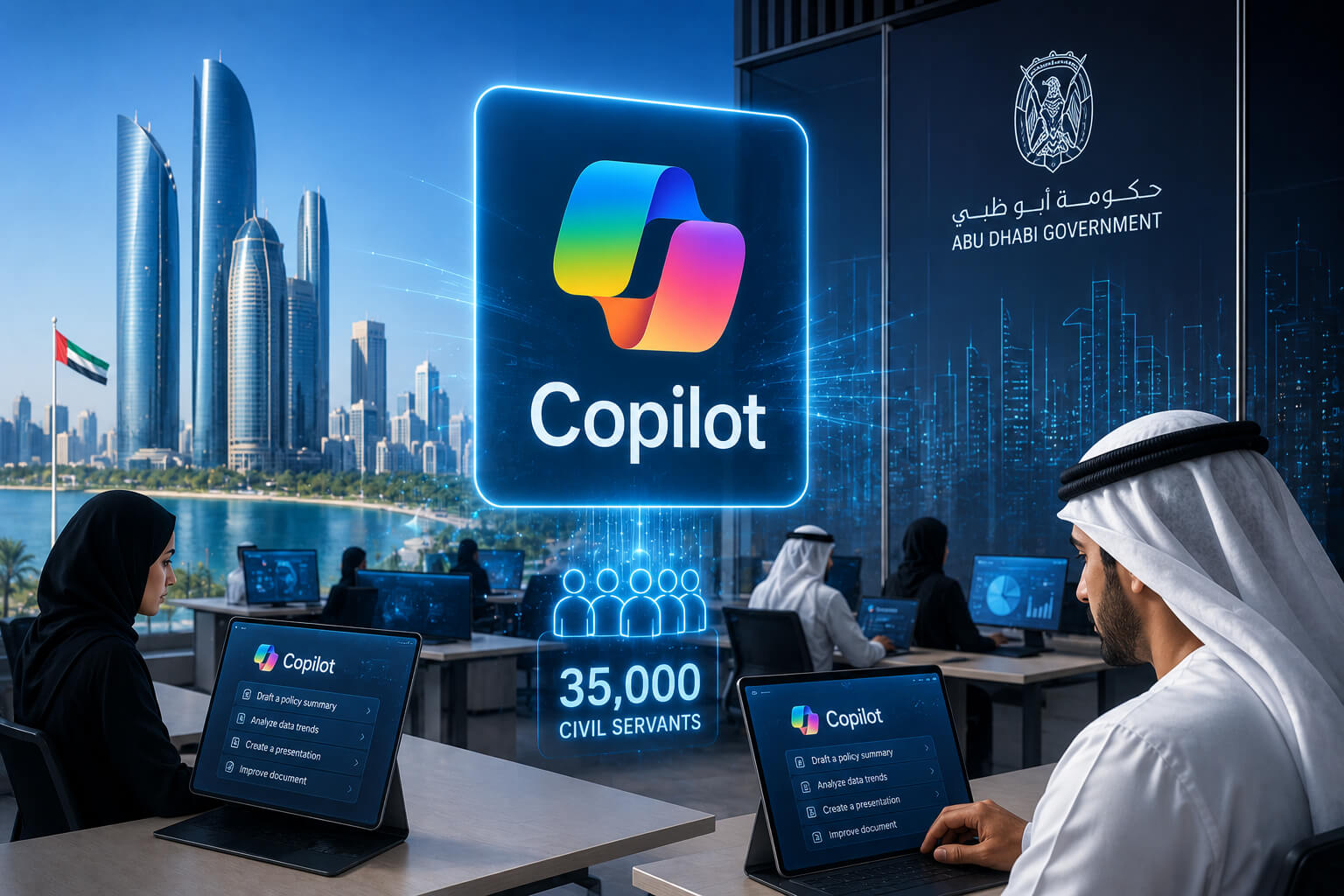
The emirate has deployed Microsoft 365 Copilot to 35,000 civil servants across 27 government entities through its Frontier Employee Programme. The rollout includes 26,000 new licences added to 9,000 already in use, making it one of the largest generative AI productivity deployments in the public sector.
Abu Dhabi Pushes AI Into Daily Government Work
The main point here is simple. Abu Dhabi wants AI inside the daily routine of government employees.
Microsoft 365 Copilot can support tasks like writing, summarising, preparing documents, handling data, analysing reports, and speeding up internal workflows. For a government workforce this large, even small time savings can become significant.
But this rollout is not just about giving employees a chatbot inside office software. Abu Dhabi is trying to build an AI-native government model, where artificial intelligence becomes part of how public services are designed, delivered, and managed.
That is a much bigger shift.
Data Sovereignty Is a Major Part of the Deal
One of the most important parts of the deployment is where the data stays.
All Copilot licences are running with Advanced Data Residency, which means AI processing remains inside UAE borders. That matters because government data cannot be treated like ordinary business data. It involves public services, citizen records, internal communications, compliance requirements, and national digital infrastructure.
For Abu Dhabi, this makes the rollout less like a standard software upgrade and more like a controlled sovereign AI deployment.
Why This Microsoft Copilot Rollout Matters
The size of the deployment is already notable. But the timing matters even more.
Governments around the world are still trying to figure out how far they can take generative AI without creating new privacy, security, or governance problems. Abu Dhabi is moving faster than most.
The rollout includes training and certification programmes focused on responsible and secure AI use. It also comes with a structured adoption framework for change management and employee readiness. That part is easy to ignore, but it may decide whether the project actually works.
AI tools can be purchased quickly. Getting thousands of public sector employees to use them properly is the harder part.
Abu Dhabi’s AI Factory Adds Another Layer
The Copilot rollout is also connected to a broader AI Factory effort across Abu Dhabi Government.
That AI Factory is expected to develop and scale hundreds of AI use cases and more than 1,000 agents. These could support areas such as document processing, public query handling, and policy analysis.
This is where the story gets more serious. Copilot helps employees work faster. AI agents could start changing how government processes actually run.
Not overnight. Not magically. But the direction is clear.
Part of Abu Dhabi’s 2027 AI-Native Government Goal
Abu Dhabi has already set a bold target: becoming the world’s first AI-native government by 2027.
In January 2025, the Abu Dhabi Executive Council approved a AED 13 billion government digital strategy for 2025 to 2027. The plan targets full AI integration across public services, sovereign cloud adoption, digitisation of government processes, and more than 200 AI solutions across public services.
The strategy is also projected to add AED 24 billion to Abu Dhabi’s GDP and create more than 5,000 local jobs by 2027.
That puts the Microsoft Copilot rollout inside a much larger national technology push, not just a productivity experiment.
Microsoft, Core42, and Abu Dhabi’s Sovereign Cloud Push
The programme also builds on a March 2025 agreement involving the Department of Government Enablement, Microsoft, and Core42 to support a sovereign cloud environment for Abu Dhabi Government.
That environment is connected to more than 11 million daily digital interactions across government entities. Abu Dhabi’s TAMM app, which provides more than 1,150 public and private services, also runs on Microsoft technologies including Dynamics 365, Power BI, and Azure.
So the Copilot rollout is not happening in isolation. It sits on top of a wider Microsoft-linked digital government stack.
A Public Sector AI Case Study Others Will Watch
Abu Dhabi’s move will likely attract attention from other governments, especially those trying to balance AI productivity with data sovereignty.
The public sector wants the speed of generative AI, but it also needs control. Security matters just as much. Local compliance cannot be ignored. In addition, employees need to understand how to use the tools without exposing sensitive information or relying on weak AI outputs.
That is why this rollout matters.
Abu Dhabi is not only asking whether AI can help government workers. It is testing whether a government can rebuild its operating model around AI, cloud infrastructure, automation, and agentic systems.
The answer is not proven yet. But Abu Dhabi is clearly moving before many others are ready to try.
