


South Korea is not treating AI infrastructure as a side project anymore.
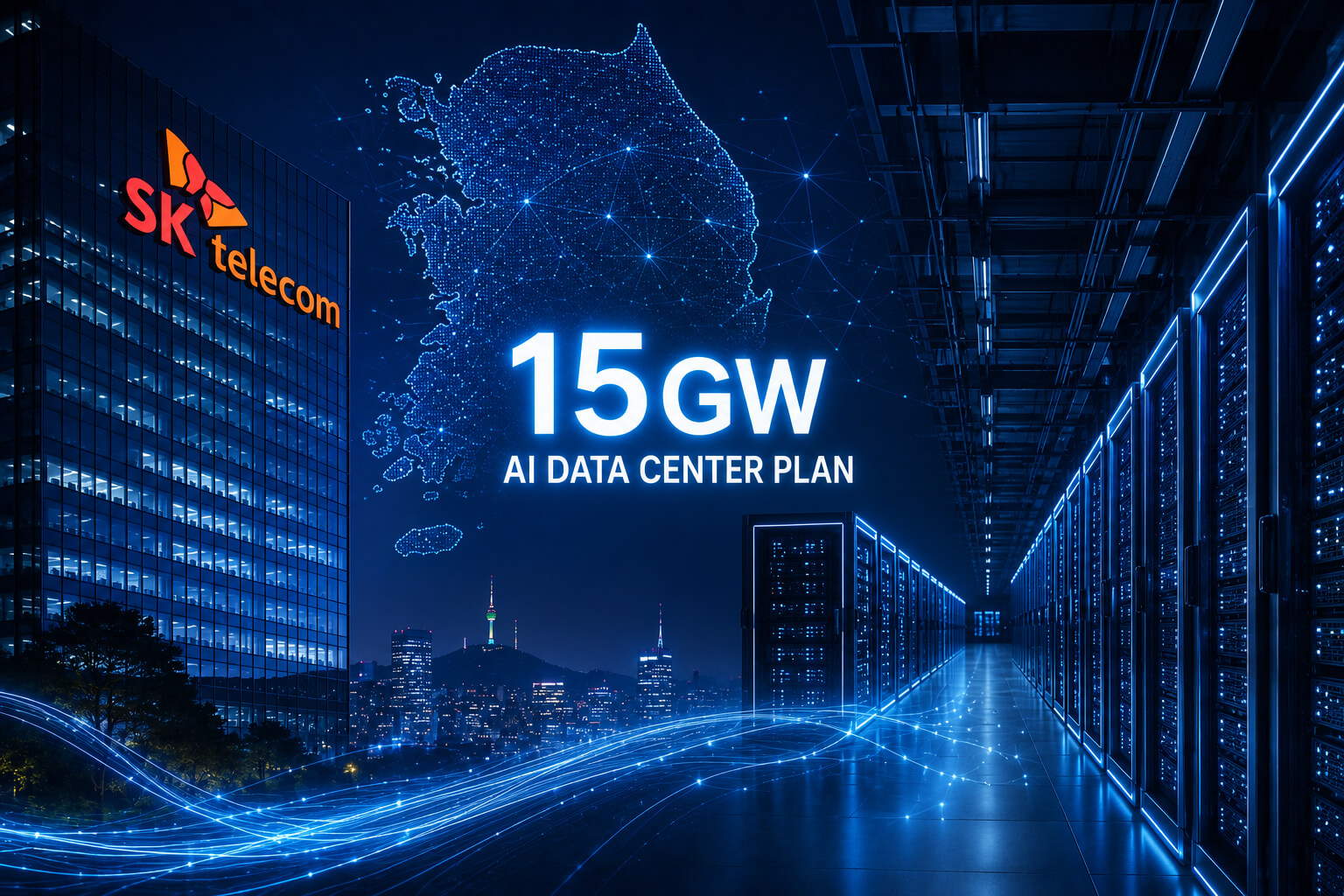
SK Telecom is now at the center of a huge AI data center buildout that could give the country one of Asia’s most ambitious AI infrastructure networks. The plan, led through SK Group, targets up to 15 gigawatts of AI data center capacity by 2035, with an earlier goal of reaching 5 gigawatts by 2029. That is not a small server expansion. That is national-scale AI infrastructure.
And the timing makes sense. AI models are getting larger. Enterprise demand is growing. GPUs need power, cooling, space, memory, and highly reliable networks. Countries that want to compete in AI now need more than startups and software talent. They need physical infrastructure that can actually run the workloads.
Why SK Telecom Is Moving So Aggressively
SK Telecom already has a strong position in connectivity, cloud, and digital infrastructure. Now it wants to move deeper into what the AI industry increasingly calls the “AI factory” model.
The idea is simple, even if the engineering is not. Instead of only hosting ordinary cloud workloads, these facilities are built for training, tuning, and running AI systems at scale. Tokens become the output. GPUs become the machinery. Power becomes the bottleneck.
SK Telecom has also been working with Nvidia on a gigawatt-scale AI cloud plan in Korea, with the first AI factory expected to come online in 2027. The companies are looking at AI infrastructure using Nvidia’s DSX platform, which signals how closely the next phase of data center growth is tied to GPU supply and advanced AI systems.
South Korea Wants to Become an AI Infrastructure Hub
This is not only about SK Telecom building bigger data centers. South Korea wants to attract global AI demand.
SK Telecom has been building out AI data center hubs across key regions in the country, including the Seoul metropolitan area, Ulsan, and the southwest region. The company has described this as part of a broader push to position Korea as a major AI hub in Asia.
That matters because AI infrastructure is becoming geopolitical. The countries with enough power, cooling capacity, chips, fiber networks, and capital will have an advantage. Everyone else may have to rent intelligence from someone else’s cloud.
South Korea does not seem interested in being only a customer.
The Energy Problem Is the Real Story
The headline number is 15GW, but the deeper story is electricity.
AI data centers do not just need land and servers. They need a massive, stable energy supply. That is why SK Group’s wider energy moves matter here. SK and KKR recently announced a renewable energy platform in South Korea, starting at 1.7GW of capacity with plans to expand to 10GW. The platform is aimed partly at corporate demand from AI data centers and semiconductor manufacturing.
That connection is important. AI growth is now tied directly to energy strategy. The winners in this market may not be the companies with the best models alone. They may be the ones that can secure power before everyone else does.
Ulsan Is Becoming a Key AI Data Center Location
Ulsan is already part of SK’s AI infrastructure map. SK Group, AWS, SK Telecom, SK ecoplant, and local government partners have been tied to AI data center development in the city, with earlier reports describing the Ulsan project as one of Korea’s largest AI-focused data center efforts outside the Seoul metropolitan area.
That location is not random either. Ulsan has industrial infrastructure, energy links, and space for large-scale development. For AI data centers, that combination is valuable. These facilities cannot simply be dropped into any city and expected to work.
They need grid planning. They need cooling. They need supply chain coordination. They need political support.
AI Infrastructure Is Becoming the Next Big Competition
The AI race used to sound like a model race. Which chatbot is smarter? Which company has the better benchmark score? Which model can write better code?
That still matters, of course. But another race is now running underneath it.
Who has enough compute?
Who has enough power?
Who can build fast enough?
Who can keep the GPUs running without energy costs destroying the business model?
SK Telecom’s 15GW plan shows how serious this second race has become. South Korea wants to be more than a semiconductor powerhouse. It wants to become a place where large-scale AI workloads are built, hosted, and monetized.
What This Means for the AI Market
For global AI companies, South Korea could become a more attractive infrastructure base if SK Telecom and its partners can deliver the capacity they are promising. For enterprises, it could mean more regional AI cloud options. For chipmakers and energy providers, it means another wave of demand.
For SK Telecom, the opportunity is bigger than telecom revenue. AI data centers could pull the company into cloud, enterprise AI, sovereign AI infrastructure, GPU services, and international AI partnerships.
That is the real shift here.
SK Telecom is no longer just supporting digital traffic. It is trying to help manufacture the next layer of artificial intelligence infrastructure in Asia.
