


AI in science is getting less theoretical and much more hands-on.
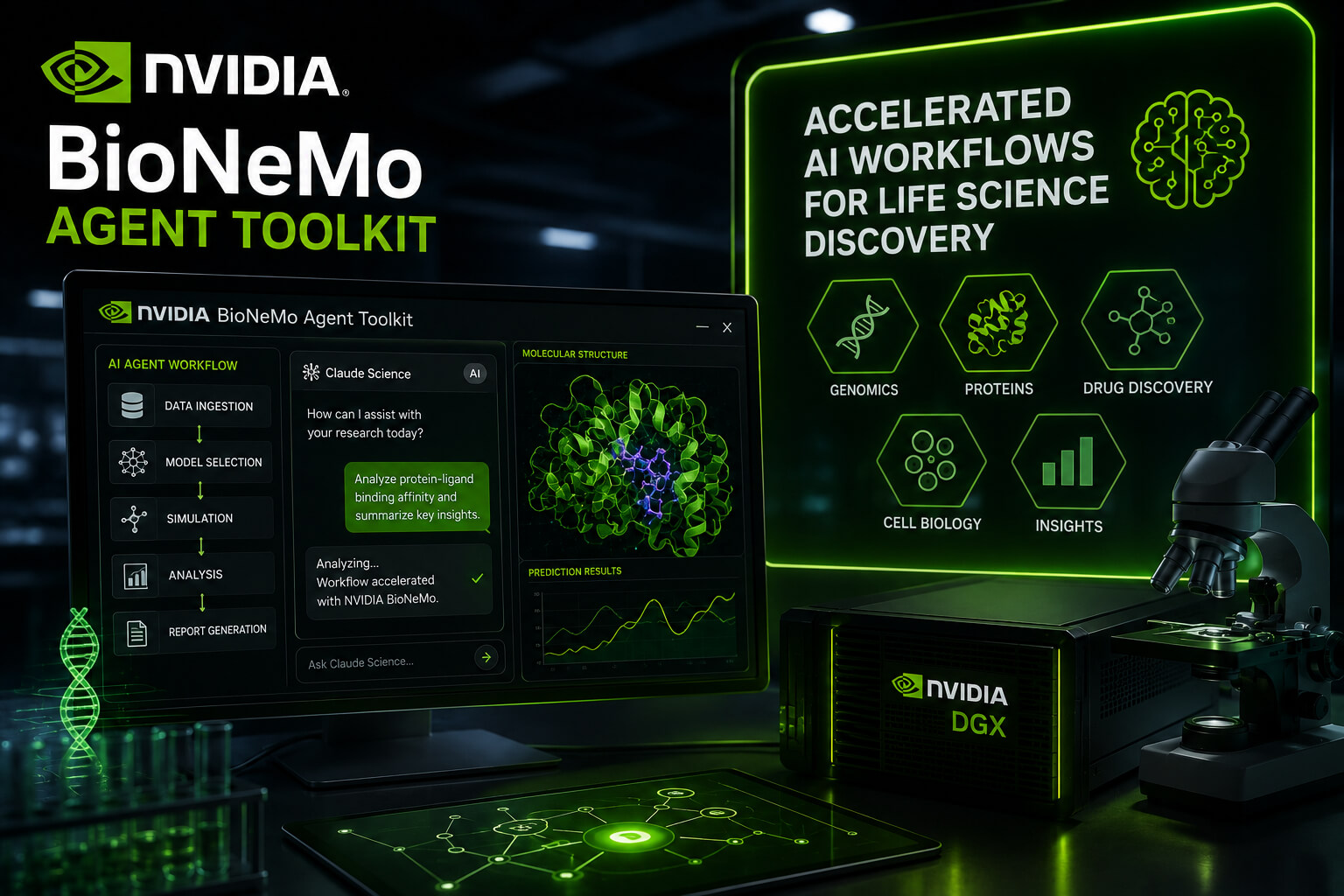
NVIDIA has brought its BioNeMo Agent Toolkit into Anthropic’s Claude Science, giving life sciences researchers a way to use AI agents for complex scientific workflows without manually jumping between models, software tools, endpoints, and compute environments. The announcement was published by NVIDIA on June 30, 2026.
Claude Science is Anthropic’s AI workbench for scientific research. It allows researchers to describe tasks in natural language and then work with AI agents that can help run research processes from start to finish. With NVIDIA BioNeMo Agent Toolkit now available inside that environment, Claude Science can connect researchers to NVIDIA’s accelerated models, libraries, workflows, and NIM microservices.
AI Agents Are Moving Into the Lab
This is not just another chatbot integration.
The bigger idea is that scientists can ask for something like genomic sequence analysis, protein structure prediction, molecular design, or binder generation, and Claude Science can route that task through the right scientific tools. BioNeMo Agent Toolkit gives those agents context about what each NVIDIA capability does, what inputs it needs, and how it should be used inside a research workflow.
That matters because life sciences research is full of tiny, technical steps that slow everything down. A researcher might need to analyze genomic data, compare molecules, cluster promising compounds, generate conformers, or inspect single-cell results before deciding what to test next. One step can depend on five other steps. One delay can stall the whole experiment.
NVIDIA is trying to make those steps faster and more accessible through agentic AI.
What the NVIDIA BioNeMo Agent Toolkit Actually Does
The NVIDIA BioNeMo Agent Toolkit packages scientific AI capabilities as callable skills. In simple terms, Claude Science can select a tool, prepare the correct inputs, and execute the workflow while connecting to NVIDIA compute resources.
That means researchers stay in the same working environment instead of manually setting up models or moving between fragmented systems.
NVIDIA says the toolkit gives access to accelerated scientific models and workflows, including tools such as Evo 2, Boltz-2, OpenFold3, NVIDIA Parabricks, RAPIDS-singlecell, nvMolKit, BioNeMo open models, and BioNeMo NIM microservices.
Some of these tools are aimed at genomics. Some are aimed at protein research. Others support cheminformatics, molecular design, and high-performance inference.
It is a stack built for scientific agents, not just general AI assistants.
Faster Drug Discovery Is the Obvious Target
Drug discovery is the loudest use case here.
NVIDIA gives an example involving cancer target inhibitors. A researcher could start with a known cancer-causing antigen mutation and ask Claude Science to design possible inhibitors. From there, Claude Science, BioNeMo Agent Toolkit, and NVIDIA NIM microservices can help accelerate prediction, optimization, and validation steps.
That does not mean AI suddenly discovers a perfect drug on its own. That would be too neat, and science is rarely neat.
But it does mean the boring and computationally heavy parts of discovery can move faster. More candidates can be tested. More iterations can happen. Researchers can inspect results, adjust the question, and push the next step without rebuilding the workflow every time.
That loop is where the value sits.
NVIDIA Wants Scientific AI to Run at Compute Scale
NVIDIA has spent years building its life sciences AI stack, covering hardware, frameworks, libraries, models, microservices, and domain-specific tools. The company says 18 of the top 20 pharmaceutical companies now use NVIDIA BioNeMo, showing how deeply its technology has moved into AI-enabled drug discovery, genomics, medical imaging, molecular design, and protein engineering.
The Claude Science integration gives those capabilities a more natural interface.
Instead of requiring every scientist to behave like a machine learning engineer, the system lets researchers describe what they need. The agents then help translate scientific intent into executable workflows.
That shift is important. Scientific AI will not scale if only specialist engineering teams can use it. The real jump happens when domain experts can work directly with accelerated models and computational tools.
Why This Matters for AI in Life Sciences
The life sciences industry is entering a phase where AI agents need more than reasoning ability. They need tools. Compute also matters. Most importantly, they need access to models that actually understand biological and chemical problems.
Claude Science gives the conversational layer. NVIDIA BioNeMo Agent Toolkit brings the accelerated scientific engine underneath it.
Together, they point toward a future where AI research assistants do not simply summarize papers or draft reports. They help run parts of the research process itself.
That is the more interesting story.
Not “AI helps scientists write faster.”
More like: AI starts helping scientists test, compare, design, and iterate faster.
BioNeMo Agent Toolkit Is Now Available
NVIDIA says the BioNeMo Agent Toolkit is open and harness-agnostic, meaning the same scientific skills can work across different agent frameworks and research platforms. The toolkit and its skills are available through NVIDIA developer resources and GitHub. Claude Science is also entering public beta, with Anthropic inviting researchers to give feedback on additional domain specialists and integrations.
For life sciences teams, this is another sign that agentic AI is moving from demo territory into real research infrastructure.
The workbench is becoming the lab interface.
And the lab interface is starting to talk back.
