


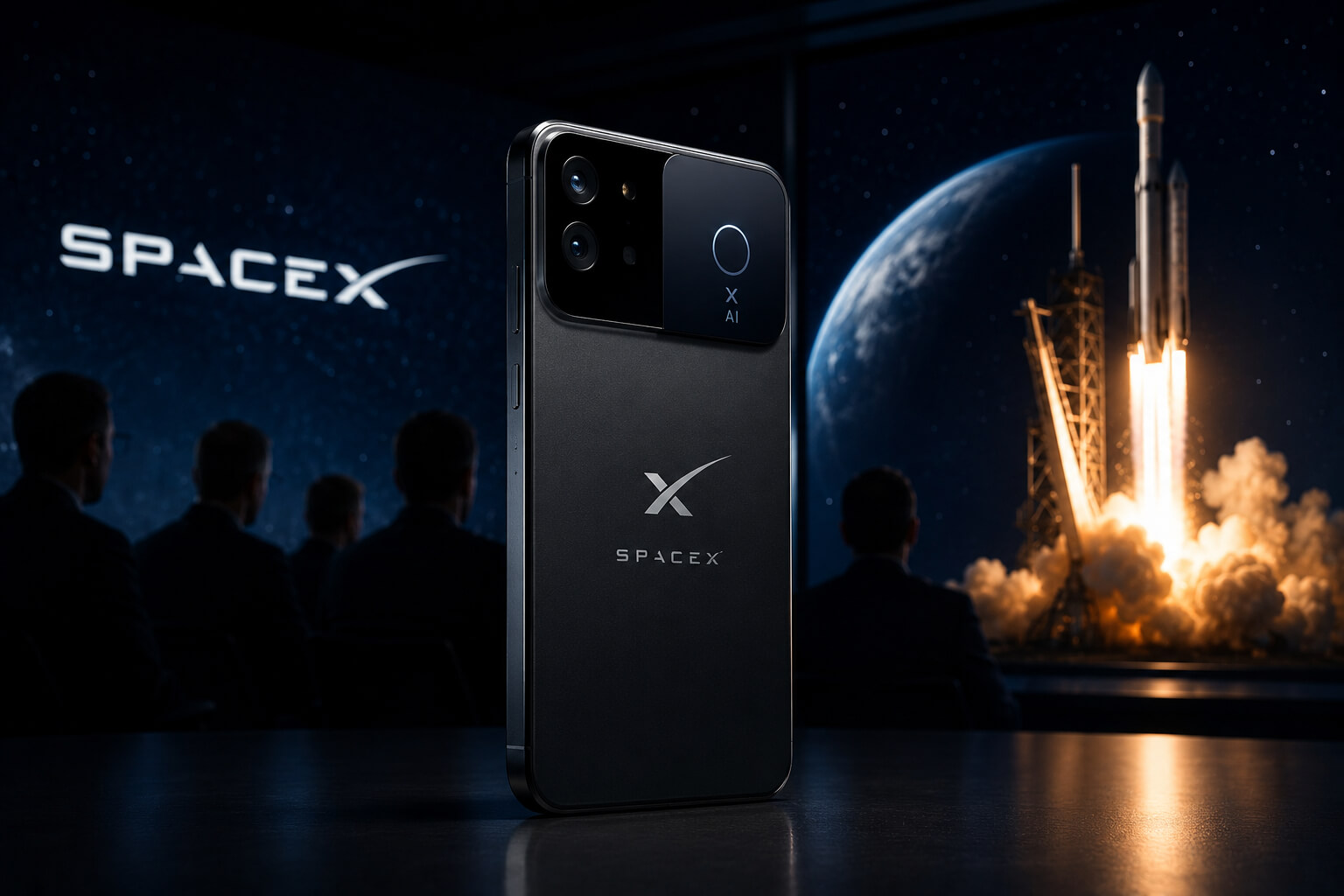
SpaceX may be moving closer to something Elon Musk has publicly tried to downplay: a device of its own.
According to a PYMNTS report citing The Wall Street Journal, SpaceX investors were reportedly shown an early handset-style prototype ahead of the company’s recent IPO. The device is said to be designed around artificial intelligence, not just another smartphone with a few AI features added on top. That difference matters. A lot.
The reported handset is still in the early stage, and its final design could change. But the idea alone is enough to raise eyebrows across AI, consumer hardware, mobile operating systems, and satellite connectivity.
A SpaceX AI Handset, Not Just Another Phone
The device shown to investors was reportedly slimmer than an iPhone and built around a proprietary operating system. It would also integrate AI technology from xAI, Musk’s artificial intelligence company.
That combination is interesting because it suggests the project is not only about competing with Apple or Samsung on hardware. It could be about controlling the full stack: device, operating system, AI assistant, satellite network, social platform, payments, and maybe even app distribution.
That is the bigger story here.
Musk has complained before about Apple’s control over third-party apps, especially when it comes to platforms like X. Building a device would give him a way around that gatekeeping. Difficult? Definitely. Impossible? Not exactly, especially when SpaceX already controls Starlink and xAI is being positioned as a major AI layer across Musk’s companies.
Musk Said He Did Not Want to Build a Phone
There is also a funny contradiction here.
Musk previously said the idea of making a phone made him “want to die,” while also adding that he would do it if necessary. Earlier this year, he denied reports that a Starlink-connected phone was in development, posting that the company was not developing a phone.
Now, based on the latest investor preview report, the picture looks less simple.
Maybe it is not a phone in the traditional sense. It could be an AI-first personal device. Another possibility is a prototype that never becomes a product. Or maybe Musk is testing whether investors will accept a future where SpaceX becomes more than rockets, satellites, and infrastructure.
That would not be a small pivot.
The Everything App Idea Keeps Coming Back
The reported device also appears connected to Musk’s long-running “everything app” vision for X.
When Musk bought Twitter and later turned it into X, he repeatedly talked about building a platform where users could communicate, pay, transact, consume content, and manage more of their digital life in one place. In Asia, super apps already do this. Users can send money, order food, book rides, shop, play games, and message people inside one digital ecosystem.
Musk wants something like that, but with AI sitting much closer to the center.
X Money is already part of that direction, with plans tied to payments, everyday spending, saving, and peer-to-peer transfers. Add an AI handset into that mix and the idea starts looking less like a social app strategy and more like a hardware-software-finance ecosystem.
Messy, yes. Ambitious, absolutely.
Why AI Hardware Is Becoming a Serious Battleground
AI companies are no longer satisfied with living inside apps. The race is shifting toward devices, operating systems, and daily user interfaces.
Whoever controls the device can control how people talk to AI, how AI sees context, how payments are handled, what apps are allowed, and which assistant becomes the default. That is why an AI handset from SpaceX would matter, even if it sounds strange at first.
Apple has the iPhone. Google has Android. Meta has smart glasses. OpenAI has been linked to AI hardware ambitions. Musk may be looking at the same problem from a different angle: AI needs a dedicated distribution channel, and relying on Apple or Google may not fit his long-term plan.
Starlink Could Make the Device More Than a Smartphone
The Starlink angle is hard to ignore.
Even though Musk denied that SpaceX was developing a Starlink phone earlier this year, any SpaceX-built handset would naturally invite speculation about satellite connectivity. A device that can connect through Starlink, run xAI systems, access X, and support payments would be very different from a normal smartphone.
It could be positioned as a global AI communication device. Or it could simply remain an investor-facing concept while SpaceX studies the market.
For now, there is no confirmed public launch, no official product name, and no clear timeline.
SpaceX Is Turning Into Something Much Bigger
SpaceX is already one of the most important companies in space infrastructure. But the recent reports around AI, xAI, and now a possible handset suggest Musk may be pushing it into a broader technology platform.
That is a huge leap. Building rockets is hard. Building phones is also hard, just in a different and more unforgiving way. Consumers are picky. App ecosystems are brutal. Hardware margins can punish even experienced companies.
Still, Musk has shown before that he likes entering industries people say are too difficult to disrupt.
A SpaceX AI handset may never reach the public in its current form. But the signal is clear enough: Musk does not want AI to stay trapped inside someone else’s device.
