


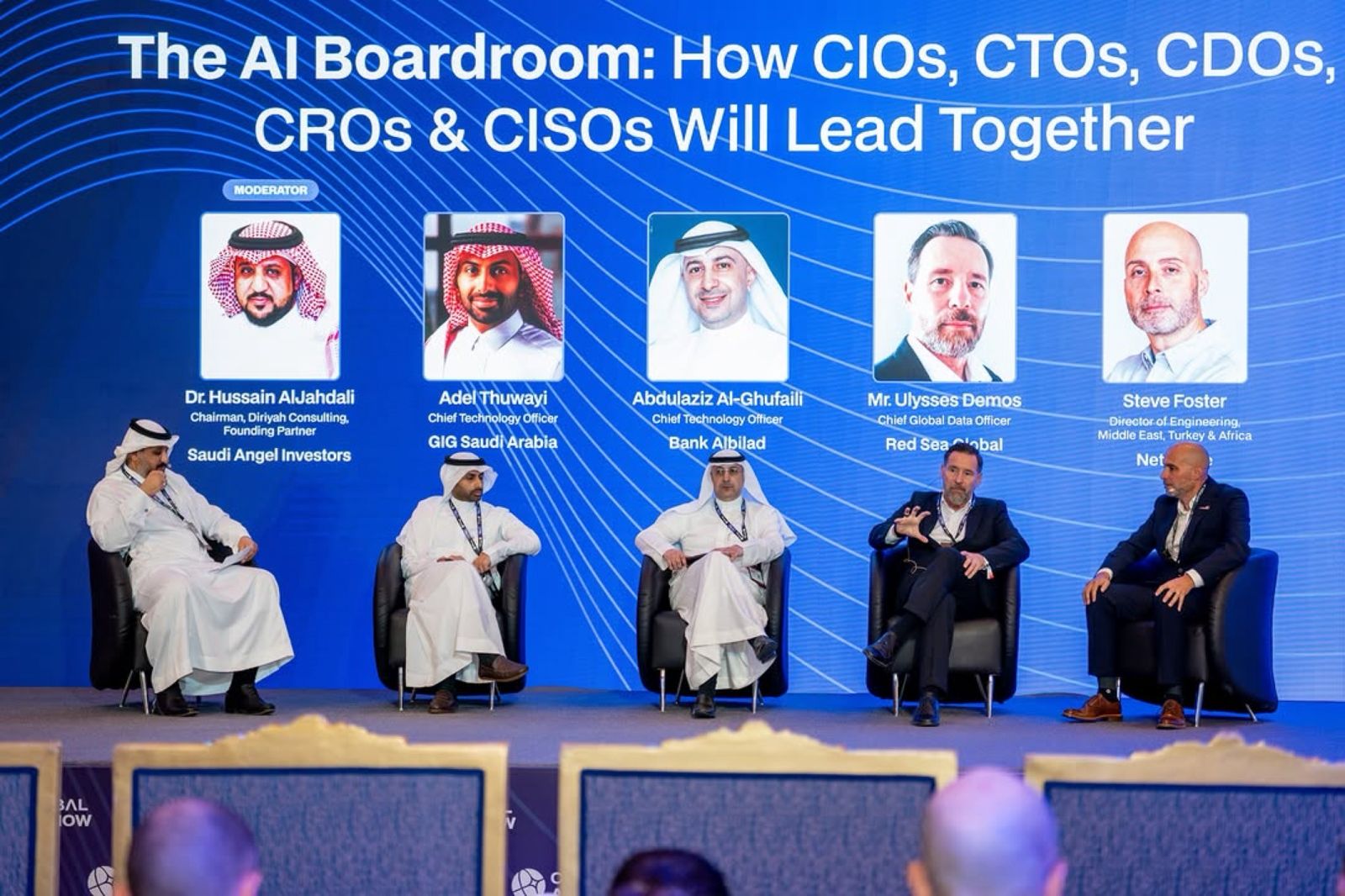
AI has moved far beyond the innovation team. That much was clear during the panel discussion “The AI Boardroom: How CIOs, CTOs, CDOs & CISOs Will Lead Together” at Global AI Show Riyadh 2026.
The session looked at something many companies are still trying to figure out quietly: who actually leads AI inside the enterprise? Is it the CIO because AI touches systems and operations? The CTO because architecture and engineering matter? The CDO because data is the fuel? Or the CISO because one weak model, one exposed dataset, or one careless integration can open the door to serious risk?
The real answer, based on the discussion, is not one role. It is all of them. And that is where things get interesting.
One AI Strategy, Many Executive Owners
The panel was moderated by Dr. Hussain AlJahdali, Chairman of Diriyah Consulting and Founding Partner of Saudi Angel Investors. He was joined by Adel Thuwayi, Chief Technology Officer at GIG Saudi Arabia, Abdulaziz Al-Ghufaili, Chief Technology Officer at Bank Albilad, Mr. Ulysses Demos, Chief Global Data Officer at Red Sea Global, and Steve Foster, Director of Engineering, Middle East, Turkey & Africa at Netskope.
Together, the panel explored how AI is changing executive leadership. Not in a neat, polished way. More like a pressure test. AI forces every major technology leader to sit at the same table because no single department can own the full picture anymore.
The CIO may understand enterprise systems. The CTO may know how to build and scale. The CDO may manage data quality, governance and sovereignty. The CISO may see the threats others miss. But AI cuts across all of these roles at once. It does not respect reporting lines.
Data Sovereignty Cannot Sit in One Department
One of the major questions raised during the session was whether the rise of AI requires a unified data sovereignty protocol across all C-suite functions.
It is a serious question. AI depends on data, but enterprise data is rarely simple. It lives across departments, regions, vendors, cloud environments, customer systems and internal platforms. That makes sovereignty more than a legal or compliance topic. It becomes an operating model.
If every executive team handles data differently, AI governance becomes messy very quickly. One team may prioritize speed. Another may focus on compliance. Another may worry about localization. Another may be thinking about cybersecurity exposure. All of them may be right, but without a shared protocol, the company ends up with fragmented AI decision-making.
This is why the AI boardroom needs common rules. Not just for data access, but for data movement, retention, model training, third-party use, auditability and accountability.
Ethical-by-Design AI Is Moving From Idea to Requirement
The discussion also raised the question of whether CIOs and CISOs should mandate ethical-by-design code reviews for every proprietary AI model.
A few years ago, that might have sounded like a policy discussion for later. Now it feels much closer to the center of enterprise AI.
Companies are building proprietary models, fine-tuning systems, deploying copilots, and embedding AI into customer-facing products. The risks are not only technical. They include bias, explainability gaps, privacy concerns, hallucinated outputs, unsafe automation, and decisions that users may never fully understand.
That is where ethical-by-design reviews become important. Not as a decorative compliance step. Not as a slogan. As part of the engineering process.
The CISO will care about security. The CIO will care about enterprise reliability. The CTO will care about architecture and performance. The CDO will care about data lineage and governance. But all of them need a shared view of what responsible AI means before the system goes live.
AI KPIs Need to Go Beyond Productivity
One of the strongest parts of the panel was the question around AI impact. How should companies define cross-functional technical KPIs that measure AI beyond productivity alone?
This matters because too many AI projects are still measured in a narrow way. Faster processing. Fewer manual tasks. Lower operating cost. Better response time. Those are useful metrics, but they are not enough.
AI impact also needs to be measured through risk reduction, customer trust, decision quality, compliance strength, data maturity, security posture, employee adoption and long-term business resilience. Some of those metrics are harder to put into a dashboard. That does not make them less important.
In the AI boardroom, productivity is only one piece of the story. A model that saves time but creates compliance exposure is not a success. A tool that automates workflows but weakens data control is not progress. A system that looks impressive in a pilot but cannot scale safely is not enterprise-ready.
The C-Suite Needs a Shared AI Language
The panel highlighted a problem many organizations face but rarely say out loud: executives often talk about AI from different angles.
For one leader, AI is a growth engine. For another, it is a security risk. For another, it is a data governance challenge. For another, it is an engineering opportunity. None of these views are wrong. The danger comes when they are disconnected.
That is why cross-functional AI leadership matters. CIOs, CTOs, CDOs and CISOs need a shared language for AI decisions. They need to agree on what “safe,” “scalable,” “compliant,” “high impact,” and “business-ready” actually mean.
Otherwise, AI becomes a collection of pilots, tools and experiments rather than a serious enterprise capability.
Could an AI Observer Join the Boardroom?
One of the more futuristic ideas from the session was whether future boardroom decisions could be guided by an “AI Observer” with a permanent seat at the table.
It sounds unusual at first. Maybe even uncomfortable. But the idea is not really about replacing executives. It is about giving leadership teams a persistent intelligence layer that can surface risks, compare scenarios, test assumptions, flag blind spots and support strategic decisions.
An AI Observer could help boards understand how a decision affects data exposure, customer experience, cybersecurity, compliance, operations and long-term competitiveness. It could act as a real-time analytical voice in the room.
Would executives trust it? Would regulators accept it? Who would govern it? Those questions are still open. But the concept shows where enterprise AI is heading. Not just tools used by employees, but systems that may influence how leadership itself works.
AI Leadership Will Be Collective, Not Siloed
The biggest takeaway from the panel was that AI leadership cannot belong to one executive function anymore.
The CIO, CTO, CDO and CISO each hold a different part of the AI puzzle. Systems, architecture, data, security, governance, ethics, performance and resilience all overlap now. Companies that keep these roles separate in AI decision-making may move fast at first, but they will probably struggle when the risks become larger.
Global AI Show Riyadh 2026 made this point clear through “The AI Boardroom” discussion. The next phase of enterprise AI will not be led by isolated technology teams or one enthusiastic executive sponsor. It will require a coordinated C-suite, shared governance, stronger technical KPIs and a much more serious view of AI accountability.
The boardroom is changing. AI is already inside it. The question now is whether leadership structures can catch up fast enough.
