


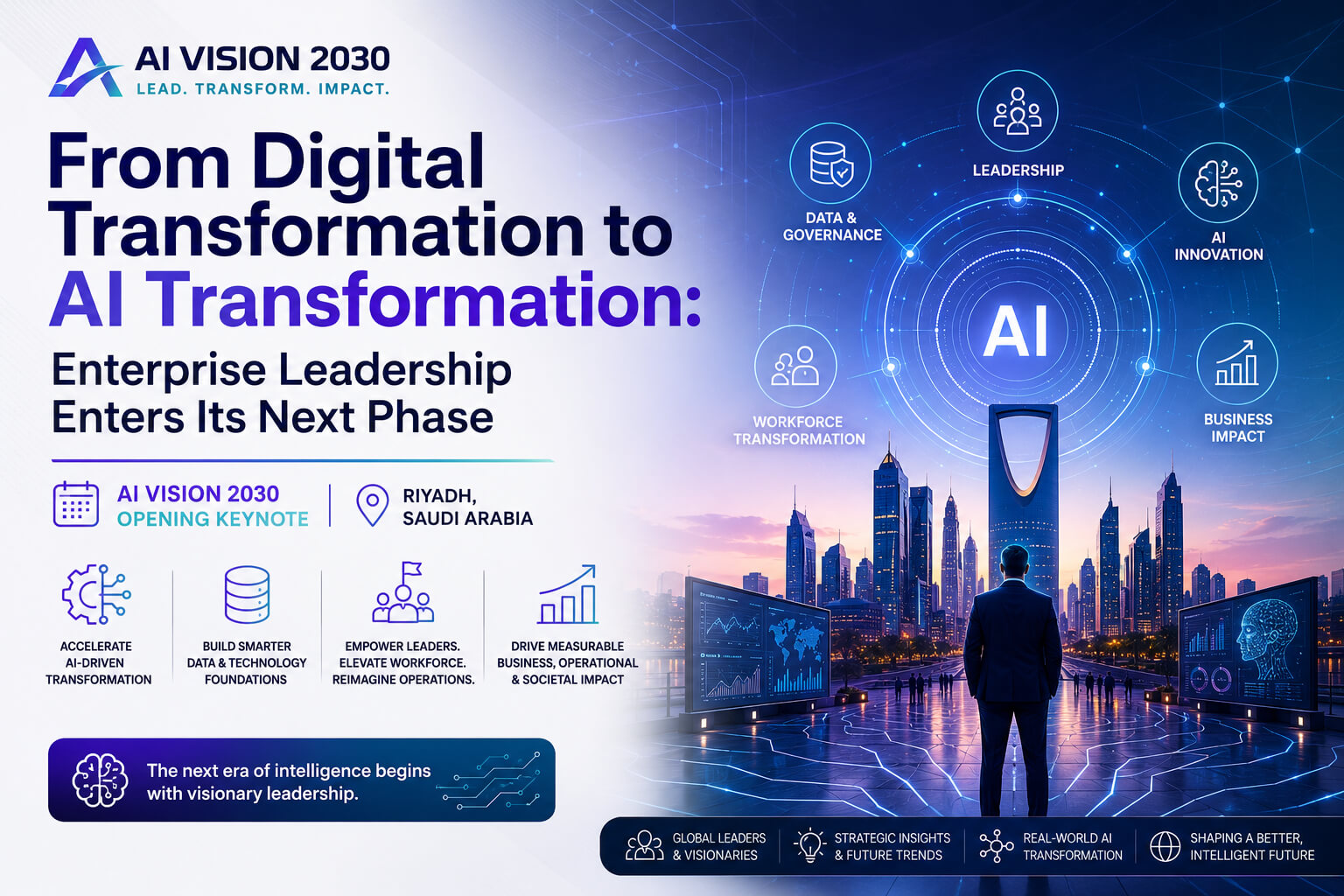
AI Vision 2030 brought a clear message to the stage: digital transformation is no longer the finish line. The conversation is quickly shifting toward AI transformation in enterprise leadership and what it means for the future.
For years, enterprises focused on becoming digital-first. They moved services online, modernized systems, automated basic processes, and invested in platforms that made operations faster and more connected.
That work still matters. But the conversation has changed.
During the opening keynote, “From Digital Transformation to AI Transformation: The Next Evolution of Enterprise Leadership,” Nezar Al Turki, Chief Information Officer at the Ministry of National Guard, addressed the next challenge facing organizations: how to move from digital adoption to AI-driven transformation.
This was not just a technology discussion. It was about leadership, structure, people, governance, and the ability to turn AI from scattered experiments into real impact.
From Digital-First to AI-Driven Enterprises
Digital transformation helped organizations become more efficient. AI transformation asks something bigger.
It pushes enterprises to rethink how decisions are made, how work is organized, how services are delivered, and how intelligence can be embedded across operations.
The shift is not simply about adding AI tools on top of existing systems. That approach usually creates noise. A chatbot here. A dashboard there. A pilot project that looks good in a presentation but never changes the business.
AI-driven enterprises need stronger foundations.
That includes reliable data, modern infrastructure, clear governance, and leadership teams that understand both the opportunity and the responsibility that come with AI adoption.
Without those foundations, AI remains experimental. With them, it can become part of the operating model.
Building the Foundations for Scalable AI
One of the strongest themes of the keynote was scale.
Many organizations can test AI. Far fewer can scale it.
A successful AI transformation requires more than enthusiasm. Enterprises need data systems that are clean, secure, and accessible. They need technology environments that can support AI workloads. They also need governance models that define how AI is used, monitored, and improved.
That part is often less glamorous than the AI itself. It is also where the real work happens.
Governance becomes especially important as AI moves closer to sensitive operations, public services, national systems, and enterprise decision-making. Leaders have to think about accountability, privacy, security, accuracy, and long-term resilience.
AI cannot be treated like a side project once it starts influencing decisions that affect people, institutions, and critical operations.
Leadership in the Age of Intelligence
The keynote also pointed to a deeper leadership challenge.
Enterprise leaders are no longer only managing digital systems. They are now expected to guide organizations through an intelligence-driven shift.
That requires a different mindset.
Leaders need to understand how AI changes workflows, job roles, and decision structures. They need to prepare teams for new tools without reducing the conversation to fear or hype. Workforce capability becomes central, because AI transformation depends on people who can use, manage, question, and improve intelligent systems.
The future of work is not just about replacing tasks. It is about redesigning work around better judgment, faster insight, and stronger human-machine collaboration.
That sounds simple until it reaches the daily reality of an organization. Existing habits, legacy systems, approval chains, and skills gaps can slow everything down. This is where leadership matters most.
Turning AI Experiments Into Measurable Impact
AI Vision 2030’s opening keynote made one point especially clear: AI has to move beyond experimentation.
Enterprises have spent years testing use cases. Some pilots produce useful results. Others fade after the demo stage.
The next phase is about measurable value.
That value can appear in different ways: better services, faster operations, stronger security, reduced costs, improved decision-making, or wider societal benefit. The important part is that AI must connect to outcomes.
For governments and large organizations, the stakes are even higher. AI transformation is not only about business efficiency. It can influence public service delivery, national readiness, workforce development, and long-term institutional capability.
The question is no longer whether organizations should explore AI.
The harder question is whether they are prepared to lead with it.
A New Enterprise Leadership Agenda
The discussion at AI Vision 2030 showed that enterprise leadership is entering a new phase.
Digital transformation created the platform. AI transformation now demands intelligence, governance, and adaptability at a much deeper level.
For organizations, the path forward is not about chasing every new AI tool. It is about building the right foundations, preparing the workforce, redesigning operating models, and using AI where it can create real impact.
The opening keynote by Nezar Al Turki placed that challenge at the center of the conversation.
AI is no longer sitting outside the enterprise as a future possibility. It is becoming part of how enterprises think, operate, and lead.
