


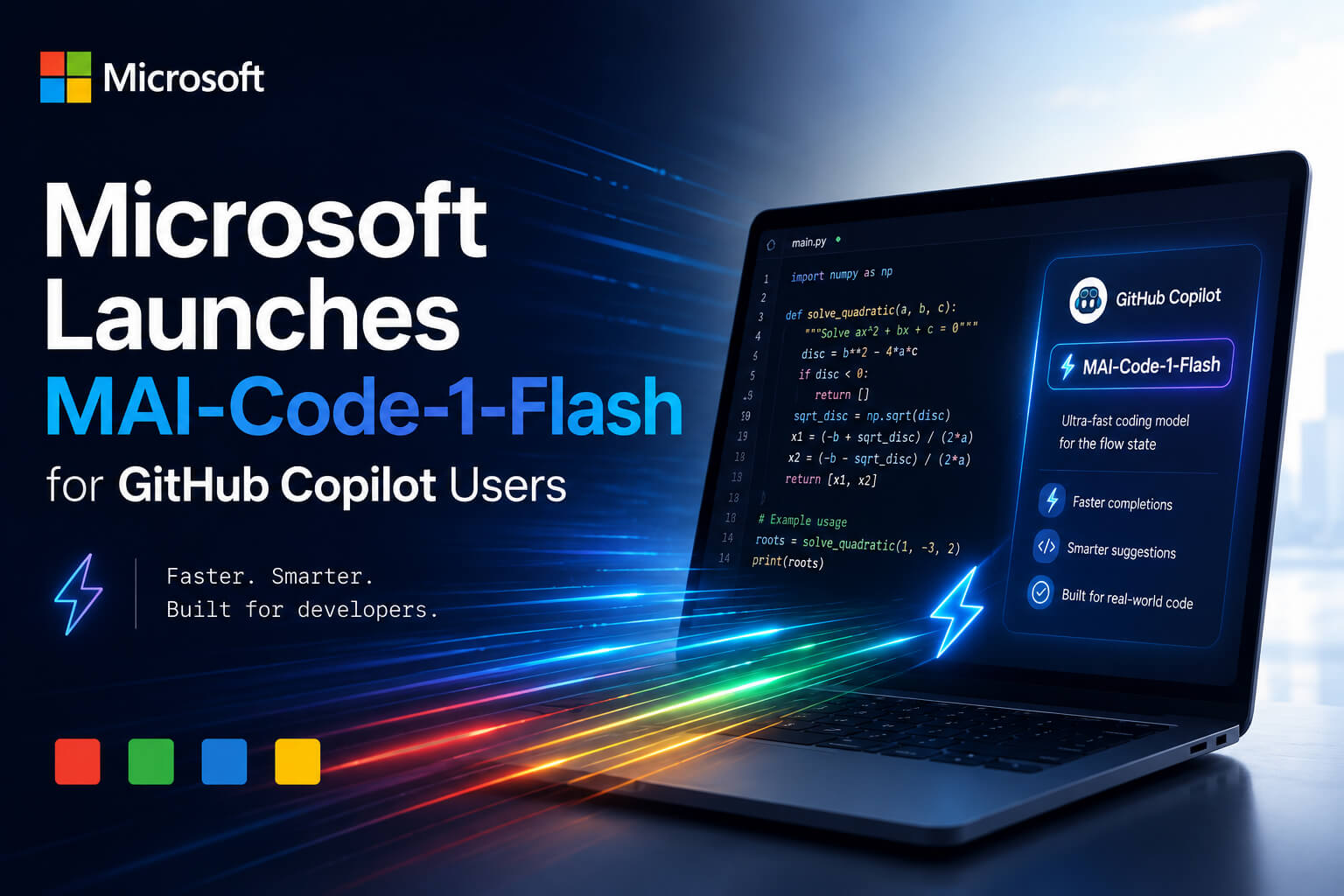
Microsoft has introduced MAI-Code-1-Flash, a new in-house AI coding model now available for GitHub Copilot Business and GitHub Copilot Enterprise users. The launch strengthens Microsoft’s growing push to expand its own artificial intelligence models inside developer tools while giving programmers more flexibility when choosing AI support for coding tasks.
The model is designed specifically for software development and optimized for GitHub Copilot. With MAI-Code-1-Flash, eligible Copilot users can access faster AI responses for coding assistance, editing, refactoring, and agentic development workflows.
What Is MAI-Code-1-Flash?
MAI-Code-1-Flash is Microsoft AI’s in-house coding model built for GitHub Copilot. It is designed to support developers during active coding sessions by delivering quick, low-latency responses.
The model is now generally available for GitHub Copilot Business and GitHub Copilot Enterprise users. However, administrators must first enable the MAI-Code-1-Flash policy in Copilot settings before users can access it.
Once enabled, developers can select the model through GitHub Copilot’s model picker, allowing them to use MAI-Code-1-Flash directly within their existing workflow.
Why Microsoft Is Adding Its Own AI Coding Model
The launch shows Microsoft’s increasing focus on building and deploying proprietary AI systems across its products. While GitHub Copilot already supports models from different AI providers, MAI-Code-1-Flash gives Microsoft a stronger in-house option for coding-related tasks.
This move also supports GitHub Copilot’s evolution into a multi-model AI platform. Instead of relying on one model or one provider, Copilot is becoming a workspace where developers can choose the model that best fits their needs.
For enterprise teams, this flexibility can be important. Different coding tasks may require different strengths, such as speed, reasoning, cost efficiency, or compatibility with internal workflows.
Built for Fast and Efficient Coding Workflows
According to GitHub, MAI-Code-1-Flash is optimized for high-volume and iterative coding workflows where speed matters. This makes the model useful for developers who need fast feedback during repeated coding tasks.
The model may help with:
- Code completion
- Code editing
- Refactoring
- Debugging support
- Conversational coding assistance
- Agentic software development workflows
By focusing on speed and efficiency, it aims to reduce friction during development and help programmers stay focused on building software.
What It Means for GitHub Copilot Users
For GitHub Copilot Business and Enterprise users, MAI-Code-1-Flash adds another model choice inside the Copilot ecosystem. This gives teams more control over how they use AI in software development.
The launch also reflects a larger industry trend: AI coding assistants are moving beyond simple code suggestions. They are becoming full development companions that can help developers write, review, improve, and manage code across more complex workflows.
As AI coding tools become more advanced, companies like Microsoft are competing not only on model quality but also on speed, cost, integration, and enterprise control.
Microsoft’s Broader AI Strategy
MAI-Code-1-Flash arrives as Microsoft continues to expand its internal AI model lineup. The company has been investing more heavily in its own AI systems while still maintaining partnerships with external model providers.
This dual strategy gives Microsoft more flexibility. It can continue offering access to third-party models while building proprietary models that are tailored for specific products and enterprise use cases.
For GitHub Copilot, the strategy could make the platform more attractive to businesses that want model choice, faster coding support, and tighter integration with Microsoft’s developer ecosystem.
Conclusion
The launch of MAI-Code-1-Flash marks another important step in Microsoft’s AI coding strategy. By adding its own fast, coding-focused model to GitHub Copilot, Microsoft is giving developers more options while strengthening Copilot as a multi-model development platform.
For businesses and enterprise development teams, the update could make GitHub Copilot more flexible, efficient, and better suited for large-scale software engineering workflows. As competition in AI coding tools continues to grow, it shows that Microsoft wants to keep Copilot at the center of AI-powered software development.
