


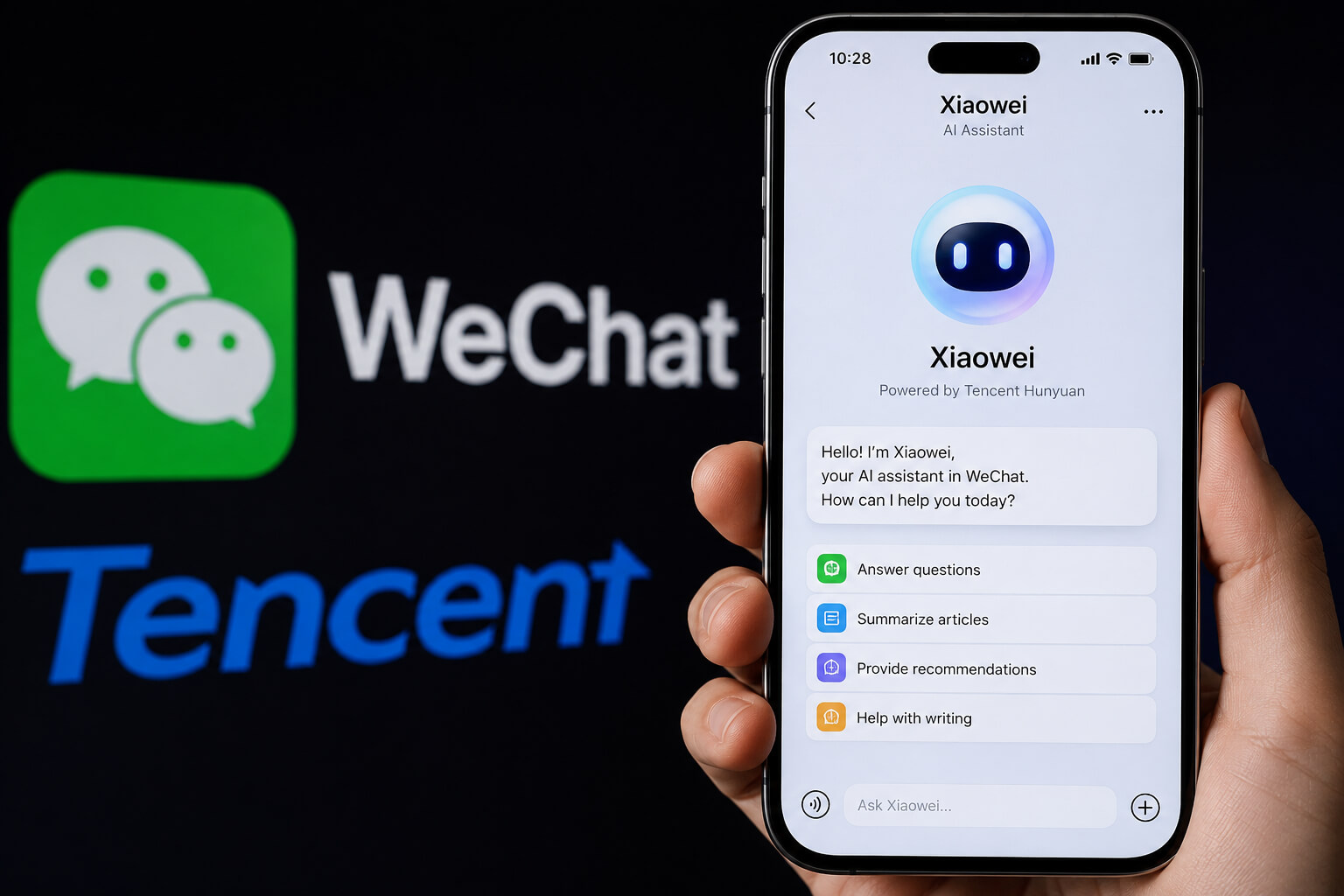
Tencent is stepping deeper into the artificial intelligence race with the rollout of Xiaowei, a new AI assistant being tested inside WeChat. The move shows how China’s largest technology companies are shifting from standalone AI chatbots toward AI agents built directly into everyday apps.
WeChat, also known as Weixin in China, is one of Tencent’s most important platforms. With messaging, payments, mini-programs, shopping, ride-hailing, food delivery, and other services already connected in one ecosystem, WeChat gives Tencent a powerful place to introduce AI tools at scale.
What Is Tencent Xiaowei AI Assistant?
Xiaowei is Tencent’s new AI assistant designed for WeChat users. The assistant is currently available to a limited group of users as part of an early test.
Users can interact with Xiaowei through text or voice. The assistant is expected to help people complete tasks inside WeChat, especially through the app’s mini-program ecosystem.
Although Tencent has not fully revealed every feature Xiaowei can perform, its placement inside WeChat suggests it could eventually help users navigate services such as ordering food, booking rides, searching for information, and interacting with mini-apps more easily.
How Xiaowei Works Inside WeChat
Xiaowei is reportedly powered by Tencent’s own large language model, WeLM. The assistant may also use DeepSeek for some queries, which suggests Tencent is taking a flexible approach while testing the system.
This could help Tencent improve the assistant’s performance across different types of user requests. By combining its own AI model with outside model support, Tencent may be able to test reliability, speed, and user experience before expanding Xiaowei more widely.
Why Tencent Is Adding AI to WeChat
Tencent’s launch of Xiaowei comes at a time when China’s AI competition is accelerating. Major companies such as Alibaba and ByteDance are already pushing AI features into their products, forcing Tencent to move faster.
For Tencent, WeChat is more than a messaging app. It’s a super app for messaging, payments, entertainment, shopping, and daily services. Bringing AI directly into WeChat could help Tencent make artificial intelligence useful for daily tasks instead of a separate chatbot experience.
This approach may open up new ways to monetize as well. If Xiaowei can direct users within WeChat services, suggest things to do, and make it easier to transact, Tencent could increase user engagement across its platform.
AI assistants are turning into super app agents
Tencent’s Xiaowei is part of a broader trend in China’s tech sector: AI assistants are becoming service agents within super apps.
These AI tools are not just answering questions, they are being built to help users take action – whether it’s booking a ride, ordering food, finding services, managing payments, or doing things in app ecosystems.
Alibaba’s Alipay has also been moving in this direction, by adding AI agent features to its financial and lifestyle services. This shows that Chinese tech companies see AI assistants as the next layer of interaction between users and digital services.
Xiaowei Could Help Tencent Catch Up in AI
Tencent has strong advantages because of WeChat’s enormous user base and its wide range of connected services. However, the company has faced pressure to keep pace with rivals in AI product deployment and large language model development.
By testing Xiaowei directly inside WeChat, Tencent is focusing on practical AI adoption rather than launching another separate AI app. This could make Xiaowei more useful if it becomes deeply connected to WeChat’s existing services.
The real challenge will be execution. Xiaowei will need to understand user intent, provide accurate answers, and work seamlessly with WeChat mini-programs. If it executes well, it could be a major AI feature for Tencent’s ecosystem.
What Comes Next for Xiaowei?
For now, Xiaowei remains in limited testing. Tencent has not announced when the assistant will be available to all WeChat users or what full capabilities it will support.
The small-scale launch gives Tencent a window to see how users interact with the assistant, beef up its capabilities, and fine-tune how AI should work within WeChat. The success of Xiaowei will likely depend on whether it can go beyond simple conversations and become a reliable tool for getting real-world work done.
Conclusion
Tencent’s Xiaowei AI assistant marks an important step in the company’s effort to compete in China’s fast-growing AI market. Tencent is embedding AI directly into WeChat. This shows its bet that the future of AI will live inside the apps people already use every day.
If Xiaowei delivers a smooth and useful experience, it could help Tencent strengthen WeChat. It could also boost AI adoption and improve competition with Alibaba, ByteDance, and other major players in China’s AI race.
