


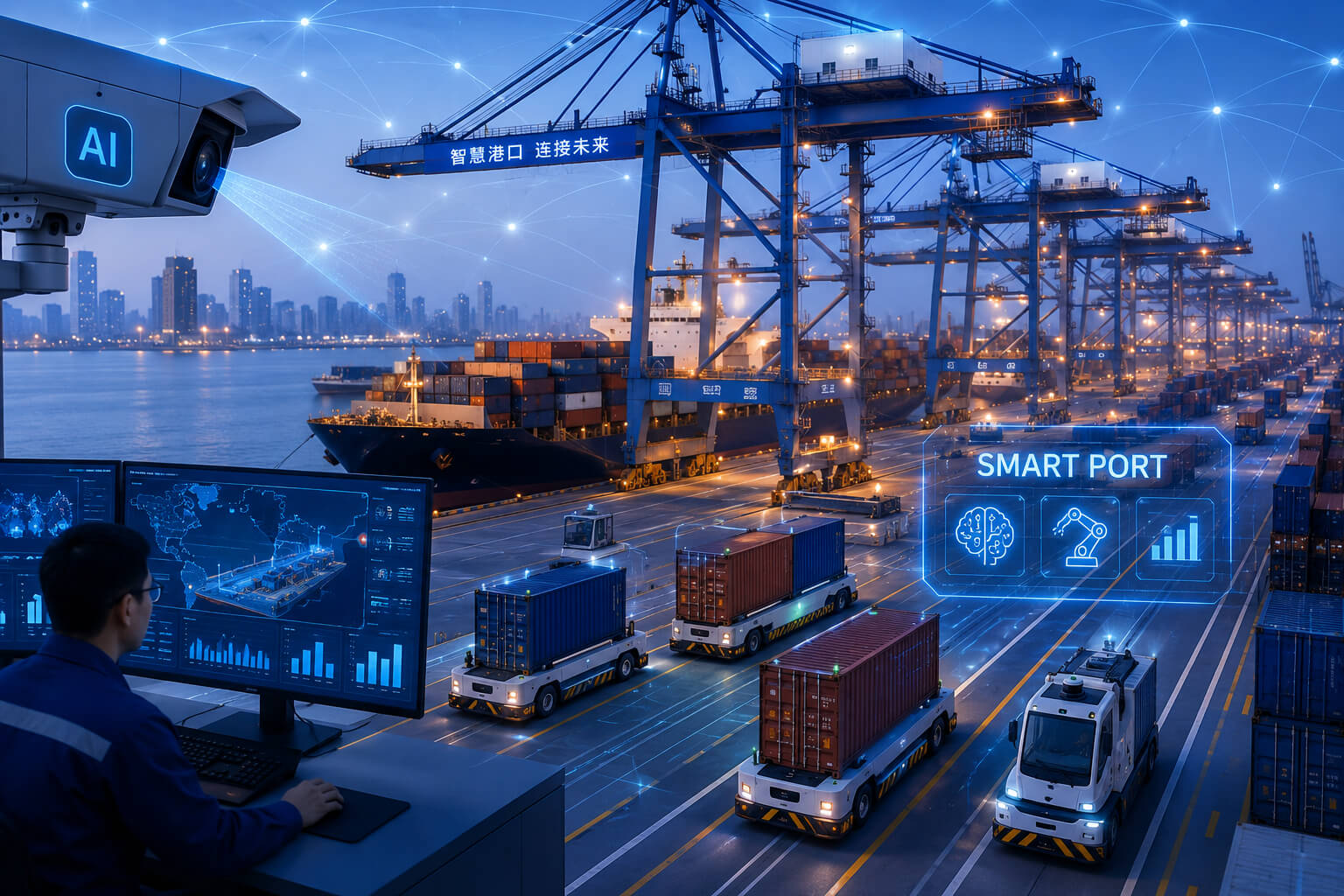
China Advances Smart Port Logistics with AI, Automation China is racing toward the future of maritime trade. The country is bolstering smart port logistics with artificial intelligence, automation and advanced digital infrastructure.
Qinzhou, a major port city in Guangxi, China, is positioning itself as a major logistics hub connecting western China with ASEAN markets. Meanwhile, the country’s growing use of AI-led systems, automated port equipment and digital trade corridors is part of a wider change. This change affects how global cargo is handled, tracked and moved across borders.
Smart ports are not a vision for the future anymore. Instead, they are fast emerging as an operational necessity for countries looking for faster cargo movement, reduced logistics costs, better supply chain visibility and enhanced cross-border trade.
AI Is Transforming the Way Ports Work
Port operations have long been built on manual scheduling, human coordination and separate systems for cargo tracking, customs processing, transport planning and equipment management. However, as global trade becomes more complex, these older systems can result in bottlenecks, delays and rising operating costs.
AI helps to solve this, as ports can process large amounts of operational data in real time. These systems can support vessel scheduling, container placement, traffic management, equipment monitoring and cargo flow optimization.
AI-powered port systems can help predict congestion, identify equipment issues and adjust logistics plans before disruptions proliferate throughout the supply chain. This is different from simply reacting to delays after they occur.
This is especially important to China as it continues to develop stronger trade links with Southeast Asia. This includes efforts such as Guangxi’s coastal logistics network.
China-ASEAN trade through Qinzhou
Qinzhou is becoming an important part of China’s regional trade strategy, due to its location on the Beibu Gulf and its access to ASEAN markets. As a result, the city is an integral part of China’s broader effort to improve land-sea trade routes. The goal is to accelerate the movement of goods between western China and Southeast Asia.
With the digitalization of logistics networks, the port infrastructure of Qinzhou may assume a more important role for the transportation of industrial products, raw materials, consumer goods and high value cargo within the region.
Automation and AI in port operations can also boost Qinzhou’s position as a China-ASEAN trade gateway. This happens through faster cargo handling, smarter route planning and better tracking systems to reduce delays and improve supply chain reliability.
Automation Accelerates Cargo Handling
Automation is one of the most visible parts of the smart port transformation. Automated cranes, smart gates, autonomous vehicles and robotic cargo systems can cut down the time it takes to move containers from ships to storage yards. Then, containers are moved onto trucks or trains.
They can also help reduce human error and improve safety in high-risk areas of port operations. Moreover, in large ports where thousands of containers move daily, even small gains in efficiency can mean major improvements in overall throughput.
That means faster turnaround times for shipping companies and exporters. Additionally, it leads to increased competitiveness for governments and port operators in regional and global trade.
The importance of smart ports for global supply chains
Supply chains are under pressure from rising trade volumes, geopolitical uncertainty, climate risks and customer demand for faster delivery.
AI and automation can give port operators a clearer picture of how cargo travels from arrival to departure. Consequently, this leads to improved decision-making by logistics companies, less waiting time, and more predictable delivery schedules.
Smart ports can also assist in sustainability goals. AI systems can optimize energy usage, minimize idle time of ships and trucks and improve routes. Such improvements may eventually lead to lower emissions in maritime logistics.
China’s smart port push shows AI is coming out of the chatbot and consumer app era
China’s investment in smart port logistics demonstrates that AI is expanding beyond chatbots and consumer apps. The technology is now being used on physical infrastructure, industrial systems and global trade networks.
Ports are a great example of this shift. They combine hardware, software, sensors, automation, and AI decision-making into one connected system. This makes them a powerful testbed for real-world AI deployment.
As China pushes ahead with developing smart port capabilities, ASEAN countries and global logistics players will be watching closely. The success of such systems could shape the way other ports modernize their own infrastructure in the years ahead.
The Bottom Line
Qinzhou’s push to speed up smart port logistics in China highlights the increasing importance of AI and automation in international trade.
China is building a more efficient logistics network by integrating intelligent systems with automated cargo handling. This is also boosting regional connectivity that could enhance trade with ASEAN and improve supply chain performance.
The message for the global shipping industry is clear: the next generation of ports will not only move goods, they will think, predict and optimize.
