


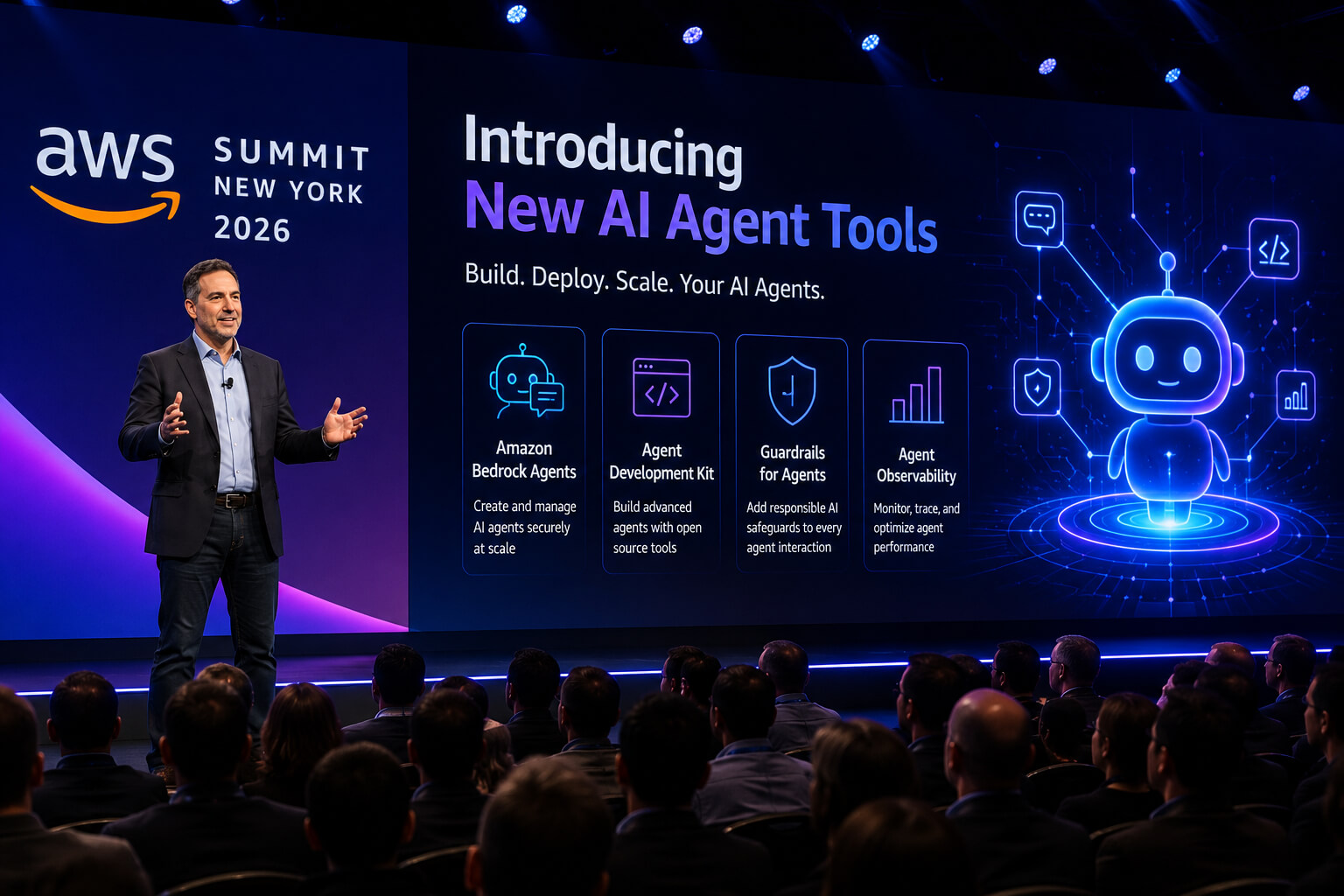
Amazon Web Services (AWS) has announced a major wave of AI agent innovations at AWS Summit New York 2026, signaling a more aggressive move into enterprise-grade agentic AI.
The announcements are meant to help companies move past experimenting with AI and begin deploying agents that can lock down code, understand company data, automate work, modernize software and operate safely at scale.
AWS announced a series of new and expanded services including AWS Continuum, AWS Context, new autonomous agents for Amazon Quick, a mobile version of Kiro, release management features for AWS DevOps Agent, continuous modernization for AWS Transform, and new enhancements to Amazon Bedrock AgentCore.
AWS Continuum Targets Code Security at Machine Speed
One of the biggest announcements was AWS Continuum for code vulnerabilities, a new AI-native security service that aims to help companies manage software risks faster.
AWS says Continuum can continuously discover vulnerabilities, validate which issues are actually exploitable, prioritize them based on business context, and support remediation across the software stack. The service is also designed to be model agnostic, meaning it can use different AI models depending on the task.
The goal is to help security teams respond to threats at what AWS describes as “machine speed,” especially as both attackers and defenders increasingly use AI systems to find and act on vulnerabilities.
AWS Context Gives AI Agents Better Business Knowledge
AWS also introduced AWS Context, a new service that automatically builds a knowledge graph from an organization’s existing data.
This is important because AI agents need more than raw information. They need to know where data lives, what sources are trustworthy, how systems relate to each other, and what business rules apply.
AWS Context provides agents with a shared understanding of company data drawn from databases, documents, emails, Slack messages, and more. The service has built-in governance to ensure agents can only access the information they are permitted to use.
This could make AI agents more reliable in answering customer questions, recommending next steps or completing complex workflows for businesses.
Amazon Quick Adds Autonomous AI Agents
Amazon Quick, AWS’s enterprise AI assistant, is also getting new autonomous agents.
These agents can work in the background with specific expertise, tone, permissions, and access to tools. For example, a company could create a finance agent to process orders or a sales agent that monitors CRM updates, emails, and Slack conversations to draft follow-ups or flag risks.
AWS says these agents require no coding, making them more accessible to business users outside engineering teams.
Amazon Quick is also getting a new activity feed that combines email, messaging, calendar, and tasks into one prioritized view. AWS is also adding 16 new built-in integrations with companies including Adobe, Moody’s, and Snowflake.
Kiro Comes to iOS for Mobile AI Coding Workflows
AWS also announced that Kiro, its software development agent, is now available as a native iOS app.
The mobile app allows developers to start projects, monitor progress, steer coding agents, review code, and approve changes from an iPhone. AWS says Kiro sessions run securely in the cloud, allowing users to continue work across mobile and desktop without losing context.
This update reflects a broader trend in AI coding tools: software agents are becoming more persistent, mobile, and always available.
AWS DevOps Agent Adds Release Management
AWS is expanding AWS DevOps Agent with new release management capabilities.
The update is designed to help companies ship AI-generated code in a safer way. Coding agents are speeding up development, so release pipelines need to catch problems sooner, before they go into production.
The AWS DevOps Agent now supports release readiness reviews and the creation of change-specific test plans. This can help find regressions, integration issues, and user experience problems before deployment.
AWS Transform Gets Continuous Modernization
AWS also announced AWS Transform — continuous modernization, an always-on capability designed to reduce technical debt.
Instead of treating modernization as a one-time project, AWS Transform can now continuously identify outdated dependencies, documentation gaps, and aging software components. It can then help fix, validate, and learn from each modernization cycle.
AWS says Transform has already eliminated more than 1.6 million hours of manual work for customers including BMW Group and Experian.
Amazon Bedrock AgentCore Receives Major Updates
AWS also announced new enhancements for Amazon Bedrock AgentCore, its platform for building and running production-ready AI agents.
The updates include:
- Amazon Bedrock Managed Knowledge Base for easier ingestion, parsing, and retrieval of organizational knowledge.
- Web Search on AgentCore to ground agents with current web information inside AWS environments.
- AgentCore optimization capabilities that turn production traces into insights for improving agent behavior.
- New policy integrations with Amazon Bedrock Guardrails to help detect prompt injection, harmful content, and sensitive data exposure.
- AgentCore harness, now generally available, to help developers create working agents faster.
AWS says the number of tasks performed by agents on AgentCore has grown 15 times in the past six months.
Southwest Airlines Expands AI Partnership With AWS
AWS also highlighted a new partnership with Southwest Airlines, which will use AWS as its preferred cloud provider.
Southwest plans to move from a largely on-premises technology environment to a cloud-based, AI-enabled architecture on AWS by 2028. More than 2,700 Southwest developers are also using Kiro to help modernize Southwest.com and support AI-driven development workflows.
Why This Matters
The announcements at AWS Summit New York 2026 show that Amazon is putting AI agents in place to be a core component of the future enterprise software stack.
AWS is building tools for agents that understand business context, secure code, modernize software, orchestrate workflows and evolve over time, rather than just building chatbots or autonomous assistants.
The larger takeaway here is that AWS wants enterprises to think of AI agents not as experimental tools but as operational systems that can be used across security, development, customer support, sales, finance and cloud modernization.
As companies race to adopt agentic AI, AWS is betting that reliability, security, context, and enterprise integration will determine which platforms win.
