


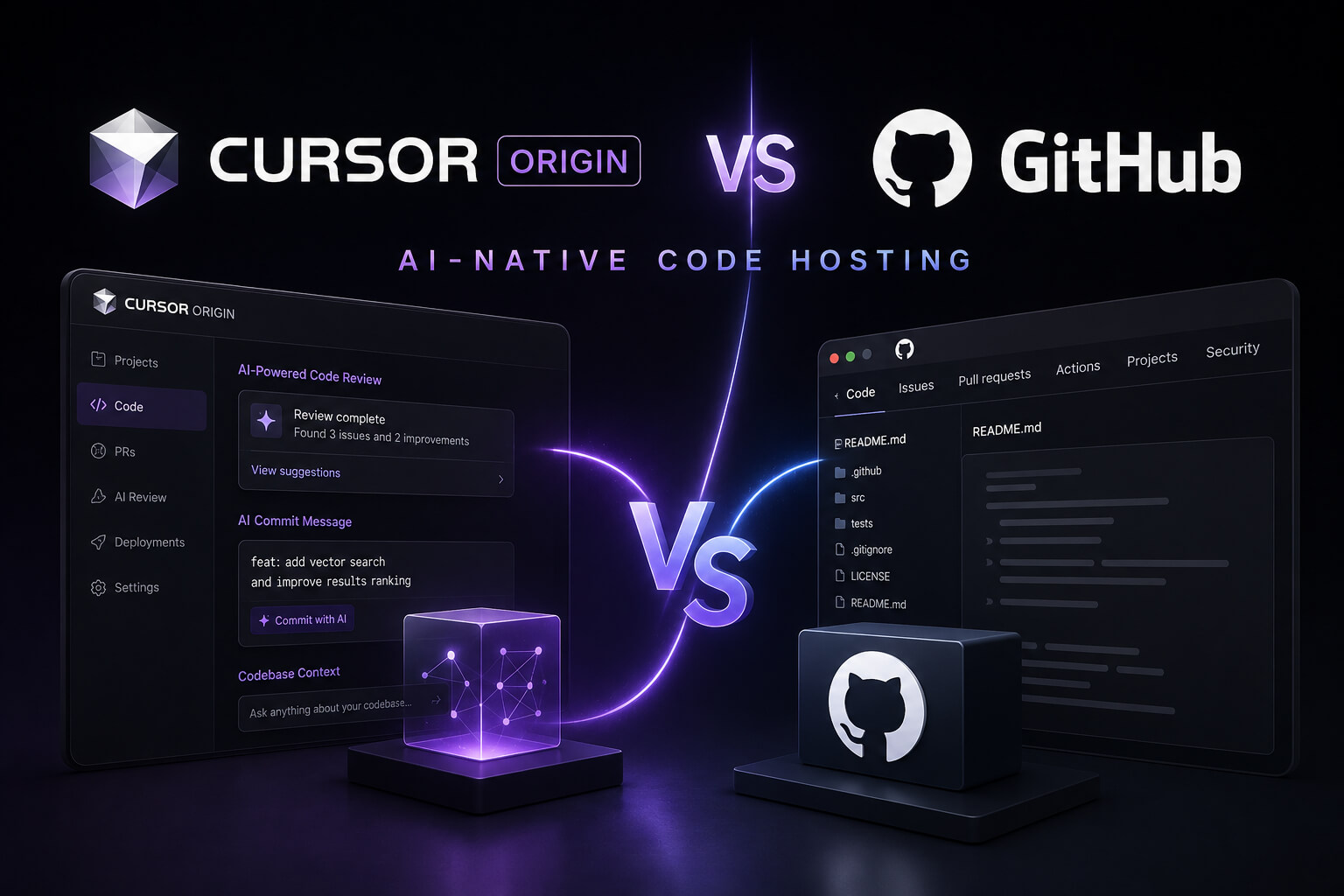
Cursor is moving beyond the AI code editor market with a new platform called Origin, a code storage and Git hosting product designed for a future where software is built by both humans and AI agents.
For more than a decade, GitHub has been the default home for software collaboration. Developers write code, open pull requests, review changes, run tests, and merge updates into shared repositories. That workflow became the foundation of modern software development, especially for open-source teams and enterprise engineering groups.
But AI coding tools are changing how software gets built. Cursor’s Origin appears to be designed around that shift. Instead of treating artificial intelligence as only a coding assistant inside an editor, Origin points toward a broader workflow where AI agents can help write, review, test, and manage code inside the development pipeline.
What Is Cursor Origin?
Cursor Origin is a new code storage and Git hosting platform from Cursor, the company behind the popular AI-powered coding environment. The platform will include features such as GitHub-like repository hosting, code review, testing and collaboration.
The key difference is the timing and positioning. GitHub was built around human-first collaboration. Cursor Origin is being introduced as AI agents become more active in software development.
That means Origin is not just another place to store code. It could turn into a place where developers bargain for contributions from humans and AI systems.
Why Cursor Origin Matters
With the rise of AI coding agents, software teams are rethinking their traditional development processes. Now, AI tools can write functions, suggest fixes, change files, explain bugs, and help with testing. In more advanced setups, agents can work in the background and complete multi-step coding tasks with less direct human input.
This creates a new challenge for software teams: existing repository platforms were not originally built for agent-led development.
GitHub’s model works well when humans are the main contributors. Developers create branches, submit pull requests, comment on code, and approve changes. However, if AI agents begin producing a larger share of code, teams may need new systems for tracking, reviewing, and controlling agent work.
Cursor Origin appears to be aimed at that future.
Cursor Origin vs GitHub
GitHub remains the dominant platform for developers, open-source maintainers, and enterprise software teams. Its ecosystem includes repositories, GitHub Actions, pull requests, security tools, issue tracking, and integrations with thousands of developer services.
GitHub is deeply ingrained in the software industry, and developers are using it for collaboration, documentation, automation, and deployment workflows. Cursor Origin has a tough challenge ahead of it.
However, Cursor has one major advantage: it is building during the AI coding era.
While GitHub was designed around human-to-human collaboration, Cursor Origin is being shaped around human-to-AI collaboration. That difference could matter as more teams experiment with AI agents that can independently make code changes, run tests, and prepare updates for review.
How AI Agents Might Transform Code Collaboration
In traditional software development, engineers generate most of the code and employ tools to manage their work. But the role of the developer could change in AI-native development.
Rather than write each line of code himself, the developer might spend more time directing, reviewing outputs, approving changes, and coordinating multiple AI agents.
This could change the meaning of a pull request. A future pull request may not come only from a human developer. It may come from an AI agent that was assigned a task, generated code, ran tests, and prepared a proposed change.
That is where platforms like Cursor Origin may become important. Teams will need better ways to understand what AI agents changed, why they changed it, whether the code passed tests, and whether the output is safe to merge.
Why GitHub Still Has the Advantage
Even with Cursor’s AI-native approach, GitHub will not be easy to disrupt. Microsoft’s platform has years of trust, a massive developer community, enterprise adoption, and deep integrations across the software ecosystem.
GitHub also has its own AI strategy through GitHub Copilot, which has already become one of the most widely known AI coding tools. This means Cursor is not competing against a company that has ignored AI. It is competing against a platform that already has developer attention, enterprise relationships, and AI-powered coding features.
For Cursor Origin to succeed, it will need to offer more than a GitHub alternative. It will need to show that AI-native repository management is meaningfully better than adding AI features on top of existing workflows.
The Bigger Picture for AI Software Development
Cursor Origin reflects a larger trend in the software industry: AI coding tools are expanding from simple autocomplete features into full development systems.
The next stage of AI-assisted software development may not be about whether AI can write code. It may be about how teams manage AI-generated work responsibly.
That includes code quality, testing, security, version control, accountability, and human oversight. If AI agents become regular contributors to software projects, development platforms will need to adapt.
Cursor’s bet is that the future of software engineering will require infrastructure built specifically for humans and AI agents working together.
Final Thoughts
Cursor Origin is one of the clearest signs that AI coding companies want to move deeper into the developer workflow. Instead of only helping developers write code faster, Cursor is preparing to compete in the infrastructure layer where code is stored, reviewed, tested, and merged.
GitHub still has a powerful lead, but Cursor Origin introduces a different vision for software collaboration. If AI agents become central to how code is written, reviewed, and shipped, platforms built for that reality could become increasingly important.
For now, Cursor Origin is a major signal that the battle for the future of software development is moving beyond AI code editors and into the core systems developers use every day.
