


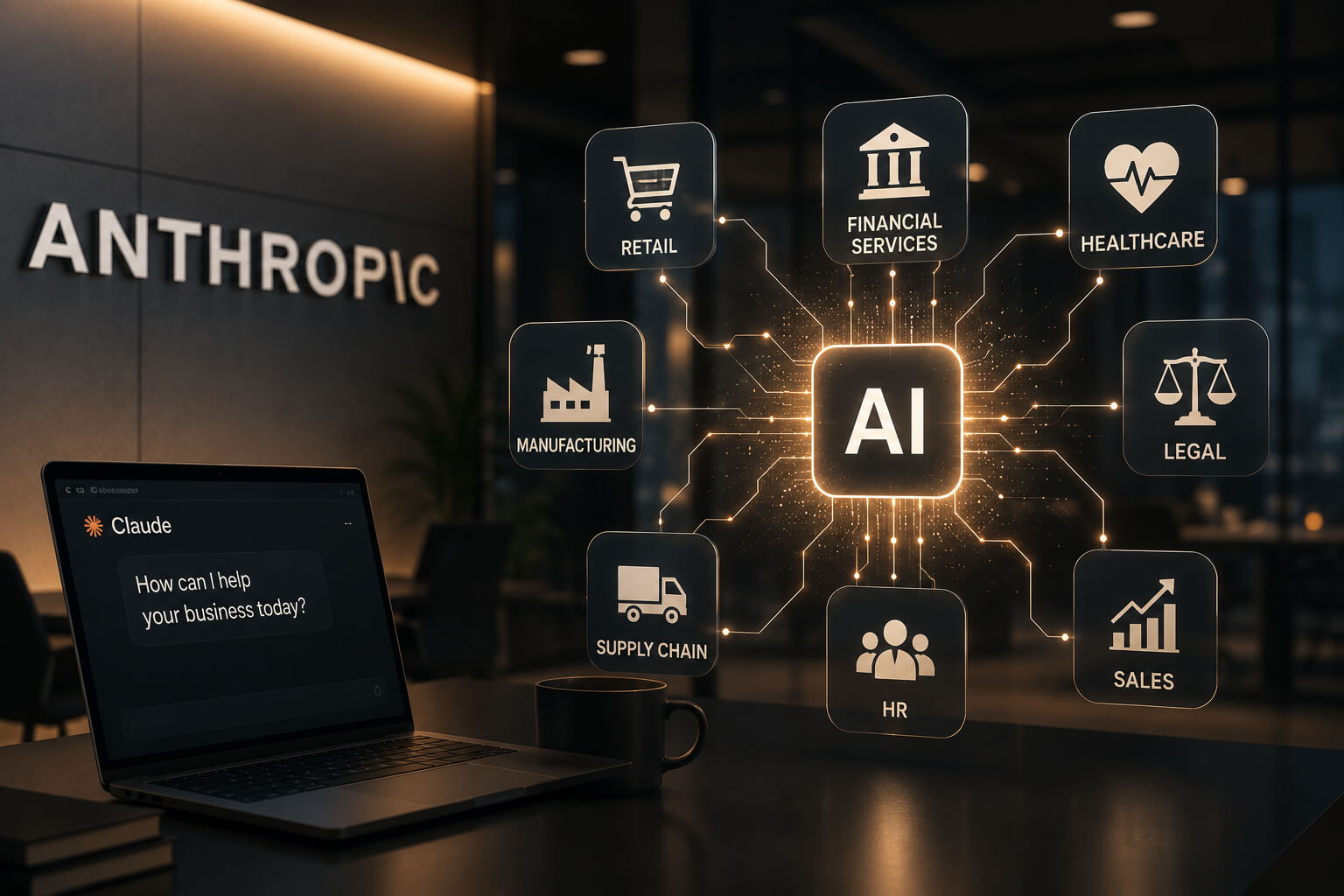
Anthropic is moving deeper into enterprise software, and its latest push could create new pressure for companies that build AI applications on top of Claude.
The AI company has been expanding its offerings beyond general-purpose chatbot and model access with more industry-specific tools built for business workflows including AI products and agents for software development, financial services, legal work and small business operations.
The shift highlights a growing tension in the artificial intelligence market: the same model providers that power third-party AI startups are increasingly launching their own specialized applications.
Anthropic Moves From Model Provider to AI Software Competitor
For many enterprise AI companies, foundation models such as Claude are the core technology behind their products. These companies build user interfaces, workflow tools, compliance layers, and industry-specific features on top of AI models developed by companies like Anthropic.
However, Anthropic’s expansion into vertical AI tools means it is no longer just supplying the underlying model. It is also creating direct products for the same business customers that many AI software builders are targeting.
According to PYMNTS, Anthropic has introduced a growing number of industry-focused tools, including Claude Code, financial services agents, Claude for Legal, and Claude for Small Business. These products are designed to help companies apply Claude directly to real-world business tasks without needing to build custom AI systems from scratch.
Why Anthropic Vertical AI Tools Matter
The launch of Anthropic vertical AI tools could change how enterprises buy and use AI.
Instead of purchasing a separate AI application from a third-party startup, businesses may choose ready-made tools from Anthropic if they are already using Claude. That could make adoption faster, reduce integration work, and give companies direct access to the model provider’s latest capabilities.
For enterprise AI builders, this creates a difficult competitive challenge. If Anthropic can provide similar tools natively, third-party companies will have to show their products offer deeper workflow customisation, stronger compliance controls, better integrations or support for multiple AI models.
This is especially important in industries such as finance and legal services, where companies often require audit trails, data security, accuracy checks, and very specific workflows.
Enterprise AI Startups Face a New Competitive Reality
Anthropic’s vertical software rollout reflects a broader trend across the AI industry. Major model developers are increasingly moving up the stack from infrastructure into applications.
That creates both opportunity and risk for AI startups.
On one hand, better foundation models can help startups build more advanced products. On the other hand, model providers may eventually launch similar tools themselves, reducing the gap between infrastructure and finished software.
Enterprise AI companies may respond by sharpening their focus on niches that the general model providers are unlikely to compete with directly — special compliance requirements, proprietary data sets, industry-specific implementation support and multi-model flexibility.
Some companies may also boast that they’re not tied to a single model provider. By giving access to Claude, OpenAI, Google Gemini and other models, AI software builders can advertise themselves as more flexible and cheaper for enterprise customers.
Anthropic’s Expansion Comes as AI Disrupts Software Valuations
The broader software market is feeling the effects of the rise of AI-native tools, too.
As AI becomes more capable of running business workflows, investors and enterprise buyers are reconsidering the value of traditional software companies. If AI agents can automate tasks across multiple departments, some stand-alone software products may face pricing pressure or a drop in demand.
This uncertainty has made it more difficult to predict which software companies will profit from AI and which will be upended by it.
Anthropic’s strategy shows how powerful AI model companies could reshape enterprise software from the inside. Instead of selling access to models, they may increasingly bundle AI into off-the-shelf tools for specific industries.
What This Means for the Future of Enterprise AI
Anthropic’s move into vertical AI tools could speed up adoption by businesses seeking practical AI solutions without having to build everything themselves.
But it also raises an important question for the enterprise AI ecosystem: How do AI application builders compete when their model provider is a direct competitor?
The answer may depend on differentiation. Companies with deep expertise, strong customization, better governance, and wider model choice may still have room to grow. But companies with thin wrappers around foundation models could face growing pressure.
As Anthropic continues expanding Claude into specialized business workflows, the enterprise AI market may become more competitive, more consolidated, and more focused on real operational value.
For now, Anthropic’s vertical AI push signals a major shift: foundation model companies are no longer just powering the AI software market. They are becoming some of its most important competitors.
