


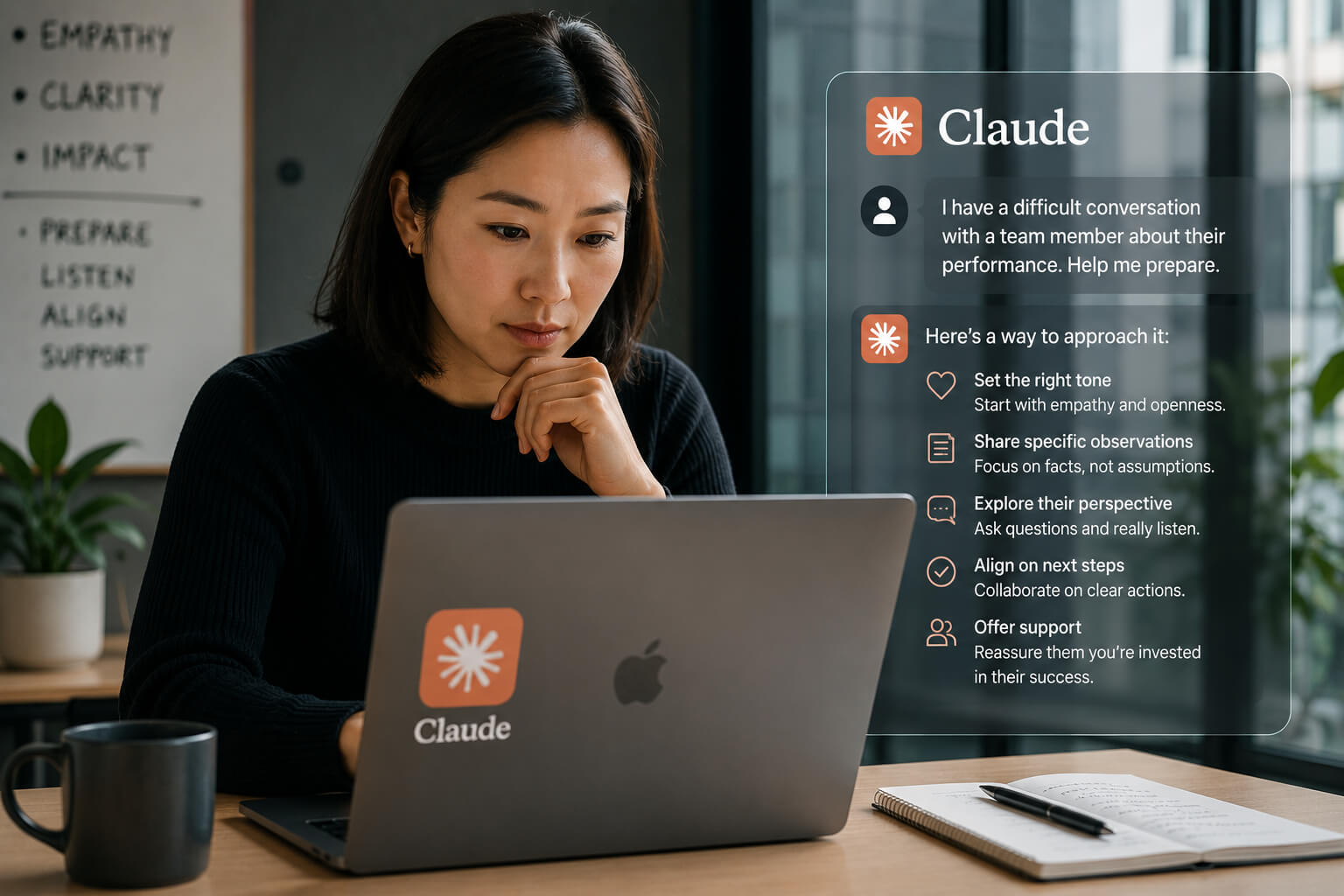
AI at work is usually discussed in terms of speed. Write the report faster. Summarize the meeting. Clear the inbox. Generate the code. In this article, you’ll learn how an Anthropic product lead uses Claude to enhance productivity in the workplace. Dianne Penn is using it for something less mechanical and considerably more human: figuring out how to talk to people.
Penn, Anthropic’s head of product management for its research and labs teams, says Claude has become part of the way she prepares for sensitive conversations, coaches employees and examines her own management decisions. She does not hand over the conversation to the chatbot. The useful part happens before she enters the room. That distinction matters.
Claude Has Become Part of Penn’s Management Toolkit
Speaking on an episode of Lenny’s Podcast released on July 26, Penn explained that Claude helps her search for clearer language when preparing for difficult workplace discussions.
Managers often know the point they need to make but struggle with its delivery. Feedback can become vague because the speaker wants to avoid conflict. Direct language can go too far in the other direction. A conversation that looked straightforward on paper suddenly becomes awkward once another person’s emotions, expectations and career are involved.
Penn uses Claude to work through that tension. She told podcast host Lenny Rachitsky that she has shared the approach with other Anthropic managers, particularly as a way to improve coaching and encourage better conversations between colleagues. The goal is not to produce a flawless corporate script. It is to spot weak assumptions before they reach another person.
A Custom Claude Skill Helps Her Test the Conversation
Penn built a custom Claude Skill influenced by Crucial Conversations: Tools for Talking When Stakes Are High, a book focused on handling discussions involving disagreement, pressure or strong emotions. Her Skill helps her assess whether she is approaching a situation with the right level of detail. It can also push her to consider how the other person may react and whether she is being sufficiently direct.
Claude Skills are reusable packages of instructions, resources and workflows that give the model a more specialized way to handle recurring tasks. Anthropic says users can create custom Skills rather than repeatedly explaining the same process in every new conversation.
In Penn’s case, the recurring task is not spreadsheet formatting or document production. It is management preparation. That feels like a small shift until you consider how much of a manager’s job involves conversations with no obvious correct answer.
She Does Not Automatically Follow Claude’s Advice
Penn said she sometimes rejects Claude’s suggestions. That may be the most useful detail in the entire discussion. She forms her own position first, then uses the model to examine it. Claude becomes a second set of eyes rather than the source of the decision. It might identify a reaction she has not considered, question whether her message is too indirect or suggest a faster route to the real issue.
Penn described the experience as a form of individualized coaching. Still, the human manager remains responsible for deciding what to say and how to say it.
An AI-generated response can sound polished while completely missing the history between two colleagues. It may not understand that someone has already received similar feedback three times. It will not automatically know which details are confidential, politically sensitive or emotionally loaded unless the user provides that context. Useful language is not the same thing as sound judgment.
Penn Wants AI to Push Back, Not Simply Agree
Many people use chatbots as reassurance machines. They describe a situation from their own point of view, receive a sympathetic response and walk away feeling confirmed. Penn wants something tougher.
She said Claude becomes more valuable when it challenges an unfinished idea or questions the way she has framed a problem. In her view, an AI assistant should operate as a thinking partner, not a tool that agrees with everything the user already believes.
Anthropic has studied this problem from another angle. In research covering one million Claude conversations, the company examined how people seek personal guidance and how often AI responses drift toward excessive validation or praise. The findings underline a basic weakness of AI advice: a response that feels supportive may not be the response a person actually needs.
For workplace coaching, constant agreement would be especially unhelpful. Managers already hold more power than the employees receiving their feedback. An AI tool that merely strengthens the manager’s first interpretation could make a flawed decision sound more convincing. Pushback is the feature.
AI Management Tools Need Clear Privacy Boundaries
Using AI to prepare for employee conversations also raises an uncomfortable question: how much workplace information should a manager place inside a chatbot?
The safest approach is to remove names, personal identifiers, health information, disciplinary records and other confidential details wherever possible. A manager can describe the structure of a situation without copying an employee’s private history into a prompt. The exercise may still work with neutral language: a team member has missed several deadlines, responsibilities have become unclear or two colleagues disagree about ownership of a project.
There is little reason to turn a coaching prompt into a personnel file. Companies adopting similar practices will need policies covering approved AI systems, data retention, sensitive information and human review. Otherwise, an experiment intended to improve communication could create a separate trust problem.
This Is a More Believable Workplace Use for AI
The idea of an AI manager replacing human leadership still feels distant and, frankly, undesirable. An AI preparation tool is easier to imagine. It can ask whether the message is specific. It can identify language that sounds defensive. It can simulate a skeptical response. It can point out that the manager has spent five paragraphs avoiding the actual issue.
Then the manager closes the laptop and has the conversation. Penn’s use of Claude offers a practical picture of AI-assisted work without pretending that a model understands the team better than the person responsible for it. Claude helps her think through the moment. It does not own the outcome.
That may be where AI provides the most value at work—not speaking for people, but helping them notice what they were about to say.
Sources
- Business Insider: Anthropic Exec Shares How She Uses AI to Help Manage Her Team
- Lenny’s Podcast: Dianne Penn on Anthropic, Claude and AI Product Management
- Anthropic: The Complete Guide to Building Skills for Claude
- Claude by Anthropic: Introducing Agent Skills
- Anthropic Research: How People Ask Claude for Personal Guidance
