


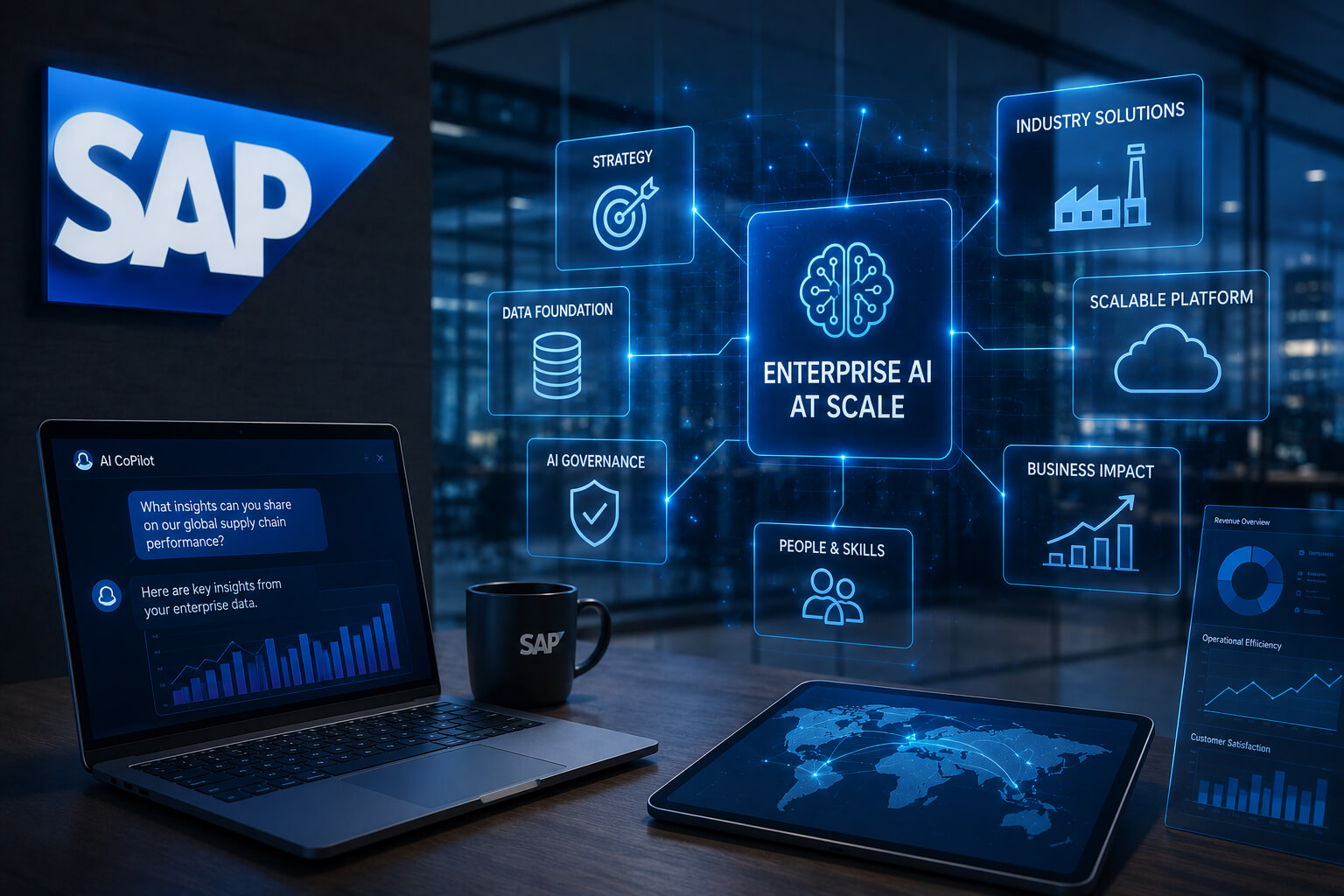
SAP does not want artificial intelligence to remain a collection of clever features buried inside business software. The German enterprise software company is aiming for something much larger: AI agents that can move across departments, work with live business data and complete entire processes without losing the controls that large organizations require.
During SAP’s second-quarter earnings call, CEO Christian Klein described this shift as moving from traditional software development toward “building AI at scale.” The wording matters. SAP is no longer pitching AI as an optional assistant. It is trying to rebuild parts of its enterprise software business around it.
Cloud Growth Gives SAP Room to Push Its AI Strategy
SAP enters this transition from a relatively strong position. The company reported that cloud revenue increased 24% during the second quarter, while overall revenue rose 11% to $11.24 billion. Enterprise resource planning migrations helped drive that growth as more customers moved workloads away from older on-premises systems.
That cloud momentum gives SAP a natural route for distributing new AI tools. Customers already shifting finance, human resources, procurement and supply chain operations into SAP’s cloud environment can receive AI features without introducing an entirely separate technology stack.
Still, the company is not treating AI as another cloud add-on.
SAP has begun redirecting consultants toward building AI agents and helping customers adopt them. Services revenue slipped slightly during the quarter, partly because the company is reallocating people and resources toward its enterprise AI ambitions. In other words, SAP appears willing to adjust parts of its existing business to support the AI business it expects to need next.
SAP Business AI Platform Sits at the Center
The core of SAP’s plan is the SAP Business AI Platform, introduced during the company’s Sapphire conference in May 2026. The platform combines business data, process information, AI development tools and governance within a shared enterprise foundation. SAP says companies can use it to build, integrate and manage AI agents, applications and automated workflows across both SAP and non-SAP systems.
This is where SAP believes it has an advantage over general-purpose AI providers. A large language model may understand a question written in ordinary language. It does not automatically understand how a company defines revenue, who can approve a supplier contract or which compliance rules apply to a particular transaction.
Klein argued that many enterprise AI projects struggle because models lack that deeper business context. He also raised concerns about unpredictable token spending, dependence on a single frontier model provider and growing demand for AI sovereignty. SAP’s answer is to place AI closer to the data and processes it already manages.
The Autonomous Suite Moves Agents Into Daily Operations
Sitting above the Business AI Platform is SAP’s Autonomous Suite. The suite introduces agents and AI assistants into business applications, allowing them to carry out workflows that cross multiple systems and departments. SAP describes its broader goal as the “autonomous enterprise,” although the company continues to emphasize human oversight rather than completely unattended automation.
An AI agent might identify an inventory shortage, examine supplier data, check procurement rules and recommend or initiate the next step. Another could follow an invoice through validation, approval and payment instead of helping with only one small part of the process.
That difference separates a chatbot from an operational agent. SAP says these agents should complete end-to-end processes accurately, securely and cost-effectively while keeping people involved in important decisions. The difficult part will not be producing a polished response. It will be giving the system enough authority to act without creating new financial, operational or compliance problems.
Enterprise Data Is Becoming the Real AI Battleground
SAP’s AI strategy depends heavily on access to clean, connected and properly governed business data. That helps explain the company’s focus on bringing SAP and third-party information into a common data layer. SAP has pointed to acquisitions involving data lakehouse platform Dremio and data management company Reltio as part of this effort.
The company has also expanded partnerships with Google Cloud, Microsoft, Snowflake and Nvidia. Google Cloud and Microsoft are supporting agent interoperability, while an expanded Snowflake partnership connects more data with SAP Business Data Cloud. Nvidia’s OpenShell technology is being incorporated as a security layer for agents running through the SAP Business AI Platform.
These partnerships reveal one of the awkward truths about enterprise AI: no single vendor controls all the information an agent needs.
A finance process may begin inside SAP, pull customer data from another platform, use a model hosted by a cloud provider and require identity or security services from somewhere else. Agents will have to navigate that mess without breaking access controls along the way. Interoperability is not a side feature here. It may determine whether enterprise agents become genuinely useful or simply create a new generation of software silos.
SAP Is Also Applying the Strategy to Its Own Workforce
SAP is not limiting the transformation to customer-facing products. The company is hiring more AI specialists while retraining existing employees through coding camps and in-person programs. SAP wants the training effort to reach more than 90% of its workforce over the coming months.
That scale suggests SAP expects AI to alter jobs well beyond its engineering teams. Consultants may spend less time configuring conventional software and more time designing agents. Developers could shift from writing every workflow manually to supervising AI-assisted development. Customer-facing teams will need to explain governance, data readiness and agent behavior alongside familiar cloud migration discussions.
The transition could be uncomfortable. It also makes SAP’s strategy more credible. A company selling autonomous business operations will eventually need to show that it can use similar technology within its own organization.
SAP Is Betting That Business Context Will Beat AI Novelty
The enterprise AI market is crowded with model providers, cloud platforms and software companies all promising agents that can perform real work. SAP’s pitch is narrower and, in some ways, more practical.
It is not claiming that its models will always be the smartest. Instead, the company argues that enterprise AI becomes valuable when a model understands the data, rules, permissions and workflows surrounding a business decision.
That is why SAP’s platform supports multiple foundation models rather than tying customers to one provider. Its generative AI hub gives companies centralized access to SAP, partner and open-source models while adding governance and cost controls around their use. For CIOs, this could be more useful than chasing every model release.
The model will change. The company’s financial records, approval structures, supplier relationships and compliance obligations will remain considerably harder to replace. SAP is betting that controlling that context gives it a durable position.
The Hard Part Starts After the AI Pilot
Most companies can now create an AI demo. Scaling one across a multinational organization is another problem entirely. Data must be accurate. Permissions need to follow employees and agents across systems. Costs must remain predictable. Every automated decision may need an audit trail.
SAP’s Business AI Platform is designed around those less glamorous requirements. The approach will face real tests. Customers must trust agents with increasingly sensitive operations, while SAP must prove that its platform can work across complex technology environments without forcing organizations into deeper lock-in.
There is also the question of measurable value. An agent that looks impressive during a presentation is not enough. Enterprises will expect shorter processing times, lower operating costs, fewer errors or better decisions.
SAP appears to understand that distinction. Its latest strategy is not simply about placing AI inside enterprise applications. The company wants AI to become part of how those applications, employees and business processes work together. That is a much bigger promise. It is also where the enterprise AI race is heading.
