


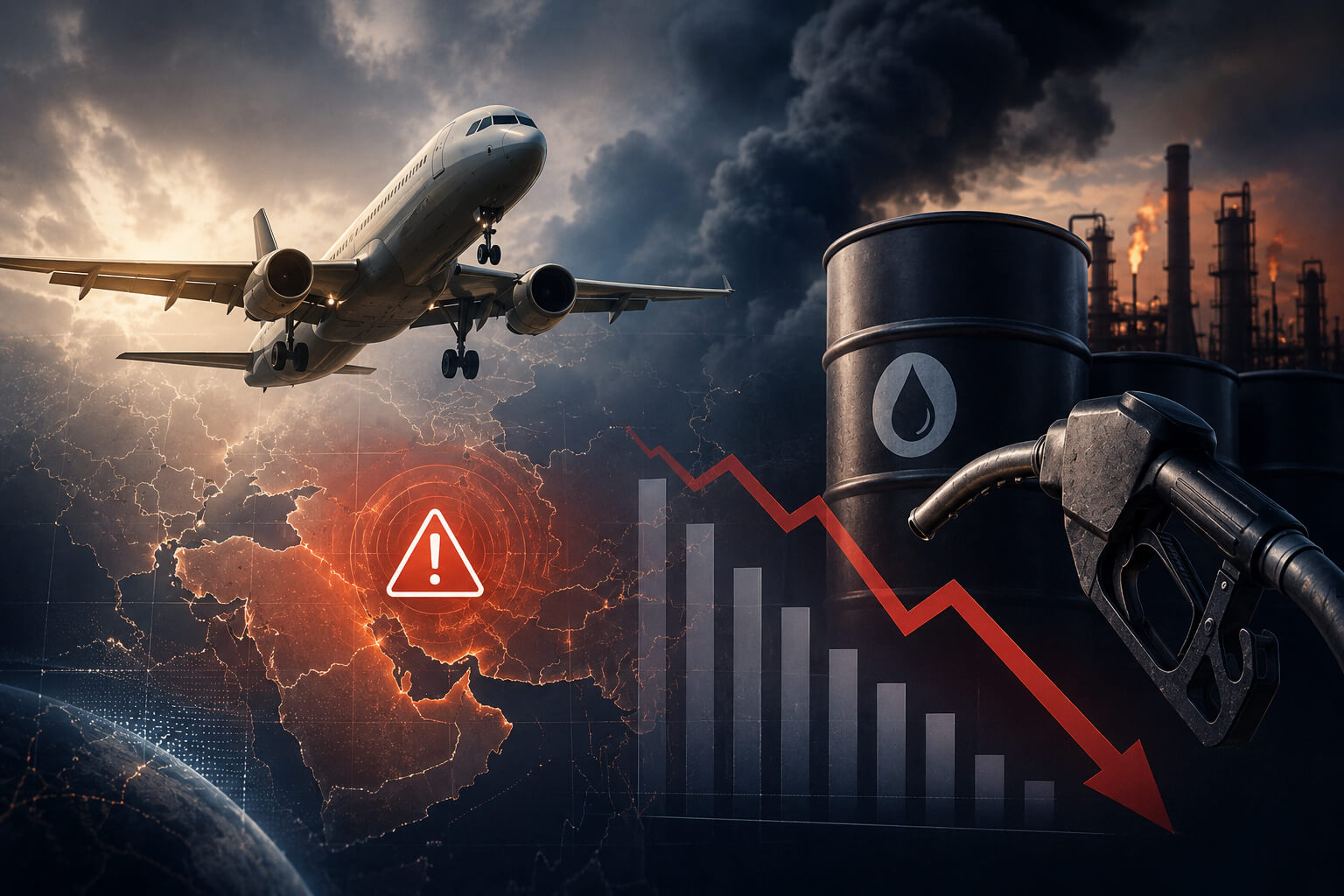
Middle East disruptions and high fuel prices are expected to cut global airline industry profitability nearly in half in 2026. This is according to the International Air Transport Association.
IATA’s latest financial outlook shows that global airlines are now expected to generate a combined $23 billion net profit in 2026. This figure is down sharply from the earlier projection of $41 billion. Moreover, the figure is also nearly half of the estimated $45 billion profit in 2025.
The sharp downgrade reflects two major pressures hitting the aviation industry at the same time. These are war-related disruptions in the Middle East and a steep rise in jet fuel prices. IATA said these pressures are weakening demand, disrupting operations, and squeezing airline margins worldwide.
Middle East Airlines Expected to Fall Into Losses
The Middle East is expected to be the hardest-hit region. IATA said airlines in the region are forecast to collectively fall into the red. This is as war-related disruptions continue to affect demand and operations.
Gulf carriers, which serve as major hubs for global travel, have faced operational uncertainty following airspace restrictions and disruptions linked to the conflict. As a result, the disruptions have forced airlines to reroute flights, protect connectivity and incur higher operating costs.
While airlines in other regions are still expected to remain profitable, IATA said their financial performance will be lower than earlier projections.
High Fuel Prices Add Major Pressure to Airline Costs
High fuel prices are another major reason airline profitability is expected to fall. IATA forecasts fuel costs will rise from $252 billion in 2025 to $350 billion in 2026.
Jet fuel prices are expected to average $152 a barrel in 2026, up almost 70% from $90 a barrel in 2025. Consequently, fuel is projected to account for 31.4% of total airline operating expenses, compared with 25.4% in 2025.
This means airlines are spending far more to operate flights. Even so, total fuel consumption is expected to remain roughly unchanged from the previous year.
Airline Margins Shrink as Costs Rise Faster Than Revenue
IATA expects the airline industry’s net profit margin to fall to 2.0% in 2026, down from 4.2% in 2025. Net profit per passenger is also forecast to drop to $4.50, half of the $9.10 recorded in 2025.
Although airlines are raising fares and improving efficiency, IATA warned these efforts will not be enough to fully offset the impact of high fuel prices and Middle East disruptions.
Total airline revenues are forecast to be $1.165 trillion in 2026. However, operating expenses are expected to outpace that, reaching $1.117 trillion.
Passengers May Have to Pay More, Take Longer Routes
Travelers could face higher airfares, longer routes and possible schedule changes in affected markets. This is because of the combination of Middle East disruptions and high fuel prices.
Passenger demand remains healthy with IATA forecasting 5.1 billion passengers in 2026, a 2.4% rise over 2025. Airlines also are expected to fill a record 84.0% of available seats.
Airlines are passing some of the higher fuel costs on to customers in the form of higher fares. In addition, operational disruptions in the Middle East continue to sow uncertainty over major international routes.
Cargo and ancillary revenue help, but not enough
Airlines are also turning to cargo, baggage fees, seat selection, loyalty programs and other ancillary revenue streams to cushion the financial blow.
For the first time since 2019, ancillary revenue is expected to exceed air cargo revenue. IATA forecasts ancillary and other revenues to reach $165 billion in 2026, while cargo revenue is forecast to reach $162 billion.
But these revenue gains are not expected to fully offset the pressure from high fuel prices and war-related disruption.
Aircraft Shortages Add to Airline Industry Pressure
The airline industry is also dealing with aircraft supply constraints. IATA said aircraft lease rates have reached record levels as limited availability and strong demand continue to pressure carriers.
Airlines are keeping older planes in service longer, which could translate to higher maintenance costs and lower fuel efficiency. The backlog of aircraft reached 18,100 in May 2026 – more than half the active fleet worldwide.
The shortage is making it more difficult for airlines to replace aging aircraft with newer, more fuel-efficient models. This is especially challenging as fuel prices are already hurting profitability.
IATA Says Airline Industry Remains Resilient Despite Profit Shock
Despite the weaker outlook, IATA said the airline industry remains resilient. Passenger demand continues to grow, load factors remain high, and global revenues are still rising.
However, the impact of Middle East disruptions and high fuel prices is expected to define the industry’s financial performance in 2026.
Profits are expected to drop to $23 billion. It will be a tougher year for airlines, with tighter margins, higher costs, regional instability and continuing uncertainty across global travel networks.
Conclusion
The biggest risks to airline industry profitability in 2026 are now Middle East disruption and high fuel prices. IATA’s latest forecast indicates that even strong passenger demand may not be enough to insulate airlines from rising costs and geopolitical disruption.
Airlines’ profits are forecast to almost halve as fuel costs soar and unrest continues in the Middle East. In what looks set to be a difficult year for the global aviation industry in 2026.
