


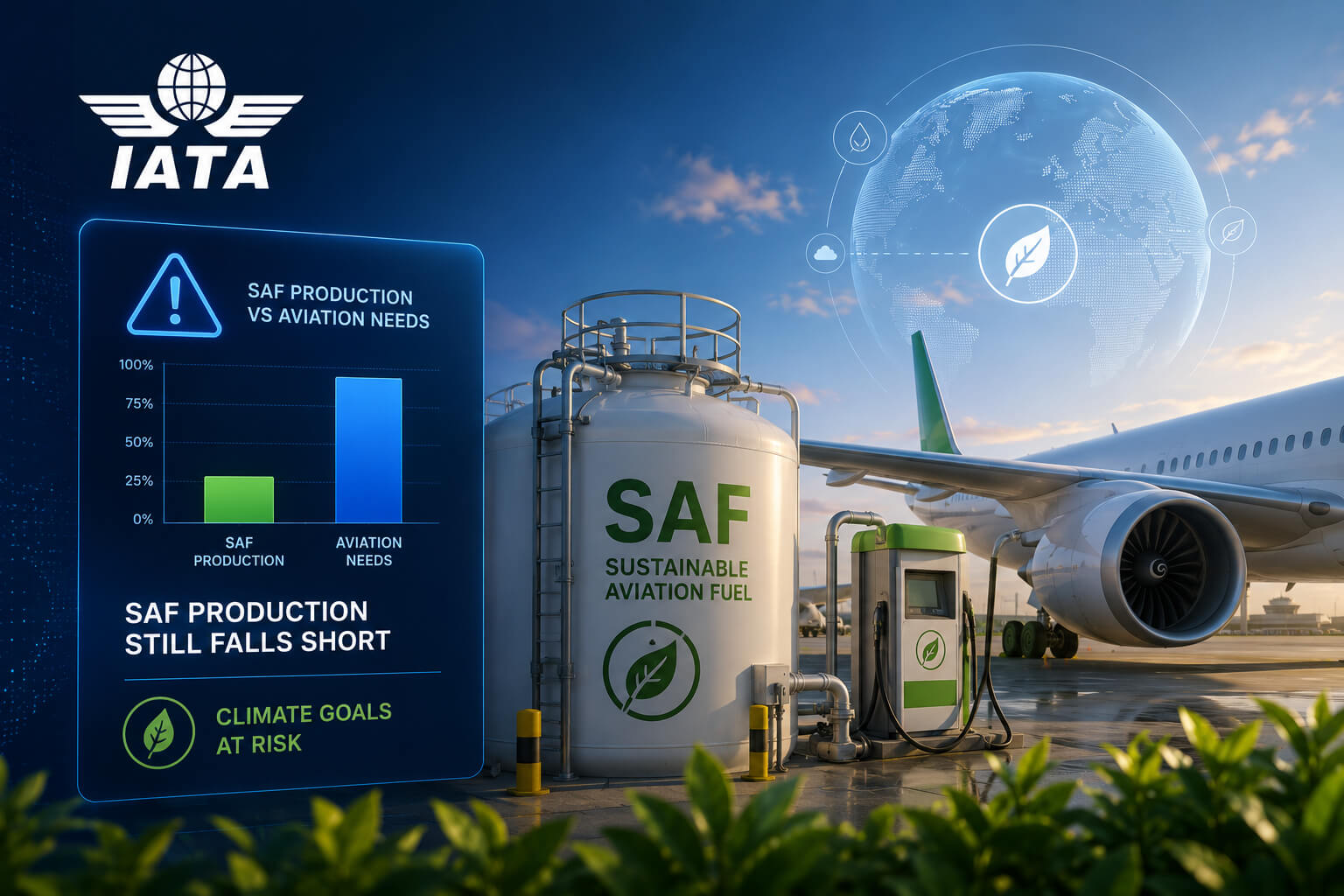
The International Air Transport Association has warned that global sustainable aviation fuel production remains far below what the airline industry needs to meet its long-term climate targets. SAF production volumes are a key concern for industry leaders working towards a more sustainable future in aviation.
According to IATA’s latest estimates, sustainable aviation fuel, commonly known as SAF, is expected to reach around 2.4 million tonnes in 2026. That would represent just 0.8% of total aviation fuel use worldwide.
The figure highlights a major challenge for the aviation sector, which has committed to reaching net-zero carbon emissions by 2050. SAF is widely viewed as one of the most important tools for reducing aviation emissions, but production volumes continue to lag behind demand.
SAF Production Remains Too Low
IATA said airlines are expected to spend around $4.3 billion on SAF in 2026. Despite that investment, the available supply remains limited.
The association warned that the industry’s path toward using SAF for a much larger share of its fuel needs by 2050 is becoming more difficult. IATA has repeatedly called for stronger government action, better investment frameworks, and more support from energy companies to scale production.
Willie Walsh, IATA’s Director General, said the industry is still not seeing the level of policy incentives needed to create a viable SAF market. He also pointed to the need for faster development of renewable energy and stronger support for clean fuel production.
Why Sustainable Aviation Fuel Matters
Sustainable aviation fuel is designed to reduce lifecycle carbon emissions compared with traditional jet fuel. It can be produced from sources such as waste oils, biomass, and other renewable feedstocks.
For airlines, SAF is important because commercial aviation is difficult to decarbonize. Battery-powered aircraft and hydrogen-powered aircraft may play a role in the future, but they are not yet ready to replace conventional jet fuel across long-haul global aviation.
That makes SAF one of the most practical near-term solutions for cutting aviation emissions while allowing airlines to continue operating existing aircraft and infrastructure.
IATA Calls for Four Key Actions
To speed up SAF production, IATA is calling for coordinated action in four major areas.
First, the organization wants governments and industry players to expand renewable energy supply. More clean energy and feedstock availability are needed to support large-scale SAF production.
Second, IATA is pushing for open access to fuel infrastructure, including pipelines, storage facilities, and airport fuel systems. This would help improve competition and make SAF distribution more efficient.
Third, the group says policy support must be better sequenced. IATA argues that production incentives and investment frameworks should come before mandates, giving producers and investors more certainty.
Fourth, IATA wants a global SAF market supported by harmonized standards. The group also supports a book-and-claim system, which would allow airlines to purchase SAF benefits even when physical fuel is not available at a specific airport.
The e-SAF Challenge
IATA also raised concerns about e-SAF, also known as electro-SAF. This fuel is produced using renewable electricity through a power-to-liquid process.
Unlike biofuel-based SAF, e-SAF does not depend on biomass or waste oils. However, it requires large amounts of renewable electricity, green hydrogen, water, and carbon dioxide.
The European Union and the United Kingdom have set e-SAF production targets of around 0.6 million tonnes by 2030. IATA said current global production capacity that is operating or under construction is only around 0.02 million tonnes, with just one production site currently operating.
The organization warned that reaching the mandated target would require around 20 commercial-scale refineries. It also noted that no new final investment decisions for e-SAF facilities have been made over the past year.
Passenger Support for Cleaner Aviation Remains Strong
Despite production challenges, IATA said passenger support for aviation decarbonization remains high.
An IATA passenger survey conducted in April 2026 found that 89% of passengers believe the aviation industry should continue reducing emissions even if governments reduce their own climate efforts.
The survey also found that about two-thirds of passengers are willing to pay more to compensate for emissions. Nearly 88% expect ticket prices to rise because of sustainability investments.
Passengers also appear to prefer direct decarbonization measures over taxes. IATA said 25% of passengers prioritize funding for SAF, while 23% favor emissions-reduction technologies.
What This Means for the Airline Industry
The latest IATA warning shows that aviation’s climate transition remains heavily dependent on fuel innovation, renewable energy investment, and supportive policy.
While passenger support is strong, SAF production volumes are still far from the level needed to transform the airline industry. Without faster growth in renewable energy, better infrastructure, and stronger production incentives, airlines may struggle to meet their net-zero commitments.
For now, the message is clear: sustainable aviation fuel is essential to aviation’s future, but global production is still moving too slowly.
