


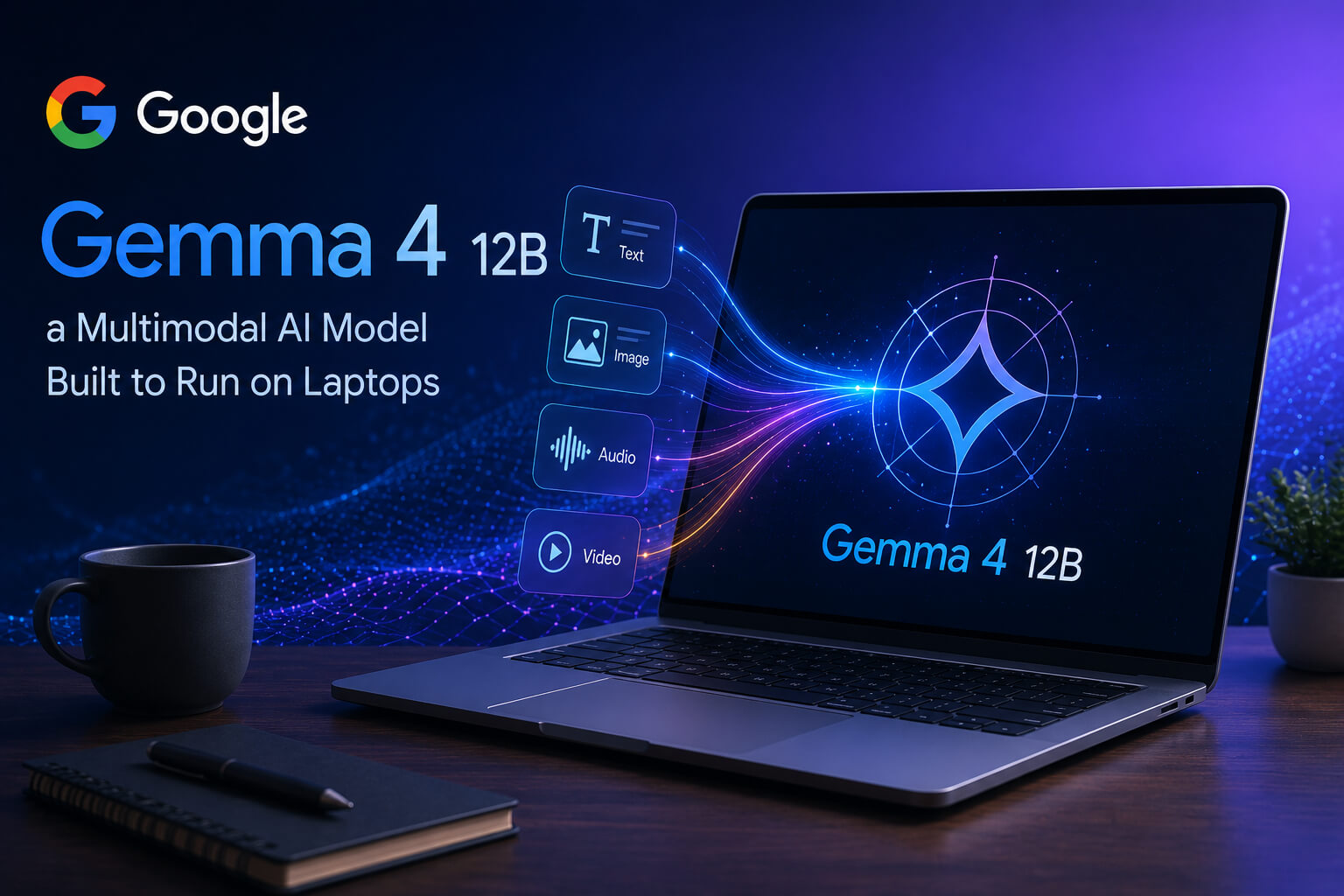
Google launches Gemma 4 12B, an open multimodal AI model for everyday laptops. Moreover, Google has launched Gemma 4 12B, a new open multimodal AI model that aims to bring advanced artificial intelligence directly to everyday laptops.
On June 3, 2026 Google DeepMind announced Gemma 4 12B, a mid-sized model with robust reasoning and multimodal input support. Additionally, it offers local operation in a smaller memory footprint.
The model can operate on text, images and audio. As a result, it marks a big step forward for developers, researchers, startups and AI fans. These users want powerful AI tools without being entirely reliant on cloud-based systems.
What Is Google Gemma 4 12B?
Google Gemma 4 12B is a 12-billion-parameter AI model built for multimodal tasks. It sits between Google’s smaller edge-focused models and its larger 26B Mixture of Experts model.
According to Google, the model is designed to support agentic multimodal intelligence directly on laptops. This means users can build AI applications that understand different types of input. These apps reason through multi-step tasks and operate locally on consumer hardware.
For developers, this opens the door to AI assistants and local productivity tools. It also introduces research workflows, privacy-focused applications, and multimodal agents that can run without sending every request to the cloud.
Run Locally on Consumer Laptops
One of the biggest highlights of Gemma 4 12B is that it can run locally with just 16GB VRAM or unified memory.
That brings the model to users with modern laptops, including those with unified memory architectures and capable consumer GPUs. Rather than requiring expensive enterprise infrastructure, Gemma 4 12B is supposed to help bring high-performance AI closer to everyday users.
Developers and businesses are looking for more control over cost, privacy, latency and data security. Therefore, local AI models are becoming more relevant.
A Unified Multimodal Architecture
Gemma 4 12B stands out because of its unified, encoder-free multimodal architecture.
Traditional multimodal AI systems often use separate encoders to process images or audio. They then pass that information into the language model. Google says Gemma 4 12B removes this extra layer by allowing vision and audio inputs to flow directly into the model’s LLM backbone.
For vision tasks, Gemma 4 12B uses a lightweight embedding module. For audio, raw audio is projected into the same dimensional space as text tokens.
The design reduces memory footprint and latency while maintaining strong multimodal performance.
Google Gemma 4 12B Key Features
The Gemma 4 12B boasts several features that will interest developers and advanced AI users.
The model can take text, images and audio inputs, opening up the possibility of supporting multimodal applications. Furthermore, it is designed for advanced reasoning, with benchmark performance that Google says approaches that of its larger 26B MoE model.
The model is under Apache 2.0 license, so it is open and available to developers. It also has Multi-Token Prediction drafters, which help to reduce output latency and increase response speed.
Google says the Gemma 4 models have been downloaded 150 million times now, with healthy adoption amongst the developer community.
How Developers Can Use Gemma 4 12B
Google has released Gemma 4 12B on a variety of developer platforms and tools.
The model can be tested in LM Studio, Ollama, Google AI Edge tools, and LiteRT-LM CLI. Model weights are available in Hugging Face and Kaggle. They can also be deployed on Google Cloud, Cloud Run, and Google Kubernetes Engine.
Google is also aiding local inference with tools like Hugging Face Transformers, llama.cpp, MLX, SGLang and vLLM. For fine-tuning, developers can use platforms such as Unsloth.
In addition, Google has released an official Gemma Skills Repository to help developers build agentic applications with Gemma models.
Why Gemma 4 12B Matters
The launch of Google Gemma 4 12B reflects a growing shift in the AI industry toward smaller, more efficient, locally runnable models.
While the largest AI models continue to dominate headlines, many developers need models that are fast, affordable, private, and practical to deploy. Gemma 4 12B is designed for exactly that use case.
Startups could use the model to reduce cloud costs. Meanwhile, businesses may rely on it to support private AI workflows. In addition, individual developers can run advanced multimodal AI more easily on personal hardware.
A Step Forward for Local Multimodal AI
Gemma 4 12B could become an important model for the next generation of local AI tools.
By combining text, image, and audio understanding with laptop-ready performance, Google is giving developers a more flexible foundation for building AI assistants, agents, and privacy-focused applications.
As competition in open and local AI models continues to grow, Gemma 4 12B shows that powerful multimodal AI is no longer limited to large cloud systems. Instead, it is increasingly moving onto the devices people already use every day.
For more Breaking AI news, visit: https://breakingai.news
