


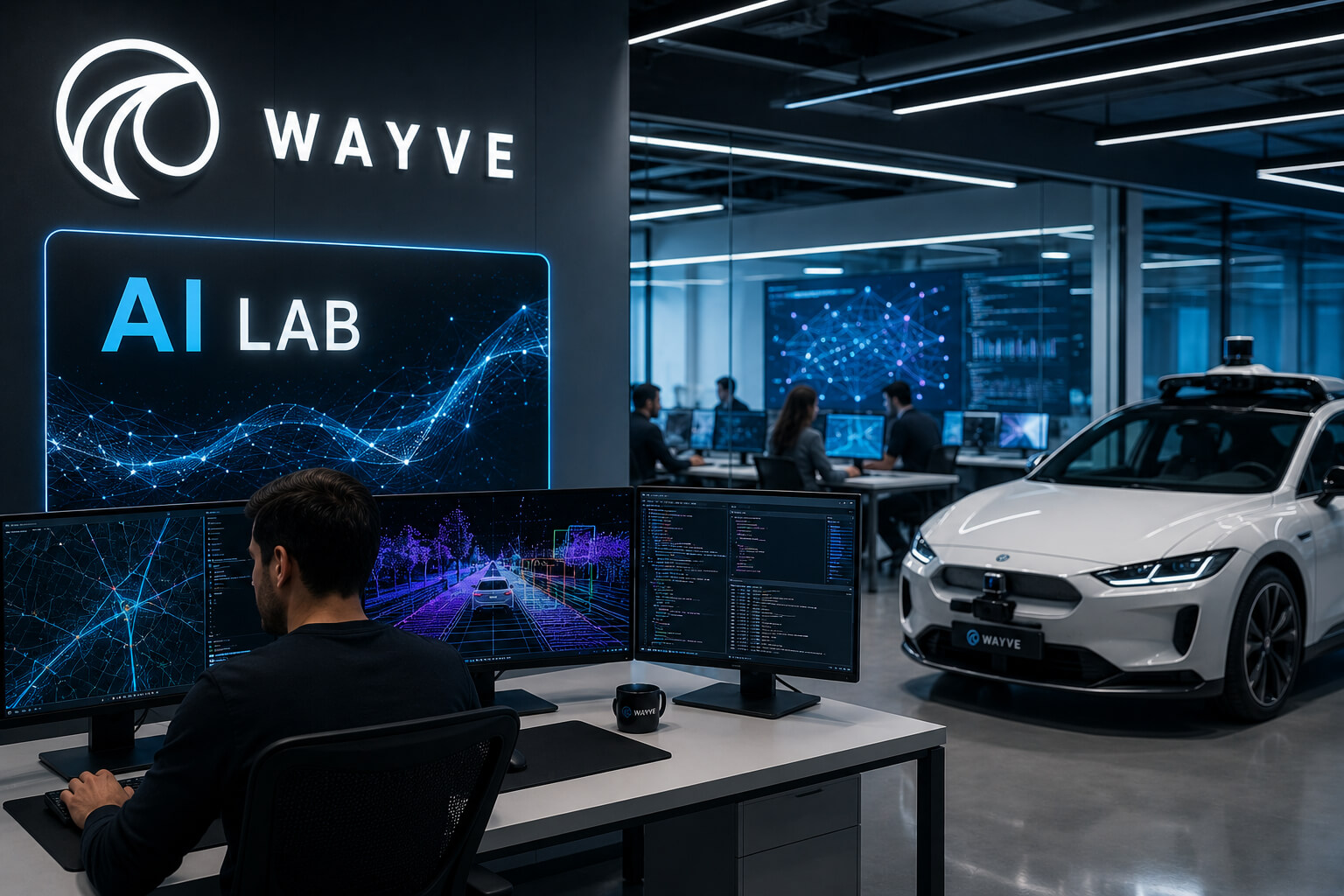
Wayve is expanding its artificial intelligence ambitions beyond self-driving cars with the launch of Wayve Labs. This is a new research unit focused on building AI systems that can better understand and operate in the physical world.
The UK-based autonomous driving startup is best known for developing AI software for driverless vehicles. But with Wayve Labs, the company is now looking at a broader frontier. Embodied intelligence is a field of AI focused on machines that can perceive, reason, move, and respond to real-world environments.
The new lab will be led by Jamie Shotton, Wayve’s chief scientist and a former Microsoft executive. Moreover, the team will focus on research areas such as spatial understanding, motion prediction, risk assessment, causality, and learning from real-world outcomes.
What Is Wayve Labs?
Wayve Labs is designed as a frontier AI research group inside Wayve. Its goal is to explore the next generation of machine intelligence. This includes systems that are not limited to screens, chatbots, or software-only environments.
Instead, the lab is focused on AI that can interact with the physical world.
That includes systems capable of understanding where objects are, how they move, what may happen next, and how actions can lead to consequences. These are critical problems not only for self-driving cars but also for robotics, logistics, automation, and other real-world AI applications.
Why Wayve Is Looking Beyond Self-Driving Cars
Wayve has spent years developing AI for autonomous vehicles. Its approach relies heavily on learning-based models rather than traditional rule-based self-driving systems.
That experience gives the company a strong foundation for broader robotics research. A self-driving car already needs to process complex environments, predict human behavior, assess danger, and make decisions in real time. Those same capabilities could eventually apply to other machines that need to operate safely in real-world settings.
Wayve’s new AI lab suggests the company sees autonomous driving as only one part of a much larger opportunity.
Embodied AI Could Be the Next Big AI Race
The launch of Wayve Labs comes as more AI companies are looking beyond text, images, and software agents. The next stage of AI development may involve systems that can act in physical environments. For example, these may include warehouse robots and delivery machines and systems for industrial automation and future humanoid robots.
This is where embodied AI becomes important.
Unlike traditional AI tools that generate content or answer questions, embodied AI must deal with messy, unpredictable environments. It must understand space, motion, timing, physical constraints, and safety risks.
That makes the field much harder, but potentially much more valuable.
No Immediate Commercial Product Yet
Wayve Labs is currently positioned as a research initiative rather than a product launch. The company has not announced a specific commercial robotics product tied to the lab.
However, the move could help Wayve build the technical foundation for future applications outside autonomous driving. By investing in long-term AI research now, Wayve may be preparing for a future where intelligent machines become useful across transportation, robotics, manufacturing, and logistics.
Wayve’s Growing Position in AI and Mobility
Wayve has already attracted major attention in the autonomous vehicle industry. The company has received backing from major technology and automotive players. It continues to position itself as a key challenger in the race to build scalable driverless technology.
Its focus on adaptable AI software could become especially important as the industry looks for systems that can work across different vehicles, cities, and driving conditions.
With Wayve Labs, the company appears to be extending that same philosophy into a wider AI vision. They are building intelligence that can generalize across the real world, not just roads.
Why It Matters
Wayve’s launch of Wayve Labs is important because it shows how the self-driving car industry may become a launchpad for broader robotics and embodied AI.
Autonomous vehicles are among the hardest real-world AI problems. If Wayve can transfer its research from driving to other physical-world systems, it could help accelerate the development of smarter robots. In addition, it could promote safer automation and AI models that understand real-world consequences.
For the AI industry, this is another sign that the next major battleground may not just be chatbots or software agents. It may be AI that can move, act, and make decisions in the physical world.
For more Breaking AI news, visit: https://breakingai.news
