


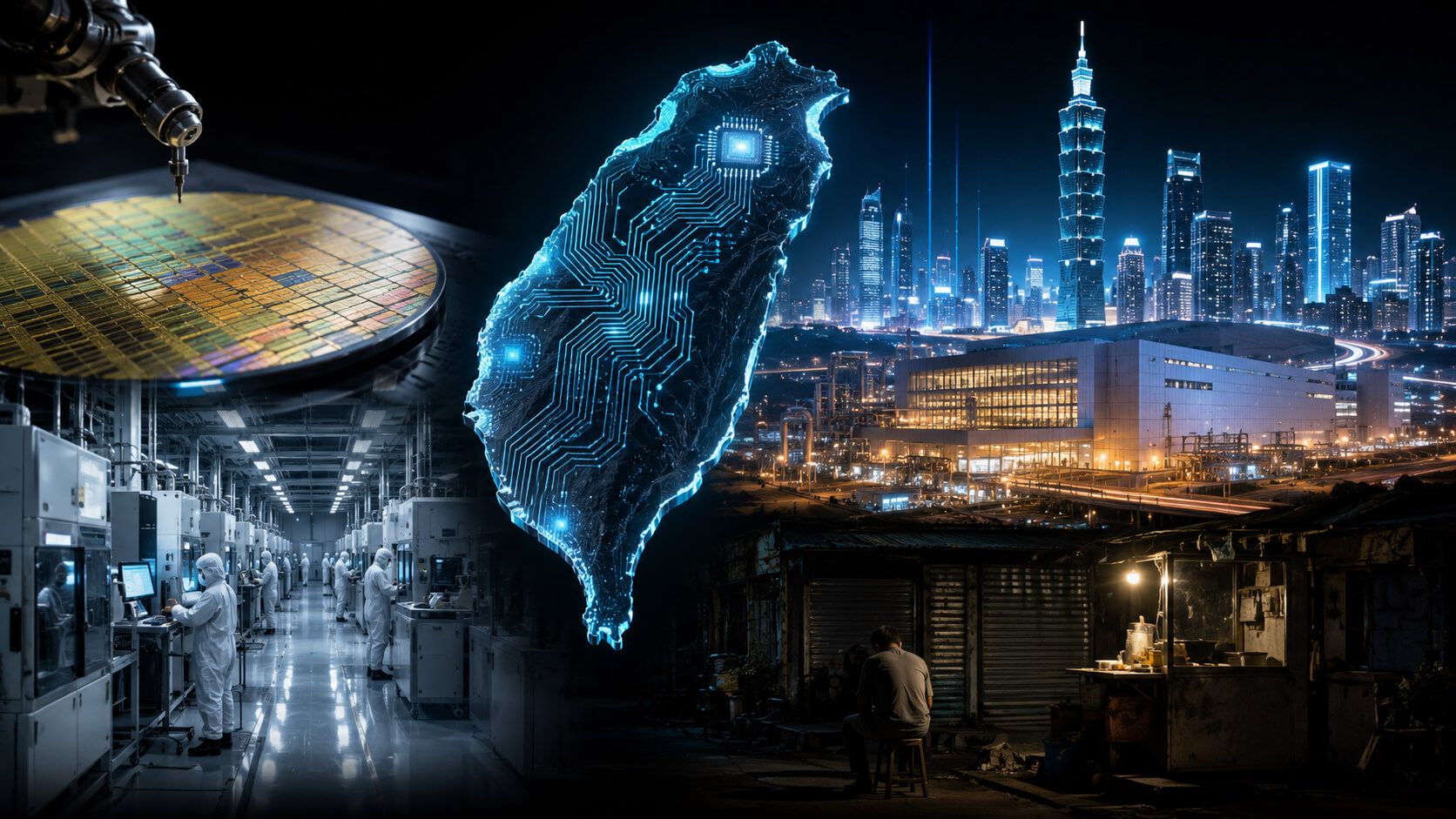
Taiwan’s economy is experiencing a powerful surge as global demand for artificial intelligence continues to reshape the semiconductor industry. But while the island’s chipmakers and tech workers are riding the AI wave, many people outside the technology sector say the benefits are not reaching them.
The rapid growth highlights Taiwan’s increasingly central role in the global AI supply chain. As companies race to build and train advanced AI systems, demand for high-performance semiconductors has exploded. Taiwan, home to some of the world’s most important chip manufacturing capacity, has become one of the biggest winners of the AI boom.
According to Al Jazeera, Taiwan’s economy grew 8.63% in 2025 and expanded by 13.69% in the first quarter of 2026. Exports also surged, rising 34.9% last year to $640.7 billion, with technology-related goods and services making up more than two-thirds of the total.
Taiwan’s AI Economy Is Being Powered by Semiconductors
Taiwan’s semiconductor industry has become a critical foundation for the AI era. The island produces about 90% of the most advanced chips used in leading AI systems, including models such as ChatGPT and Claude. Much of this production is led by Taiwan Semiconductor Manufacturing Company, better known as TSMC.
TSMC’s importance to Taiwan’s economy is enormous. Al Jazeera reported that semiconductors account for more than 20% of Taiwan’s GDP, while TSMC alone represents more than 40% of the island’s stock market value.
This has helped turn Taiwan into a major beneficiary of the global AI race. Nvidia, Apple and other technology giants depend heavily on advanced chips, making Taiwan a key player in the infrastructure behind artificial intelligence.
A Growing Gap Between Tech and Non-Tech Workers
Despite the impressive numbers, Taiwan’s AI-driven growth is not being felt equally across society.
Economists and workers quoted by Al Jazeera warned that the country is developing what Taiwan’s central bank governor has described as a “K-shaped economy”. In this kind of economy, some sectors rise quickly while others stagnate.
The semiconductor sector is highly valuable, but it does not employ most Taiwanese workers. Al Jazeera cited data showing that the semiconductor industry employs around 300,000 people out of a workforce of about 11 million. The wider electronics and IT manufacturing sector employs roughly one million, while around seven million people work in services.
That means the industries driving Taiwan’s headline economic growth represent only a fraction of total employment.
Wages Are Rising, But Unevenly
Taiwan has seen wage growth return after years of stagnation, but the gains remain uneven. Real average wages grew 1.4% in 2025, while median wages rose 1.35%, according to figures cited by Al Jazeera from Taiwan’s Directorate-General of Budget, Accounting and Statistics.
However, the gap between average and median earnings suggests that high salaries in the tech sector are pulling national figures upward. Al Jazeera reported that 70% of Taiwanese workers earned less than the average wage, partly because tech-sector pay is almost double the national average.
For many office workers and service-sector employees, the AI boom has not translated into a significantly easier life. Rising housing prices and living costs remain major concerns.
Stock Market Gains Have Helped Some Households
Taiwan’s stock market has also benefited from the AI boom. According to Al Jazeera, the Taiwan Stock Exchange more than doubled in value between 2019 and 2025, reaching $2.2 trillion.
More ordinary investors have entered the market after regulatory changes made it easier to buy individual stocks. By January 2026, the number of trading accounts had reached 13.77 million, equivalent to about 60% of Taiwan’s population.
But stock ownership does not solve the broader inequality problem. People without extra income to invest may feel increasingly left behind as asset prices rise.
AI Growth Is Creating a Dual Economy
Taiwan’s AI-powered expansion shows both the promise and the risks of depending heavily on one high-growth sector.
On one hand, the island has become essential to the global AI ecosystem. Its semiconductor industry gives it economic strength and strategic importance. On the other hand, reliance on chips and AI-related exports may widen the gap between those connected to the tech economy and those outside it.
The challenge for Taiwan now is turning AI-driven growth into broader prosperity. Without policies that support wages, housing affordability, small businesses and non-tech industries, the AI boom could deepen economic divisions even as national growth figures remain strong.
Why It Matters
Taiwan’s experience offers a warning for other economies hoping to benefit from artificial intelligence. AI can generate enormous wealth, but that wealth may concentrate in a small number of companies, sectors and asset holders.
The Taiwan AI chip boom is proving that artificial intelligence is not just a technology story. It is also an economic inequality story — and one that may become more important as AI reshapes global markets.
For more Breaking AI news visit: https://breakingai.news
