

Close Menu
    What's Hot
    Technology & Innovation

    Claude’s Agentic Work Reshapes Anthropic Economic Index

    By Art RyanJune 28, 20260

    Anthropic is changing how it measures the economic impact of Claude as artificial intelligence moves…

    Google Demand Gen Campaigns Get Gemini AI Guidance to Improve Ad Performance

    June 28, 2026

    Tech Equity Sales Renew AI Debt Binge Worries as AI Infrastructure Spending Accelerates

    June 28, 2026

    Global AI Show Riyadh 2026 Opens in 2 Days as Saudi Arabia Prepares for Major AI Conference

    June 27, 2026
    Facebook X (Twitter) Instagram
    Facebook X (Twitter) Instagram
    Breaking AI News
    Sunday, June 28
    • Home
    • Events
    • Videos
      • Machine Can Think Summit 2026
      • Step Dubai Conference 2026
    • Technology & Innovation

      Claude’s Agentic Work Reshapes Anthropic Economic Index

      June 28, 2026

      Google Demand Gen Campaigns Get Gemini AI Guidance to Improve Ad Performance

      June 28, 2026

      Tech Equity Sales Renew AI Debt Binge Worries as AI Infrastructure Spending Accelerates

      June 28, 2026

      Global AI Show Riyadh 2026 Opens in 2 Days as Saudi Arabia Prepares for Major AI Conference

      June 27, 2026

      NVIDIA Supercomputers Now Power Over 400 of the World’s 500 Fastest Systems

      June 27, 2026
    • Business & Marketing

      Google Demand Gen Campaigns Get Gemini AI Guidance to Improve Ad Performance

      June 28, 2026

      Tech Equity Sales Renew AI Debt Binge Worries as AI Infrastructure Spending Accelerates

      June 28, 2026

      UAE Investors Lead the World in AI Adoption, HSBC Survey Finds

      June 26, 2026

      Amazon Deepens India AI Push With Additional $13 Billion Cloud Investment

      June 26, 2026

      TikTok launches agentic AI advertising tools at Cannes Lions 2026

      June 24, 2026
    • Industry Applications

      NVIDIA Supercomputers Now Power Over 400 of the World’s 500 Fastest Systems

      June 27, 2026

      NVIDIA Vera CPU to Power Agentic Scientific AI at Los Alamos

      June 27, 2026

      UAE Education Sector Gets AI Boost with NOVA Initiative

      June 26, 2026

      Linux Foundation Launches Akrites to Defend Open Source From AI-Enabled Cyber Threats

      June 26, 2026

      GEMS and Oracle to Train 11,000 Students in AI and Cloud Skills

      June 25, 2026
    • Trends & Insights

      Claude’s Agentic Work Reshapes Anthropic Economic Index

      June 28, 2026

      Tech Equity Sales Renew AI Debt Binge Worries as AI Infrastructure Spending Accelerates

      June 28, 2026

      UAE Investors Lead the World in AI Adoption, HSBC Survey Finds

      June 26, 2026

      Google Says Generative AI Is Creating a New Language for Marketing and Creativity at Cannes Lions 2026

      June 24, 2026

      OpenAI Reveals Future Ad Plans as ChatGPT Moves Toward the Intelligence Economy

      June 24, 2026
    • AI in Travel

      Global AI Show Riyadh 2026 Opens in 2 Days as Saudi Arabia Prepares for Major AI Conference

      June 27, 2026

      Agoda AI Travel Features Bring Real-Time Updates and Smarter Trip Planning

      June 26, 2026

      AI Travel Agents Could Disrupt Brand Loyalty as Travelers Embrace Smarter Booking Decisions

      June 26, 2026

      Jamaica Tourism 3.0 Uses AI to Transform Visitor Economy Into National Development Platform

      June 26, 2026

      Southwest Airlines Teams Up with AWS to Speed Up AI and Cloud Modernization

      June 21, 2026
    Breaking AI News
    Home » Marine Biological Laboratory Explores Human Memory With AI and Virtual Reality
    Technology & Innovation

    Marine Biological Laboratory Explores Human Memory With AI and Virtual Reality

    Art RyanBy Art RyanDecember 28, 2025No Comments5 Mins Read
    Facebook Twitter Pinterest LinkedIn Tumblr Email
    Share
    Facebook Twitter LinkedIn Pinterest Email

    The works of Plato state that when humans have an experience, some level of change occurs in their brain, which is powered by memory — specifically long-term memory.

    This change is what Andre Fenton, professor of neural science at New York University, and Abhishek Kumar, assistant professor of cell and regenerative biology at the University of Wisconsin–Madison, are studying at the Marine Biological Laboratory (MBL) in Woods Hole, Massachusetts.

    “My life’s work is to understand how minds operate, and especially to understand memory — not merely as a trace of the past in the brain but as an estimate of the future that the brain is afforded,” Fenton said.

    The researchers have upleveled their project by harnessing NVIDIA RTX GPUs and HP Z Workstations to visualize massive datasets and by integrating custom AI tools and syGlass, a virtual-reality (VR) platform for scientific exploration.

    This project is additionally supported by grants from the National Institute of Mental Health and the Chan Zuckerberg Initiative.

    A Neural Forest Uncovered

    Memory is the job of the brain’s hippocampus. This C-shaped structure, resembling a seahorse, is the main focus of the MBL research group.

    Fenton describes the cells within the hippocampus as a forest, where billions of neurons look like tiny tree trunks and the lines coming off the trunks look like leaves.
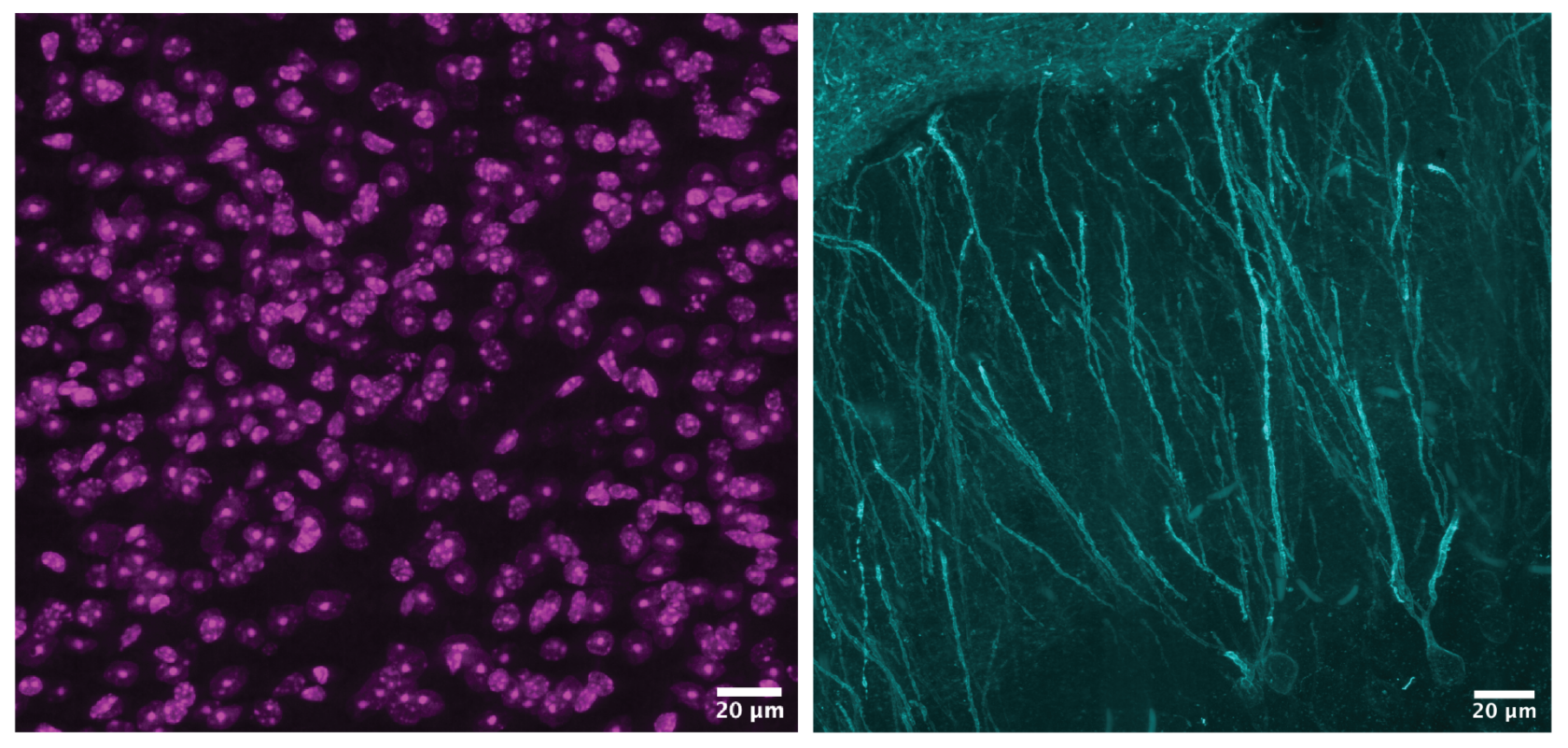
    Two projection images of a neuronal cell nuclei (left) and dendrites (right) or branched extensions of a nerve cell.
    Projection image of neuronal cell nuclei (left) and dendrites (right) or branched extensions of a nerve cell. Images were acquired by Matthew Parent and Daryl Watkins.

    The team is studying a small portion of these “leaves” — representing protein markers: an incredibly tedious task due to their length, at about a micrometer each. A researcher must search through the forest of brain cells to find the correct protein markers, which make up only about 1% of all protein markers in the hippocampus.

    The researchers were looking to ease the process of studying these proteins and what their varying structures may reveal about memory encoding.

    Collecting and analyzing enough 3D volumetric data on protein markers was a bottleneck within the project until NVIDIA and HP technologies were introduced into the workflow.

    “This is a massive computational challenge, and the HP and NVIDIA technologies have enabled us to do the first step: capture, check and store the 3D image data,” Fenton said.

    Using these technologies, the MBL researchers captured 10 terabytes of volumetric data and then performed human visual-quality inspections.

    Understanding Memory Could Prevent Neurological Diseases

    The team’s ultimate goal of discovering the function of memory at a molecular level can boost research into the root causes of brain diseases tied to neurocognition, such as Alzheimer’s and dementia.

    “People don’t normally think of memory as part of their mental health, but almost all mental dysfunction depends on what your brain stores — the beliefs, the anticipations, the anxieties that you have and the things that you expect,” said Fenton. “These are all different aspects of what happens when you have a memory, so almost all neuropsychiatric illnesses and manipulation depend on this understanding.”

    As a step toward solving these large-scale problems, the researchers are looking at how memory is affected when proteins go to incorrect locations in the hippocampus.

    The team is also examining the correlation between the structure and function of brain cells through high-resolution 3D images curated and stored using syGlass on the HP Z high performance workstation powered and supported with multiple NVIDIA RTX GPUs.

    “If we can understand how something is built, then if there’s a problem, we can dissect that and get to the bottom of it,” said Kumar. “That’s what we’re trying to do: understand how we retain memory, so if a problem arises, we know how to fix it.”

    Enabling Virtual Reality and Student Exploration

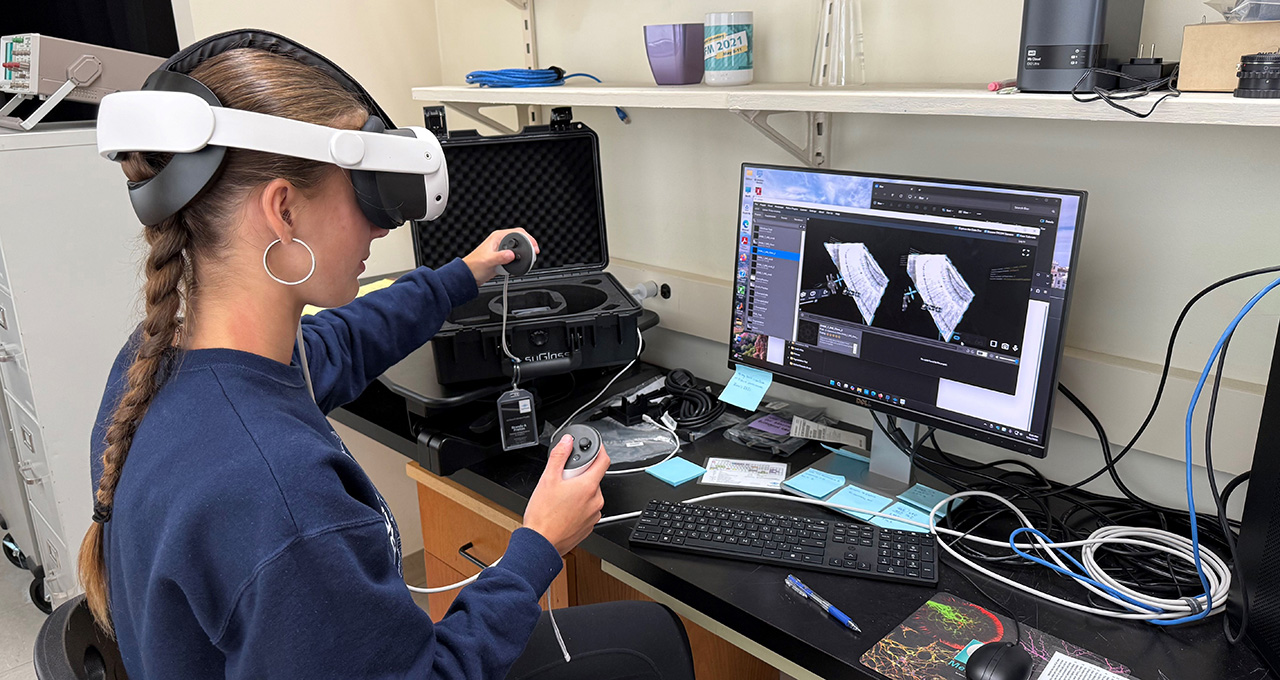
    The use of syGlass on the HP Z6 desktop workstation, running on NVIDIA RTX GPUs, turned the researchers’ endeavor from a time-consuming operation into an interactive scientific exploration — ideal for high-school-student engagement.

    “The HP-NVDIA-syGlass system lets us innovate by engaging three high-school interns,” said Kumar. “They had an abstract interest in our science, and we recognized that the syGlass virtual experience might enthrall them. We were right.”

    The researchers brought these three curious students into their lab this summer to analyze the memory proteins using the VR headsets, which allowed for 3D visuals of the data.

    Their task was to find the specific proteins that were memory-related and label them as such. While this may sound like a simple task, the interns had to sift through a sea of billions of neurons to find only a few thousand protein markers that were relevant to the research.
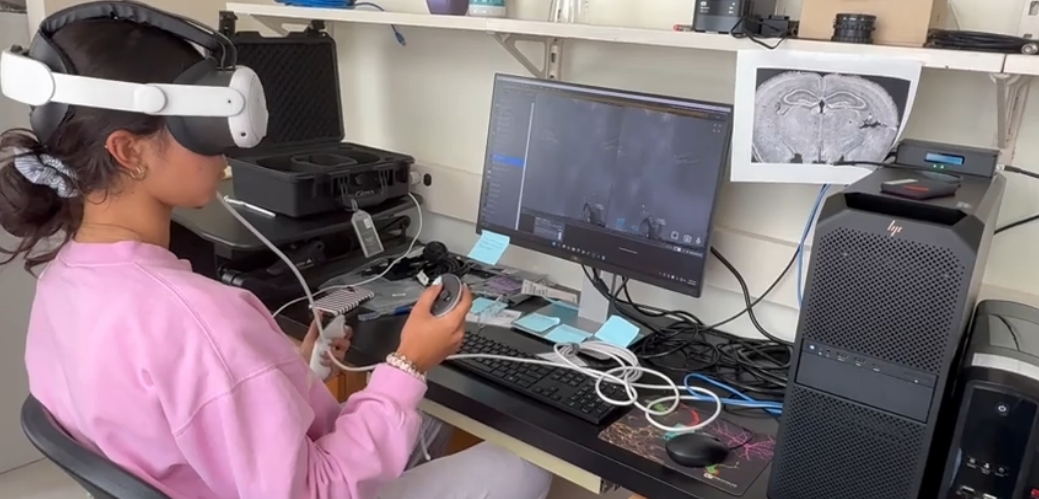
    An image of a high school student intern using the syGlass VR headset in the MBL lab to identify protein markers.
    High school intern using the syGlass VR headset to identify protein markers. Image taken by Andre Fenton.

    Due to the success of this pilot program, the team is now looking to expand high-school research opportunities for the project.

    “Why leave it at three students?” said Fenton. “Next year, it could be 10 at multiple locations helping us learn about brains while they learn about brains.”

    Learn more about NVIDIA-accelerated academic research.

    Share. Facebook Twitter Pinterest LinkedIn Tumblr Email
    Art Ryan

    Related Posts

    Claude’s Agentic Work Reshapes Anthropic Economic Index

    June 28, 2026

    Google Demand Gen Campaigns Get Gemini AI Guidance to Improve Ad Performance

    June 28, 2026

    Tech Equity Sales Renew AI Debt Binge Worries as AI Infrastructure Spending Accelerates

    June 28, 2026

    Comments are closed.

    Latest News

    Claude’s Agentic Work Reshapes Anthropic Economic Index

    June 28, 2026

    Google Demand Gen Campaigns Get Gemini AI Guidance to Improve Ad Performance

    June 28, 2026

    Tech Equity Sales Renew AI Debt Binge Worries as AI Infrastructure Spending Accelerates

    June 28, 2026

    Global AI Show Riyadh 2026 Opens in 2 Days as Saudi Arabia Prepares for Major AI Conference

    June 27, 2026
    Facebook X (Twitter) Pinterest Vimeo WhatsApp TikTok Instagram LinkedIn YouTube Spotify Reddit Snapchat Threads

    AI University

    • Global Universities
    • Universities in Africa
    • Universities in Asia
    • Universities in Europe
    • Universities in Latin America
    • Universities in Middle East
    • Universities in North America
    • Universities in Oceania

    AI Tools & Apps Directory

    • AI Productivity Tools
    • AI Coding Tools
    • AI Voice Tools
    • AI Video Tools
    • AI Image Generators
    • AI Writing Tools

    Info

    • Home
    • About Us
    • AI Organizations & Associations
    • Contact Us
    • Cookie Policy
    • Copyright Policy
    • Disclaimer
    • Editorial Policy
    • Terms and Conditions

    Subscribe to Updates

    Get the latest creative news from FooBar about art, design and business.

    © 2026 Breaking AI News.
    • Privacy Policy

    Type above and press Enter to search. Press Esc to cancel.

    Sign Up

    Want to stay ahead In Artificial Intelligence?

     Sign up now and get exclusive breaking AI news and special updates—FREE!