


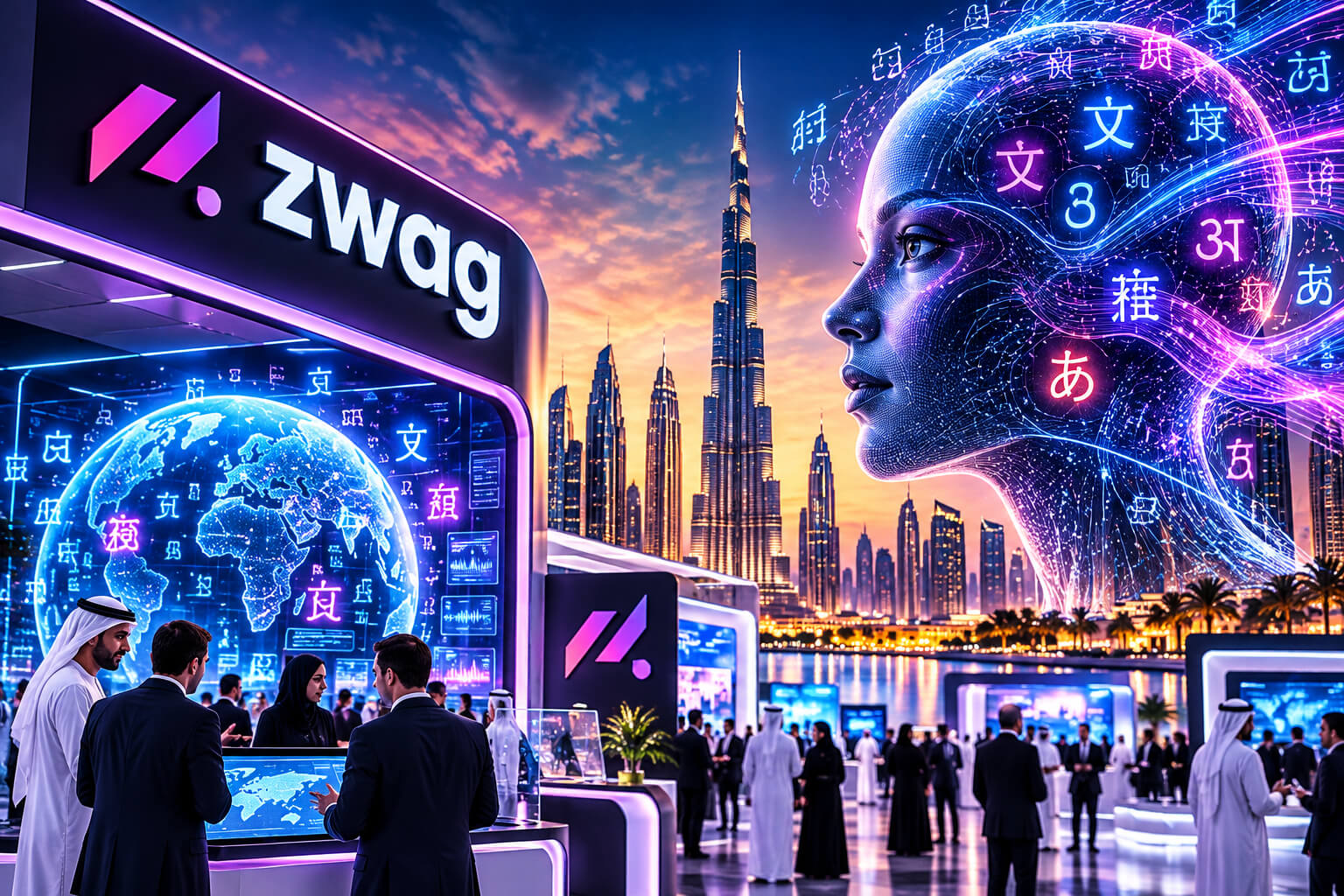
Dubai-based artificial intelligence company ZWAG AI has announced the launch of its Center of Excellence for Linguistic Sovereignty (CoE-LS) at Dubai AI Festival 2026, introducing an initiative focused on improving how artificial intelligence understands and processes languages across different cultures.
The announcement highlights a growing challenge in AI development. While modern language models can generate fluent responses in numerous languages, they do not always preserve grammatical accuracy, cultural meaning or linguistic structure.
ZWAG AI wants to address that problem by developing technology that allows AI systems to adapt more accurately to the languages people already speak, rather than expecting communities to adjust their language to accommodate technology.
The initiative brings together linguistic research, artificial intelligence and international collaboration, with the goal of making multilingual AI systems more reliable and culturally aware.
ZWAG AI Addresses Gaps in Multilingual Artificial Intelligence
Artificial intelligence has made significant progress in translation, automated communication and multilingual content generation. However, producing a sentence that sounds natural does not necessarily mean an AI system has correctly interpreted its grammar or cultural meaning.
Languages such as Arabic, Tamil, Thai and Swahili contain complex grammatical structures, regional expressions and cultural distinctions that AI systems can struggle to reproduce accurately. Even small mistakes may change the intended meaning of a message, particularly in education, government communication and professional translation.
ZWAG AI’s Center of Excellence for Linguistic Sovereignty aims to address these limitations by supporting the development of detailed linguistic profiles that reflect the grammatical and structural characteristics of individual languages.
The initiative focuses on strengthening language representation in artificial intelligence while giving linguistic communities a more active role in shaping how their languages appear in digital systems.
Mātṛ AI Platform Supports More Than 2,400 Languages
At the center of ZWAG AI’s initiative is Mātṛ, a linguistic intelligence platform designed to improve the accuracy of content generated by large language models.
Unlike conventional approaches that require developers to retrain AI models, Mātṛ operates as an additional correction layer. The technology evaluates AI-generated language, identifies potential grammatical or structural inaccuracies and helps produce outputs that better align with established linguistic rules.
According to ZWAG AI, the platform’s Translation Studio public beta supports more than 2,400 languages, demonstrating the company’s ambition to expand multilingual AI capabilities beyond the languages most commonly supported by major technology platforms.
The technology could become particularly useful for organizations operating across international markets, where accurate communication depends on more than translating individual words.
ZWAG AI has also highlighted research involving the International Institute of Information Technology Hyderabad (IIIT Hyderabad), reflecting its interest in combining academic linguistic expertise with practical AI development.
Linguistic Sovereignty Gains Importance in Responsible AI Development
Linguistic sovereignty is becoming an increasingly important issue as artificial intelligence enters education, public services, business operations and everyday communication.
The concept focuses on the ability of communities to preserve their languages and influence how those languages are represented in digital technologies. For AI developers, this means recognizing that linguistic accuracy involves grammar, cultural context and established language conventions, not simply generating text that appears understandable.
ZWAG AI Co-founder and CEO Priya M. Nair has emphasized the importance of developing artificial intelligence that respects linguistic identity instead of forcing languages into structures that are easier for machines to process.
The company’s approach reflects a broader concern about the uneven representation of languages in AI training datasets. Many widely spoken languages receive substantial technological attention, while others remain underrepresented or lack sufficient digital resources.
By focusing on linguistic sovereignty, ZWAG AI hopes to contribute to AI systems that better reflect the diversity of human communication.
Center of Excellence Encourages Global Linguistic Collaboration
The newly launched Center of Excellence for Linguistic Sovereignty is designed to encourage cooperation among universities, government institutions, professional linguists, cultural organizations and native-language communities.
Through this collaborative approach, ZWAG AI intends to develop linguistic profiles that capture the grammatical structures, patterns and characteristics of different languages. These profiles can then support improvements in how AI systems interpret and generate multilingual content.
The company is also seeking partnerships to establish regional Linguistics Excellence Centres, allowing local language experts to contribute their knowledge to the development of AI technologies.
Native speakers and linguistic specialists are expected to play an important role in refining the information used by the Mātṛ platform. Their involvement could help address errors that automated systems may overlook, particularly when dealing with culturally specific expressions or complex grammatical conventions.
For ZWAG AI, collaboration is a central part of the initiative. Language expertise cannot come exclusively from software developers, especially when the goal is to preserve the distinct characteristics of thousands of languages.
Dubai AI Festival 2026 Highlights International AI Innovation
ZWAG AI introduced its linguistic sovereignty initiative during Dubai AI Festival 2026, held on October 26–27 at the Dubai World Trade Centre.
The event brings together technology companies, investors, policymakers, researchers and industry leaders to explore emerging developments in artificial intelligence and their potential applications across different sectors.
Organized by Dubai AI Campus at the Dubai International Financial Centre, the festival provides a platform for discussions on responsible AI development, digital transformation, investment opportunities and international technology collaboration.
For ZWAG AI, the event offers an opportunity to introduce its linguistic technology to organizations interested in developing AI systems that operate across multiple languages and cultural environments.
The announcement also reflects Dubai’s growing role as a regional center for artificial intelligence research, investment and technology development.
ZWAG AI Strengthens Its Position in Language-Aware AI Technology
ZWAG AI operates from DIFC Innovation One at Dubai AI Campus, where it focuses on developing technology intended to improve the reliability of multilingual artificial intelligence.
The company’s Mātṛ platform represents a central part of that strategy, providing a language-focused correction system designed to work alongside existing AI models.
With the launch of the Center of Excellence for Linguistic Sovereignty, ZWAG AI is expanding its work beyond software development to include linguistic research, institutional partnerships and contributions from language communities.
The initiative could create opportunities for governments, educational institutions and international businesses seeking more dependable multilingual AI solutions.
However, the platform’s long-term effectiveness will depend on continued linguistic research, independent performance evaluation and successful implementation across languages with different levels of digital representation.
A More Inclusive Future for Multilingual Artificial Intelligence
ZWAG AI’s latest initiative highlights a challenge that will become increasingly difficult for the artificial intelligence industry to ignore.
AI systems may already communicate in thousands of languages, but meaningful linguistic understanding requires greater attention to grammatical accuracy, cultural identity and the knowledge embedded within individual languages.
The Center of Excellence for Linguistic Sovereignty represents an effort to close that gap by connecting advanced AI technology with linguistic expertise from communities around the world.
Whether the initiative can deliver consistent improvements across its supported languages remains to be seen. Its broader message, however, is clear: the future of multilingual artificial intelligence should involve technology adapting to human languages, not human languages adapting to technology.
