


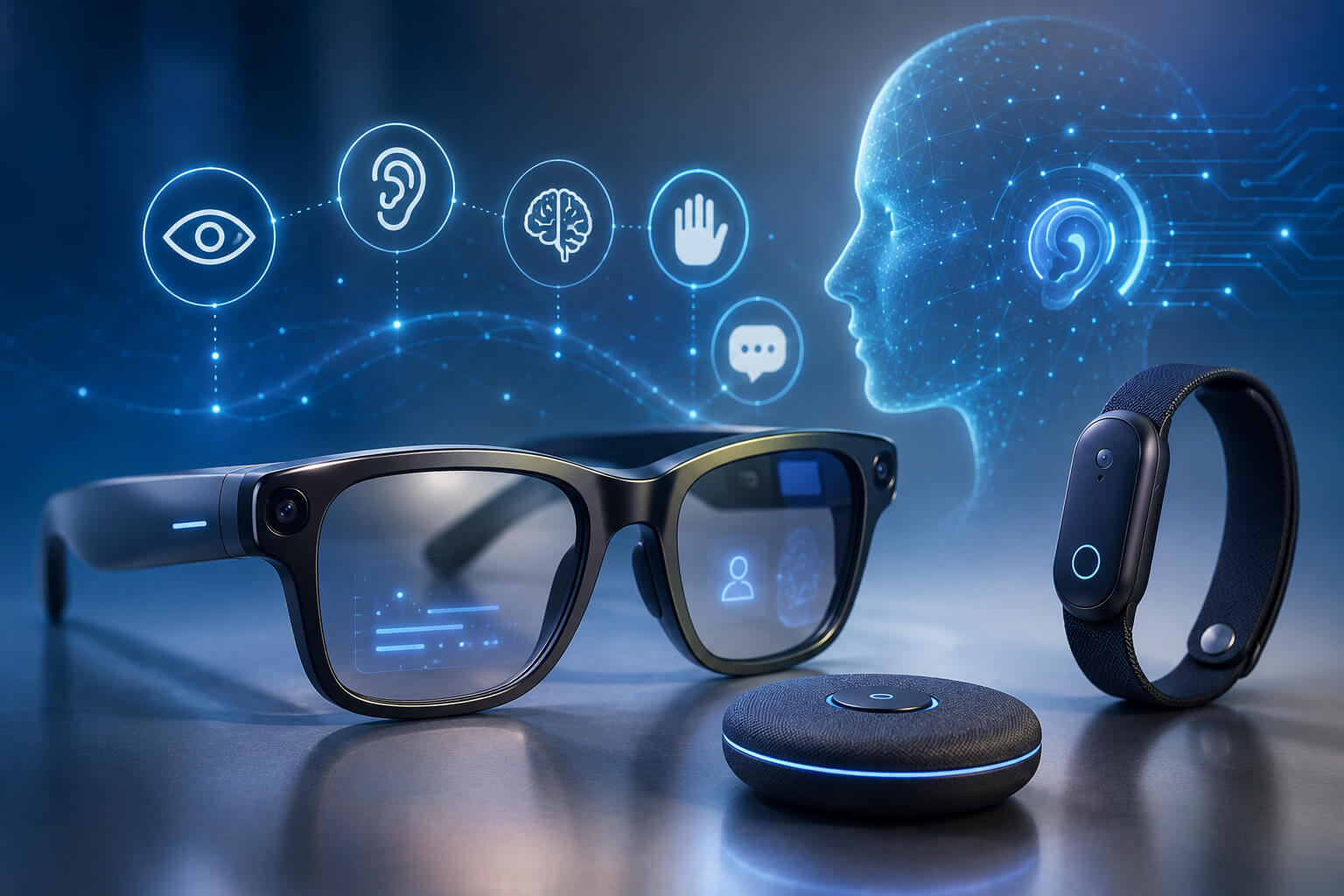
Today, AI-driven devices and gadgets are integrating into our daily routines. And Meta is making significant progress in deploying assistive AI technology into the everyday environments of users with wearable devices.
Meta Ray-Ban smart glasses and wristbands represent an impressive ecosystem of devices aimed at providing users with real-life assistance and freedom.
How Do Meta’s Wearable Devices Help People with Disabilities?
Meta’s wearable technology includes such solutions as Ray-Ban smart glasses and Meta Ray-Ban Displays that can provide users with assistive functions.
With Meta AI glasses, users can:
- Make hands-free calls and send messages
- Obtain live speech translations and captions
- Get a description of what’s happening around you in real-time
- Read text aloud
- Take photos and videos via voice commands
- Contact volunteers via integration with Be My Eyes platform
According to Meta, such devices can help visually-impaired users perform their everyday activities independently.
In addition, Meta collaborated with the Blinded Veterans Association to develop guides that would help people with visual impairments learn how to use AI glasses.
Neuromotor Wristband: The Next Level of Assistance?
Among other projects, Meta developed a neuromotor wristband with surface electromyography (sEMG) sensors. This technology can detect and interpret electric signals sent by your brain to the muscles.
This means the wearable can recognize gestures based on slight muscle movements.
Such technology is believed to help people with:
- ALS (amyotrophic lateral sclerosis)
- Troubles recovering from strokes
- Difficulty using hands
- Weakened muscles
- Paralysis
Meta experts claim that this technology can help users in controlling various devices using intention alone.
If implemented, it can bring about more natural interaction between a person and his device of choice, from computer to smartphone and even smart glasses.
Assistive Technology Is Getting Smarter with Every Day
In addition, Meta continues to add new functions to its wearable technology ecosystem.
According to recent rumors, the next-gen Meta smart glasses are expected to include functions such as:
- Object recognition
- Helping users with memory impairment
- Facial recognition
- Live navigation
- Context-sensitive help
- Predictive reminders
Moreover, Meta will soon introduce AI assistants in future wearables, as part of its overall ambition to build ambient computing devices.
According to Meta CEO Mark Zuckerberg, AI glasses will become one of the main ways to interact with AI in the future.
Accessibility as a Driving Force of AI Innovation
It’s worth noting that AI wearable devices are also drawing attention to the issue of accessibility of AI technology itself.
Some experts suggest that accessibility of AI systems should not be viewed as a secondary characteristic but as one of the key goals of designing any technology.
The fact is, accessibility cannot be ensured in post-production – if it is not included into the design, it might cause exclusion of many disabled users from the benefits of AI. However, there are countless possibilities in assistive AI.
Thus, Meta’s focus on accessibility can prove helpful to thousands of people worldwide.
Meta’s Ambitions and Future Developments
Meta continues working on its AR technology and AI-powered wearables in 2026. The company reportedly increases production of smart glasses, while further developing AI-powered wearables.
In addition, Meta is expected to demonstrate more innovative technology during its annual event Meta Connect 2026, including smart glasses, neural interfaces and AI computing experiences.
Seemingly, Meta is committed to incorporating accessibility into its technology in order to help users with disabilities obtain more freedom and independence as AI innovation continues expanding across wearable devices.
For more Breaking AI news visit: https://breakingai.news
