


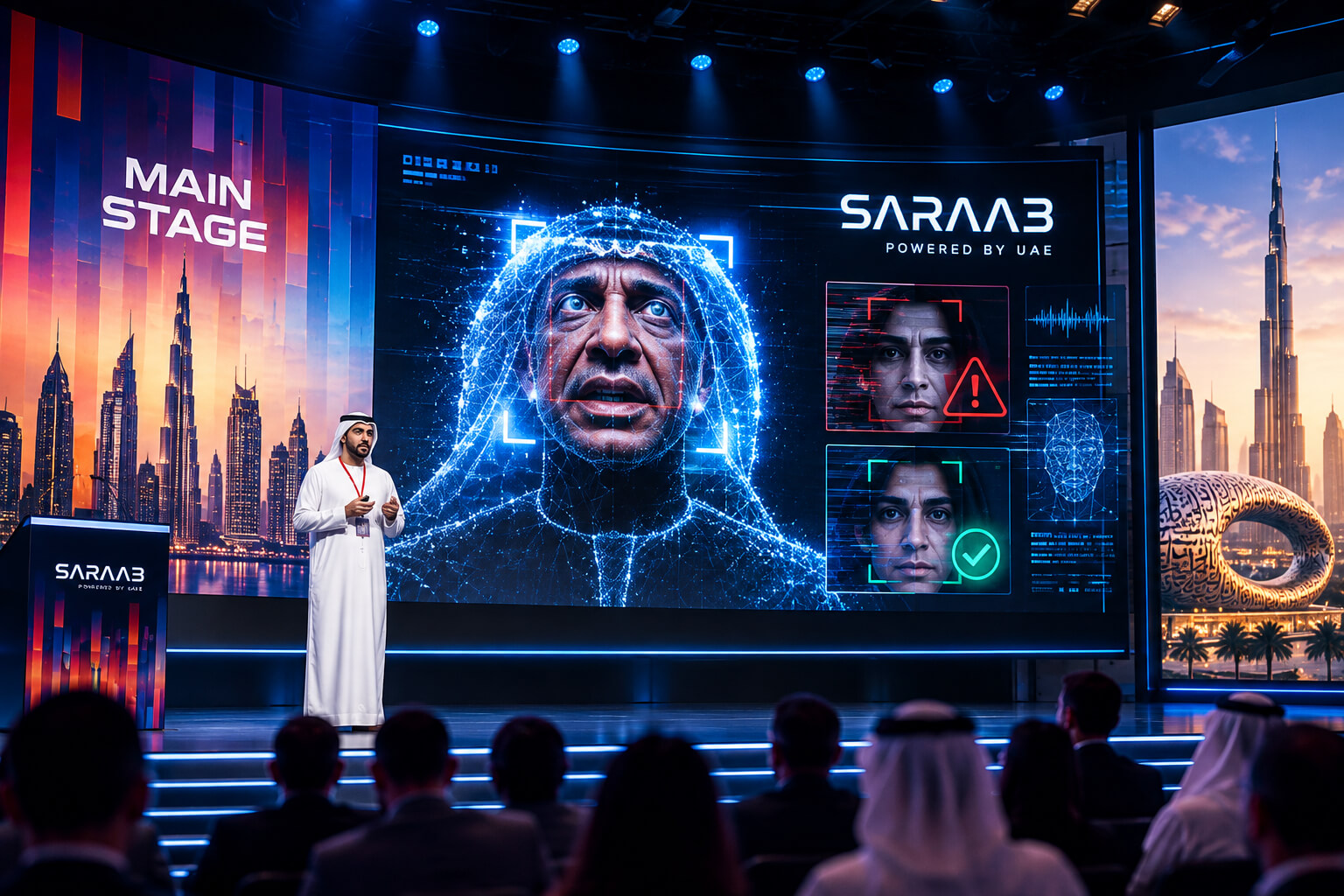
Dubai has introduced a new artificial intelligence model designed to detect deepfake videos. It adds another locally developed tool to the growing effort to identify manipulated digital content.
The Dubai Electronic Security Centre, or DESC, unveiled the system, called SARAAB, during GISEC Global 2026 at Dubai Exhibition Centre in Expo City Dubai. Developed by an Emirati team, the model analyses video content for signs that faces or visual elements may have been artificially generated or manipulated.
DESC says SARAAB is the first AI model of its kind developed by a government entity in the Arab region. The centre also plans to make the technology open source. This would give researchers, developers and cybersecurity professionals access to the model for testing and further development.
SARAAB Uses AI to Detect Signs of Deepfake Manipulation
Deepfake detection has become much harder as generative AI systems produce increasingly realistic video. Obvious visual glitches are disappearing. As a result, detection tools must look deeper at patterns that may not be noticeable to the human eye.
SARAAB analyses facial information across video footage and looks for traces of synthetic manipulation. Hassan Majid Alkhazraji, Senior Artificial Intelligence Executive at DESC, said the model can generate a heat map showing areas of a face where artificial layers may have been introduced. Instead of relying on a single frame, the system examines footage across the duration of the video. This can help identify manipulation that only appears at certain moments.
The model currently delivers a reported accuracy rate of around 91%. DESC is also preparing to make SARAAB available through Hugging Face. This would allow AI developers and cybersecurity researchers to access the model, experiment with it and potentially improve its performance.
Dubai Is Taking an Open-Source Approach to Deepfake Detection
The decision to make SARAAB open source could be one of the project’s most important elements. Deepfake technology changes quickly, and a detection system that works today may struggle against new generation methods introduced months later.
By opening the model to external researchers, DESC can allow independent testing, benchmarking and technical contributions. Developers will be able to examine how SARAAB performs against different kinds of manipulated videos. They can also identify weaknesses that may need to be addressed in future versions.
This approach could make the model more adaptable as generative AI evolves. Instead of keeping the technology limited to a closed government environment, DESC is creating a system that can potentially benefit from contributions across the wider cybersecurity and AI research community.
SARAAB was unveiled during GISEC Global 2026, while its broader public release is expected later in 2026.
Deepfakes Are Becoming a Bigger Cybersecurity Threat
Deepfakes are no longer simply an unusual side effect of generative AI. They are becoming a cybersecurity issue as synthetic video becomes easier to produce and more difficult to distinguish from genuine footage.
Manipulated videos can imitate individuals, fabricate statements or create false evidence that appears convincing at first glance. The same technology can also be used in impersonation attempts, online fraud, misinformation campaigns and other forms of digital deception.
That makes deepfake detection increasingly important for governments, businesses, media organisations and online platforms. Human visual inspection alone may no longer be enough when AI-generated content can closely imitate facial movements, voices and real-world environments.
DESC said SARAAB responds to the growing challenges that synthetic media creates for digital trust and cybersecurity. The model is intended to provide another layer of analysis when organisations need to assess whether video content may have been manipulated.
SARAAB Was Part of a Wider Cybersecurity Push at GISEC Global 2026
SARAAB was introduced alongside other cybersecurity initiatives from the Dubai Electronic Security Centre during GISEC Global 2026.
DESC also announced the Dubai Cyber Skills Framework, which establishes a common reference for cybersecurity qualifications, professional certifications, training and career development. The framework is intended to support cybersecurity professionals. It will also help employers, universities and training providers align their skills programmes with industry requirements.
Another initiative, the ISR Auditor Certification Programme, focuses on strengthening the skills of auditors and information security professionals. These experts are responsible for assessing organisations against Dubai’s Information Security Regulation.
Together, the projects show that Dubai is approaching cybersecurity from several directions. SARAAB addresses emerging threats created by generative AI. Meanwhile, the other programmes focus on workforce capabilities and stronger information security standards.
Emirati-Built AI Takes a Bigger Role in Dubai Cybersecurity
SARAAB also reflects Dubai’s wider effort to develop more artificial intelligence and cybersecurity technology locally rather than relying completely on systems developed overseas.
DESC says the model was built entirely by an Emirati team. The project adds to the centre’s previous work on locally developed cybersecurity platforms and AI-powered security tools. These are designed to strengthen Dubai’s digital infrastructure.
Local development could also give Dubai more control over how these systems evolve. Deepfake detection is especially sensitive because the technology needs constant updating as new generative models appear. Synthetic media also becomes more realistic over time.
SARAAB puts Emirati-developed AI directly into that fast-moving contest. Once the model becomes available to researchers outside DESC, its performance under wider real-world testing should become clearer.
Why SARAAB Matters for AI and Digital Trust
A reported 91% accuracy rate gives SARAAB a strong starting point. However, deepfake detection is unlikely to have a permanent technical solution. The systems used to create synthetic media continue to improve. This means detection models will also need constant retraining and development.
That makes SARAAB’s open-source strategy particularly relevant. Researchers will be able to test the model against different deepfake techniques. They can examine where it fails and potentially contribute improvements as new threats appear.
For Dubai, the project places locally developed AI into a wider global discussion around digital authenticity, cybersecurity and trust. The ability to generate convincing fake video is becoming easier. Building tools that can reliably identify it is becoming just as important.
Sources
Gulf News: Dubai launches SARAAB, open-source AI designed to detect deepfake videos
https://gulfnews.com/uae/government/dubai-launches-saraab-open-source-ai-designed-to-detect-deepfake-videos-1.500676722
Khaleej Times: Dubai to launch region’s first AI model to detect deepfake videos
https://www.khaleejtimes.com/business/tech/dubai-to-launch-regions-first-ai-model-to-detect-deepfake-videos
Dubai Media Office / Dubai Electronic Security Centre:
https://www.mediaoffice.ae/
