


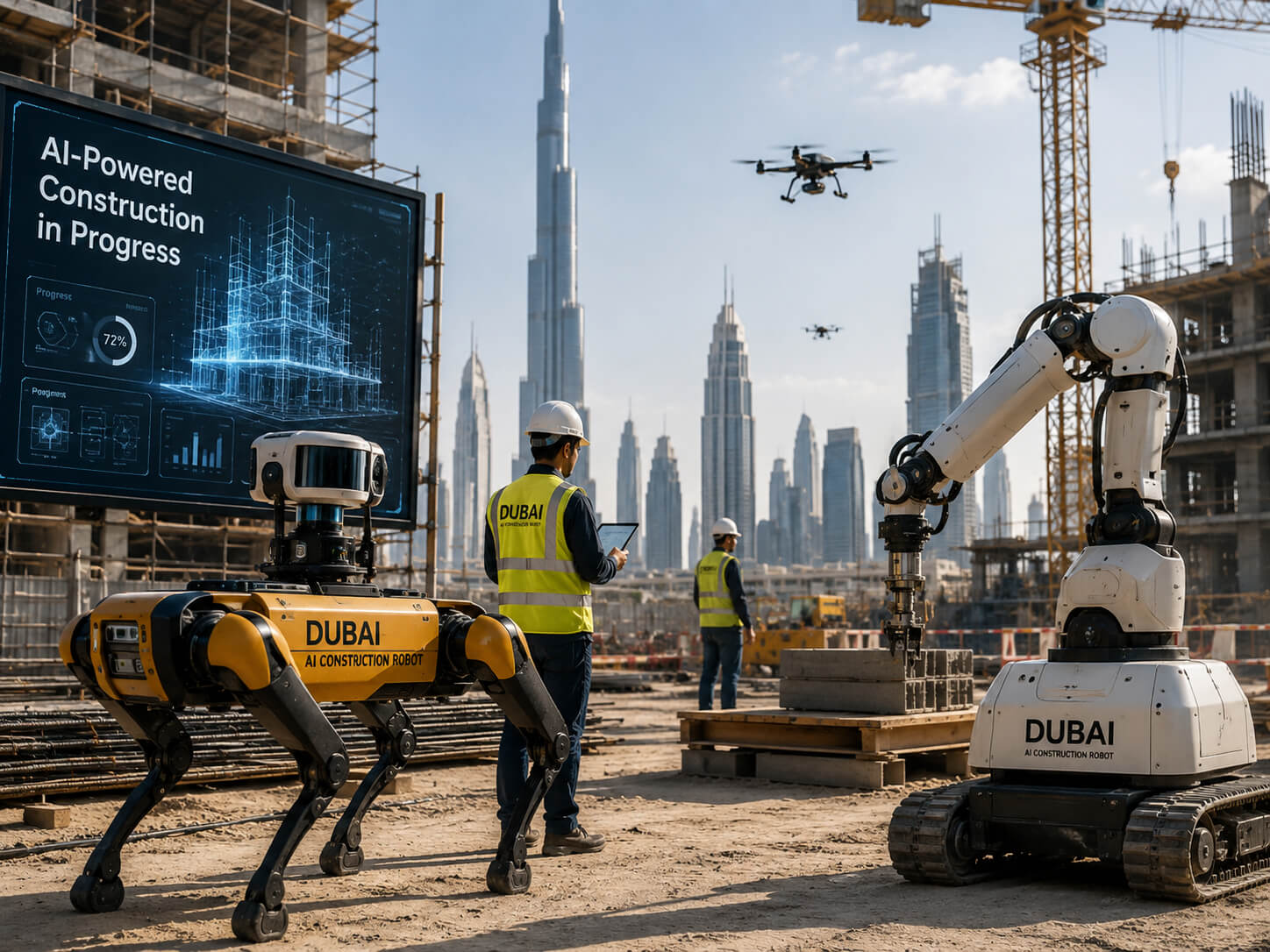
Dubai is taking another major step toward the future of construction as AI-powered robots are set to enter a live building environment at the Ghaf Woods development.
Innovo Group has partnered with FieldAI to deploy general-purpose physical AI robots to the Dubai project, marking a milestone for the region’s construction industry. As a result, the move brings robotics, artificial intelligence, and automation directly into one of the UAE’s most ambitious real estate developments.
The deployment is expected to improve safety, productivity, and operational efficiency on site. At the same time, it will give the industry a closer look at how autonomous robots can support large-scale construction work.
AI Robots Move From Labs to Live Construction Sites
For years, robotics in construction has been discussed as a future possibility. Dubai’s latest development shows that the technology is now moving beyond controlled demonstrations and into real-world building environments.
FieldAI’s technology is centered around physical AI, a form of artificial intelligence that enables machines to comprehend and function within complex physical environments. In the realm of construction, this could imply that robots could maneuver through active sites. Additionally, they could assist workers, gather data, inspect areas, and ultimately perform repetitive or hazardous tasks.
Construction sites, unlike factory floors, are always changing. Materials move, layouts shift, workers operate across multiple zones, and safety risks can change quickly. That makes construction one of the most difficult industries for robotics to enter at scale.
The Ghaf Woods deployment is important because it puts AI-powered robots into exactly this kind of challenging environment.
Why Ghaf Woods Is a Key Test Site
Ghaf Woods is one of Dubai’s major forest-living residential projects. The development is designed around sustainability, wellness, and nature-connected urban living, with thousands of homes planned across a green community.
Innovo is the main contractor for the project, which includes multiple residential buildings across key clusters. The company’s work on Ghaf Woods already places it at the center of a large and complex construction effort. Therefore, this makes the site a strong testing ground for next-generation building technology.
The project can be a model for the Middle East to adopt more advanced construction tools by introducing AI robots to this environment.
How AI Robots Can Enhance Construction Safety
Safety represents one of the biggest opportunities for AI robots in Dubai construction.
Construction sites involve high-risk activities such as moving heavy equipment, working at height, handling materials and operating in changing site conditions. Therefore, AI-driven robots could help to reduce risk by taking on tasks that are repetitive, physically demanding or potentially dangerous for human workers.
Robots can also help to provide more consistent site monitoring. With the right sensors and AI systems, autonomous machines can gather real-time data, detect hazards and provide faster insights to safety teams.
It’s not about robots replacing people. Instead, it’s about a support system that will enable teams to work more safely and more efficiently. This approach will give the opportunity for skilled workers to work on higher-value tasks.
Productivity in Dubai’s Construction Sector
Dubai’s construction sector is known for its speed, scale and ambitious design. However, as with many global construction markets, it is under pressure to deliver projects faster, more safely and with tighter cost control.
AI robots could be used to help solve these problems through better site visibility and automation of repetitive tasks. Robots that can navigate construction environments could help with progress monitoring, inspection, logistics coordination, and data collection.
This could cut delays, improve decision-making and help contractors spot problems earlier over time.
For developers and contractors, the value of AI is not only in automation. It is also in better information. A construction site that can be monitored and understood in real time gives project teams more control over timelines, resources, and safety.
Dubai’s Bigger Push Into Robotics and Construction Technology
The deployment at Ghaf Woods fits into Dubai’s wider strategy of using advanced technology to transform major industries.
The emirate has already positioned itself as a hub for artificial intelligence, smart city systems, autonomous transport, and digital infrastructure. Construction technology is now becoming part of that larger innovation agenda.
Dubai Municipality has also supported robotic construction initiatives, including projects aimed at proving how automation can be used in residential building. These efforts show that robotics is no longer just a futuristic concept for Dubai. In fact, it is becoming part of the city’s long-term construction strategy.
What This Means for the Future of Building
The arrival of AI robots at a Dubai construction site could signal the start of a wider shift in how buildings are delivered.
In the near term, robots are most likely to assist with inspection, mapping, monitoring, safety support, and repetitive tasks. As the technology matures, construction companies may look to more advanced applications. These could include movement of materials, precision installation and semi-autonomous site operations.
The biggest impact may be in the combination of robotics with other technologies such as digital twins, computer vision, predictive analytics and off-site construction.
Together these systems could make construction more automated, data-driven and efficient.
Will AI Robots Replace Construction Workers?
The rise of construction robots will naturally raise questions about jobs. However, the most realistic near-term future is not full replacement. It is collaboration between humans and machines.
Construction continues to be an industry that relies on human judgment, experience, engineering knowledge and problem-solving. Robots can assist teams by taking on dangerous, repetitive or data-heavy tasks, but trained professionals will always be needed.
As AI adoption speeds up, construction workers might also need to develop new skills. Site teams could increasingly work collaboratively with robotic systems, process AI-generated data, and utilize automation tools in their daily work.
This shift could create demand for new roles in robotics supervision, construction technology management, AI safety and digital project delivery.
Dubai May Become a Global Showcase for AI Construction
Dubai has a track record of bringing ambitious technology ideas to life in large-scale public and private sector projects. The use of AI robots at Ghaf Woods could help the city become a global showcase for physical AI in construction.
If the deployment proves successful, it could serve to encourage a greater number of developers and contractors in the UAE and across the wider Middle East to deploy robotic systems on active sites.
The construction industry has been a laggard in digital transformation compared to finance, logistics and manufacturing. But Dubai’s latest move suggests that the next wave of AI adoption may come not just via screens but on the ground, within actual construction projects.
The Bottom Line
Dubai’s Ghaf Woods project looks set to become a prime example of the future of AI-powered construction.
The partnership between Innovo Group and FieldAI aims to bring AI robots into a live construction environment. The goal is to improve safety, productivity, and operational efficiency.
For the construction industry, this is a giant leap towards a future where robots and human teams work together side by side to build faster, safer and smarter.
Dubai’s investment in artificial intelligence and advanced construction technology means the use of AI robots at Ghaf Woods could be an early sign. This could indicate how the next generation of cities will be built.
