


Dubai is looking ahead to 2040, and its vision of the future goes well beyond skyscrapers, automated transport, and futuristic architecture. The emirate wants to build a city where technology works behind the scenes, public services anticipate people’s needs, and urban infrastructure becomes more responsive to everyday life.
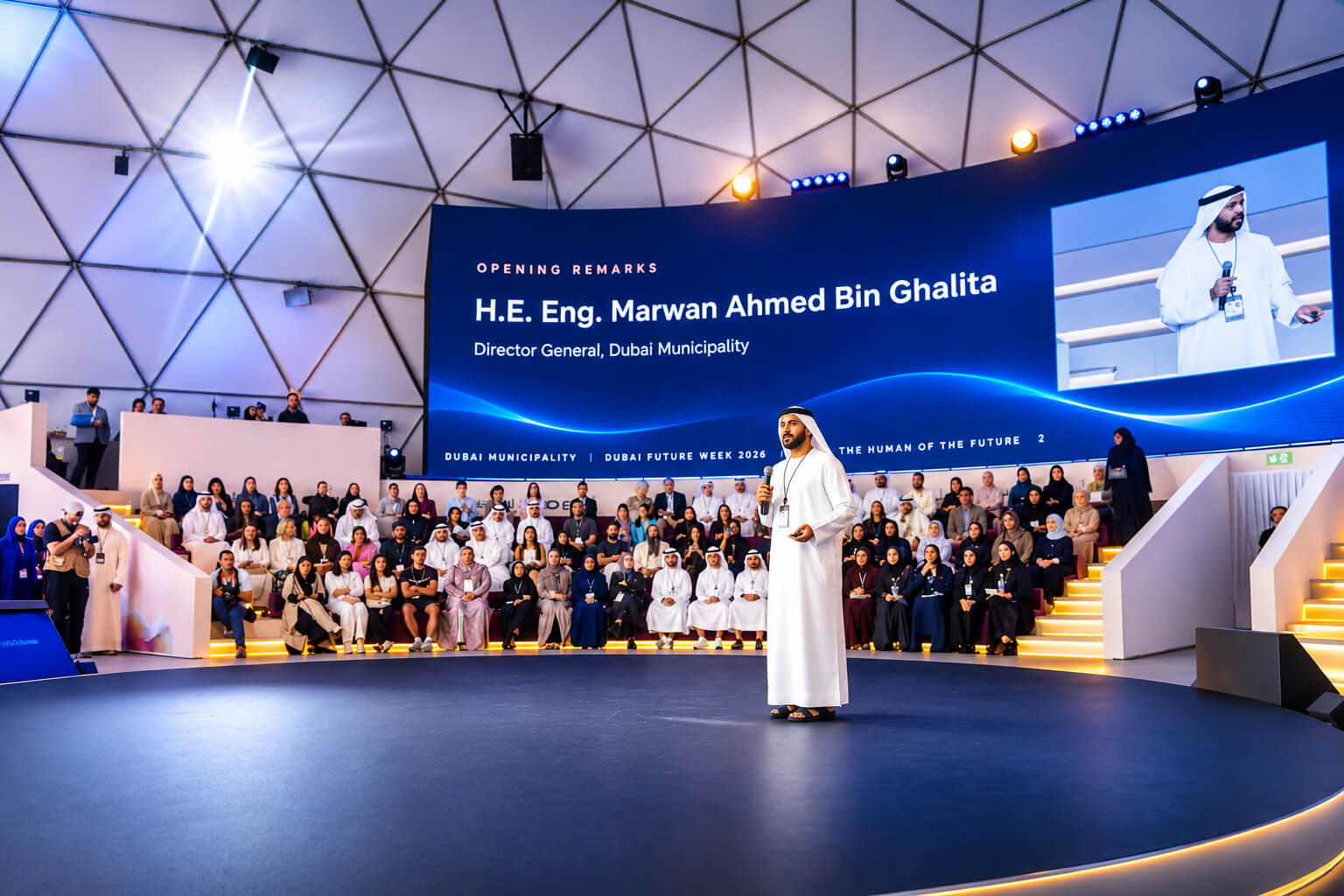
During Dubai Future Week 2026, Dubai Municipality presented an ambitious picture of what life in the city could look like over the next 14 years. The presentation explored how digital twins, intelligent infrastructure, sustainable urban planning, and advanced municipal services could reshape the way residents experience Dubai.
The vision was presented by Eng. Marwan Ahmed bin Ghalita, Director-General of Dubai Municipality, during a session titled “Dubai: The City That Never Sleeps.” Rather than focusing solely on technological breakthroughs, the discussion highlighted something more practical: creating a city that remains efficient, accessible, and comfortable for the people who call it home.
Dubai 2040 Smart City Vision Puts People at the Center
Dubai Municipality’s vision for 2040 is built around a straightforward idea: the best urban technology should improve people’s lives without making everyday activities more complicated. The municipality is exploring how intelligent systems, better infrastructure management, and responsive public services could create a more seamless experience for residents and visitors. This includes maintaining public spaces, improving municipal operations, and ensuring essential services remain available as the city grows. Much of this work already happens quietly, from maintaining water networks to monitoring infrastructure and keeping public facilities operational. By 2040, Dubai hopes to make these systems even more efficient through advanced planning and technology-supported decision-making.
Digital Twins Could Change How Dubai Plans and Operates
Digital twin technology is among the innovations highlighted in Dubai Municipality’s future vision. These virtual representations of physical environments allow planners to examine infrastructure, simulate possible changes, and better understand how different urban systems interact. In a rapidly developing city like Dubai, digital twins could help authorities assess new construction projects, analyze infrastructure performance, and identify potential challenges before they affect residents. Instead of relying entirely on traditional planning methods, urban teams could use data-driven simulations to explore different scenarios. The technology could also support long-term sustainability by helping planners understand how development decisions influence energy consumption, transportation, and public infrastructure. While the presentation offered a glimpse of these possibilities, it did not confirm that every proposed application is already operational.
Dubai Municipality Imagines a Full Day in the City of 2040
One of the highlights of the presentation was an interactive experience that imagined what a typical 24-hour period in Dubai might look like in 2040. Six young professionals from Dubai Municipality guided audiences through six scenarios illustrating how future municipal services could operate. The experience explored possibilities such as public spaces that remain accessible throughout the day and night, more efficient building processes, improved environmental management, and technology-supported public services. It also examined how waste materials could become useful resources and how residents might play a more active role in shaping their communities. These scenarios were designed to encourage discussion about the future rather than announce a fixed development schedule. What stood out was the emphasis on ordinary experiences and how technology could make them simpler, safer, and more convenient.
Intelligent Infrastructure Could Make Municipal Services More Predictive
Dubai’s future urban strategy also points toward a shift from reactive maintenance to more proactive infrastructure management. Traditionally, many city services respond when equipment fails, infrastructure deteriorates, or problems become visible. Intelligent monitoring systems and predictive analytics could change that approach by helping municipal teams identify unusual conditions earlier and plan maintenance before disruptions occur. For Dubai, such capabilities could eventually support water infrastructure, environmental monitoring, public facilities, and other essential services. Artificial intelligence may play an important role in analyzing large volumes of operational information, although the municipality’s presentation did not announce a specific new AI system. The wider opportunity lies in connecting reliable data with faster, more informed decisions that improve the city’s daily operations.
Young Professionals Help Shape Dubai’s Future Urban Experience
Dubai Municipality also placed younger generations at the center of its long-term planning discussion. Six young professionals participated in presenting the 2040 scenarios, bringing fresh perspectives to questions about urban living, technology, and public services. Their involvement reflected the municipality’s recognition that the expectations of future residents may differ significantly from those of today. The way people travel, work, access government services, and use public spaces continues to change, making long-term planning increasingly challenging. By involving younger professionals in these conversations, Dubai aims to explore ideas that reflect emerging lifestyles and changing community needs. The approach also reinforces the importance of human participation in technological development, particularly when decisions could shape how millions of people experience the city.
Dubai 2040 Urban Master Plan Provides the Bigger Picture
The municipality’s futuristic presentation connects with Dubai’s wider development ambitions under the Dubai 2040 Urban Master Plan. Launched in 2021, the plan provides a framework for managing population growth, improving infrastructure, expanding green spaces, and creating more sustainable communities. It emphasizes accessibility, efficient land use, environmental protection, and better connections between residential areas and essential services. Technologies such as digital twins and predictive analytics could complement these objectives by giving planners more detailed insights into urban development. The relationship between technology and planning is particularly important as Dubai continues to grow. A successful smart city requires more than connected buildings or advanced software. It also needs accessible public spaces, reliable transportation, efficient infrastructure, and communities designed around the people who live in them.
Dubai Future Week 2026 Brings Urban Innovation Into Focus
Dubai Future Week 2026 provided a platform for government leaders, researchers, entrepreneurs, and technology specialists to discuss how emerging innovations could influence society. Held from November 18 to 21, the event featured conversations about future industries, technological transformation, and new approaches to public services. Dubai Municipality participated as a strategic partner, using the event to introduce its long-term urban vision and encourage discussion about the future of municipal operations. Its presentation demonstrated how cities are beginning to look beyond individual technological solutions and consider how entire urban systems might evolve. For Dubai, the challenge is not simply adopting the latest innovations. It is identifying which technologies can deliver meaningful improvements in sustainability, accessibility, and quality of life.
What Dubai’s 2040 Vision Means for the Future of Smart Cities
Dubai Municipality’s 2040 vision offers a glimpse of how smart-city development could evolve over the coming years. Digital twins may help authorities understand complex infrastructure networks, predictive technologies could improve maintenance planning, and more responsive public services could make everyday life easier for residents. Yet the most important part of the vision is not any single technology. It is the idea that future cities should become more adaptable to the people living in them. Many of the concepts presented during Dubai Future Week remain forward-looking scenarios, and their eventual implementation will depend on technological progress, planning priorities, and practical requirements. Still, Dubai is making its direction clear. The city of 2040 may be defined less by how futuristic it looks and more by how smoothly it works.
Sources
1. Emirates News Agency (WAM) – Dubai Municipality Offers Glimpse Into Dubai in 2040 at Dubai Future Week — November 19, 2026. Emirates News Agency
2. Dubai Municipality – Dubai 2040 Urban Master Plan. Dubai Municipality
3. Government of Dubai Media Office – Hamdan bin Mohammed Witnesses Launch of Dubai Digital Twin Platform. mediaoffice.ae
4. Emirates News Agency (WAM) – Dubai Municipality Announced as Strategic Partner of Dubai Future Week — November 15, 2026. Emirates News Agency
5. Emirates 24|7 – A Day in Dubai in 2040: Waste Becomes a Gift and Digital Twins Test Solutions — November 19, 2026
