


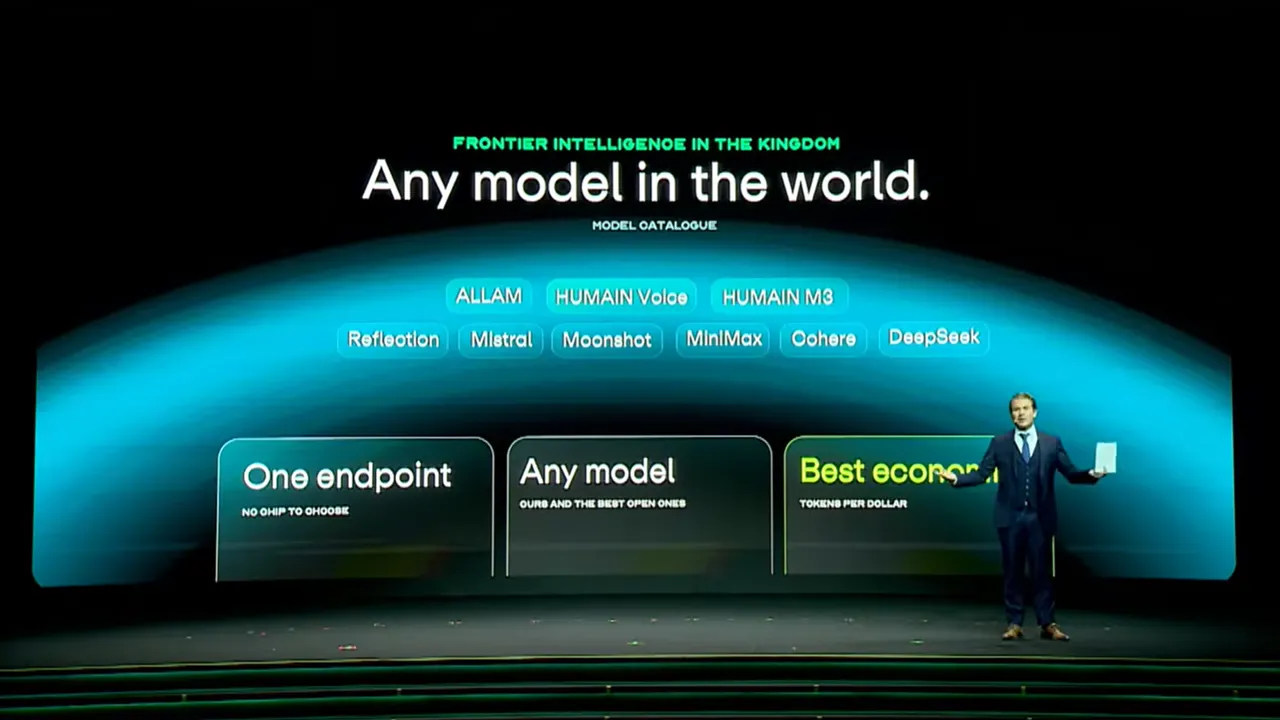
Saudi Arabia’s HUMAIN has unveiled one of its biggest Arabic AI projects yet. The new HUMAIN humain-m3 Arabic AI model is set to advance the field significantly.
The Public Investment Fund-backed company introduced humain-m3 during LEAP 2026 in Riyadh. It is a 428-billion-parameter AI model built with Chinese AI developer MiniMax.
The model focuses heavily on Arabic language understanding and reasoning. HUMAIN says it was further trained on more than one trillion tokens of Arabic-native content.
Humain-m3 is already available through HUMAIN Node in a limited research preview. An open-weight release is also planned.
HUMAIN Goes Bigger With Arabic AI
Humain-m3 is built on the MiniMax-M3 model family. It uses a mixture-of-experts architecture with 428 billion parameters. However, only around 23 billion parameters are active for each token. That design can reduce the computing burden while keeping a very large overall model. HUMAIN then added extensive Arabic post-training to make the system more capable across Arabic tasks.
More Than One Trillion Arabic Tokens Went Into Training
Arabic data sits at the heart of the new model. HUMAIN says the underlying system received further pre-training on over one trillion Arabic-native tokens. That matters because many global models still depend heavily on English training data. Arabic often receives a smaller share. A larger native dataset can help with grammar, context, regional expressions and more complex reasoning in Arabic.
HUMAIN Says M3 Leads Its Arabic Benchmark Tests
The early numbers are getting attention. HUMAIN reports an average score of 89.37% across seven public Arabic benchmarks. The company’s own evaluation placed the model ahead of several frontier systems it tested. Those benchmarks cover Arabic understanding, knowledge, examinations, language proficiency and truthfulness. Retrieval-augmented generation was also included. These remain HUMAIN’s reported results, so independent testing will matter once access expands.
The Model Is Built for More Than Text
Humain-m3 is also multimodal. It can work with text, images and video rather than operating only as a chatbot. HUMAIN says these capabilities were trained together from an early stage. The system also supports screen interaction and longer video understanding. That could make it useful for Arabic enterprise applications beyond basic question-and-answer tools.
Agentic AI Is Part of the Design
HUMAIN is positioning the model for agent-based workloads as well. Humain-m3 includes tool-use and computer-use capabilities. These features are aimed at longer workflows where AI must perform several connected tasks. The model also offers different reasoning modes. Users can keep reasoning active, make it adaptive or switch it off. That gives developers more control over speed and compute use.
HUMAIN Node Is Becoming the Distribution Layer
The model launch is also about HUMAIN Node. The platform is designed to give developers and enterprises access to multiple AI models through one system. Humain-m3 is the first model available to preview users there. HUMAIN says more than 100 additional models are already planned for the platform. Businesses could eventually switch between models without rebuilding their entire AI infrastructure.
Developers Can Test Humain-m3 Through an API
Approved users can access the model through HUMAIN Node’s Playground. API access is also available during the preview. HUMAIN uses an OpenAI-compatible interface, which could simplify integration for developers already using similar APIs. For now, access remains limited. The company describes the current release as experimental and unsuitable for production deployment.
Research Access Comes With Fewer Guardrails
HUMAIN offers both guarded access and a separate research mode. Researchers can request access to the full model checkpoint with reduced filtering. That option is designed for model evaluation and safety research. HUMAIN says participants must explicitly opt in before using it. The company can also limit sessions, API access and other capabilities.
An Open-Weight Release Is Planned
The current model remains behind HUMAIN Node access controls. That will not necessarily stay the case. HUMAIN says it intends to open the model weights after the preview period. Feedback from early users will help shape later checkpoints. Middle East AI News reports that the eventual release is expected under the MiniMax Community License.
Humain-m3 Adds Another Model to Saudi Arabia’s Arabic AI Push
HUMAIN is already developing its own ALLAM family of Arabic models. Humain-m3 takes a different route by working with an international AI developer. That gives HUMAIN access to MiniMax’s architecture while adding its own Arabic training and alignment. It also fits a wider Saudi strategy around local AI infrastructure, models and compute.
Arabic AI Is Becoming a Bigger Competitive Market
For years, the largest AI models were designed mainly around English. Arabic capability often arrived later through multilingual training. That situation is changing.
Saudi Arabia, the UAE and other regional players are investing more heavily in Arabic-first systems. The opportunity is larger than translation. Enterprises need AI that understands local language, dialects and business environments.
Humain-m3 pushes that competition further. Its 428-billion-parameter scale immediately makes it notable. Yet the more important test will come outside HUMAIN’s own benchmarks.
If independent developers see the same gains in everyday Arabic tasks, the model could become an important part of the region’s AI stack.
Sources
Middle East AI News — HUMAIN unveils 428B parameter Arabic model with MiniMax
Read the original report
HUMAIN Node — HUMAIN M3
View the official HUMAIN M3 model page
