


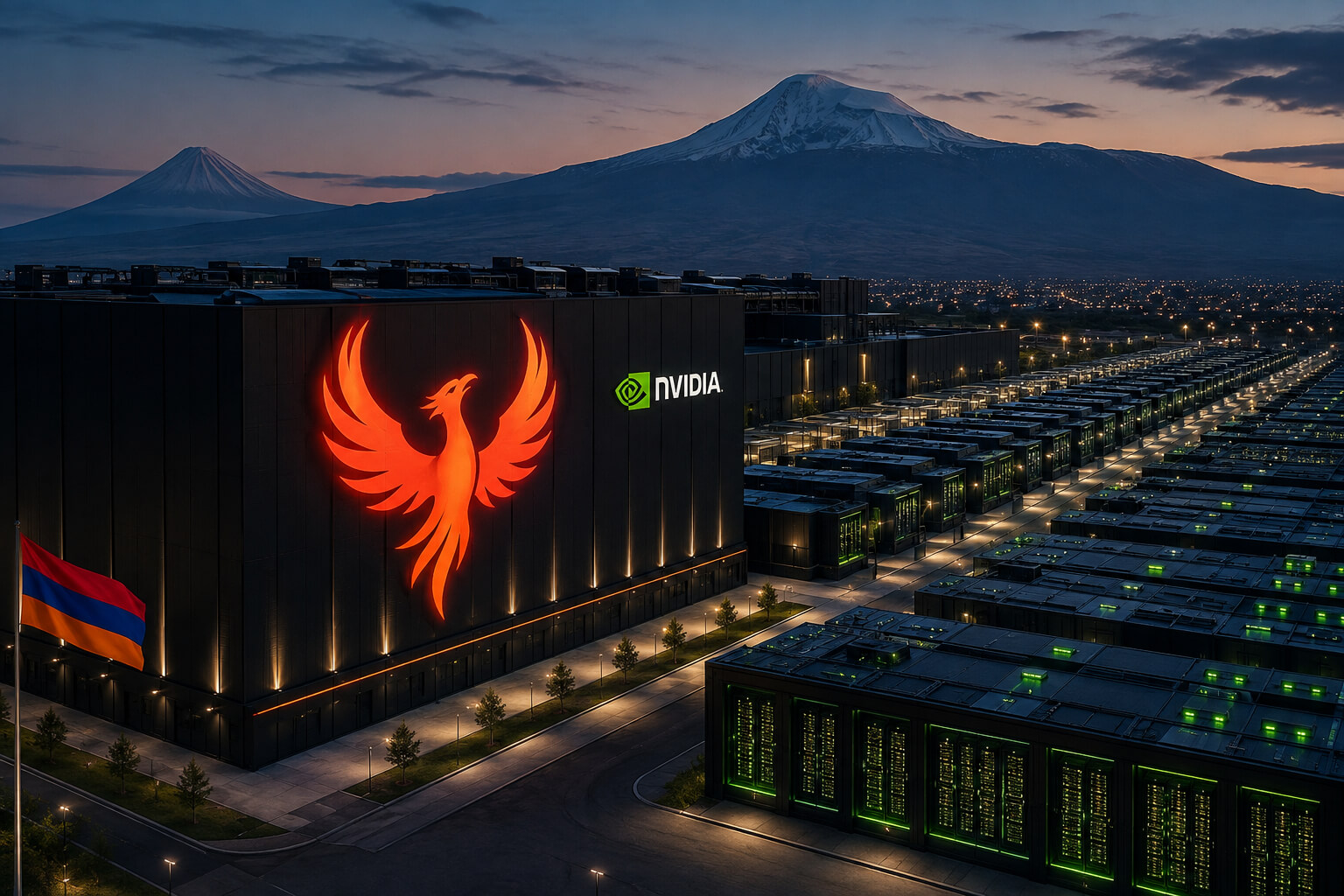
Armenia has suddenly become home to one of the biggest AI infrastructure projects in its region.
Firebird has officially opened what NVIDIA describes as the largest AI factory in the Commonwealth of Independent States (CIS), launching a new computing hub in Hrazdan built around NVIDIA accelerated computing and Dell Technologies infrastructure.
And the facility operating today is only the beginning.
Firebird plans to deploy more than 70,000 NVIDIA Blackwell and Rubin GPUs in Armenia and build out roughly 300 megawatts of AI infrastructure capacity by the end of 2027.
That puts the project well beyond the scale of a conventional data center. Firebird is building infrastructure intended for large-scale AI training, inference, AI agents and other compute-heavy workloads.
Armenia Gets Its Own Large-Scale AI Computing Hub
The new Firebird AI factory gives Armenian developers, universities, startups, companies and public institutions something that has become increasingly important as AI models grow larger: access to high-performance computing without depending entirely on infrastructure located abroad.
NVIDIA describes AI factories as facilities designed specifically to train, fine-tune and run artificial intelligence models at scale.
Think less traditional cloud data center and more industrial production line for compute.
The Hrazdan facility opened with Armenian Prime Minister Nikol Pashinyan, Kazakhstan Deputy Prime Minister Zhaslan Madiyev and U.S. chargé d’affaires David Allen among those attending the ceremony.
Firebird says the initial facility was delivered in a little over six months.
For infrastructure of this scale, that is a particularly aggressive deployment schedule.
More Than 70,000 NVIDIA Blackwell and Rubin GPUs Are Planned
The number that will probably grab most attention is 70,000.
Firebird says it expects to deploy more than 70,000 NVIDIA Rubin and Blackwell GPUs alongside 300MW of AI infrastructure capacity in Armenia by the end of 2027.
Blackwell is already being deployed across the AI industry, while Rubin represents NVIDIA’s newer generation of accelerated computing hardware aimed heavily at increasingly demanding agentic AI workloads.
NVIDIA says its Vera Rubin architecture was designed for workloads where AI systems perform long chains of reasoning, retrieval, tool use and generation rather than simply answering isolated prompts.
Firebird isn’t stopping at Armenia either.
The company is working toward an approximately 2-gigawatt AI infrastructure roadmap covering Armenia, Kazakhstan and other markets.
That is an enormous power footprint if the full roadmap materializes.
NVIDIA DSX Sits Underneath the AI Factory
There is another piece of the announcement that matters almost as much as the GPU count: NVIDIA DSX.
Firebird’s Armenia facility is built around NVIDIA’s DSX platform, which is designed to treat the entire AI data center as a single coordinated system rather than a collection of servers.
Compute, networking, power delivery, cooling and software all have to work together.
That matters because modern AI infrastructure has increasingly become limited by far more than raw GPU performance. Electricity, cooling, networking and how efficiently hardware can actually be utilized are becoming major parts of the economics.
NVIDIA claims DSX can allow operators to run up to 40% more GPUs within the same footprint, helping facilities produce more AI tokens from available power and infrastructure.
DSX is also becoming a larger part of NVIDIA’s strategy around Rubin. The company has positioned the platform as a reference framework for designing, simulating, deploying and operating next-generation AI factories.
Cooling and Power Are Becoming Part of the AI Story
Putting tens of thousands of GPUs in a facility creates an obvious problem: they consume huge amounts of power and generate huge amounts of heat.
That part tends to disappear underneath the headline GPU numbers.
For Firebird’s Hrazdan facility, Schneider Electric supplied power infrastructure including switchgear, uninterruptible power systems and rack equipment.
Vertiv supplied the cooling architecture, using chilled-water technology along with control systems designed to adjust cooling resources as AI workloads change.
This is becoming a defining issue for the AI infrastructure race.
Buying GPUs is difficult. Powering thousands of them continuously — while keeping them cool and economically useful — is another problem entirely.
As NVIDIA pushes toward Rubin and increasingly dense AI systems, those physical constraints are becoming just as important as chip performance.
NVIDIA Plans to Invest in Firebird
The relationship between the two companies may soon extend beyond hardware.
NVIDIA said it intends to invest in Firebird. Financial terms were not disclosed in the announcement.
CoreWeave has already invested in the company earlier in 2026.
Firebird also appears to have early customer demand. Perplexity is working with the company to access high-performance AI infrastructure for its answer engine and AI agent platform, according to NVIDIA.
That detail is important. Building giant GPU clusters is one thing; keeping expensive computing capacity occupied with paying workloads is what turns infrastructure into a viable business.
Why Armenia’s AI Factory Matters
The most interesting part of the Firebird project may not be the GPU count at all.
AI computing capacity is spreading geographically.
For years, frontier AI infrastructure has been concentrated heavily around hyperscalers, major cloud providers and large technology companies operating massive data centers in a relatively small number of markets.
Projects like Firebird’s Armenia AI factory point toward something different.
Countries want local access to the computing infrastructure needed to develop models around their own languages, industries, research programs and economic priorities. Companies are simultaneously hunting for locations where power, infrastructure and regulatory conditions can support increasingly large clusters.
Armenia now wants a place in that equation.
Whether Firebird ultimately reaches 70,000 GPUs, 300MW in Armenia and its broader 2GW international roadmap remains to be seen. Those are ambitious numbers, particularly in an industry where hardware availability, electricity supply and construction schedules can change quickly.
The first site, though, is no longer just a proposal.
It is operating.
And with Blackwell running today, Rubin coming next and NVIDIA itself preparing to invest, Armenia has unexpectedly landed on the map of the global AI infrastructure race.
Sources
- NVIDIA Blog — Firebird Launches CIS Region’s Largest AI Factory in Armenia
- NVIDIA Newsroom — NVIDIA DSX Gives Infrastructure Builders the Playbook for AI Factories
- NVIDIA Newsroom — Vera Rubin Ramps Into Full Production to Power Agentic AI Factories Worldwide
- NVIDIA Newsroom — Vera Rubin DSX AI Factory Reference Design
