


Microsoft’s quarterly earnings have become much more than another Big Tech report.
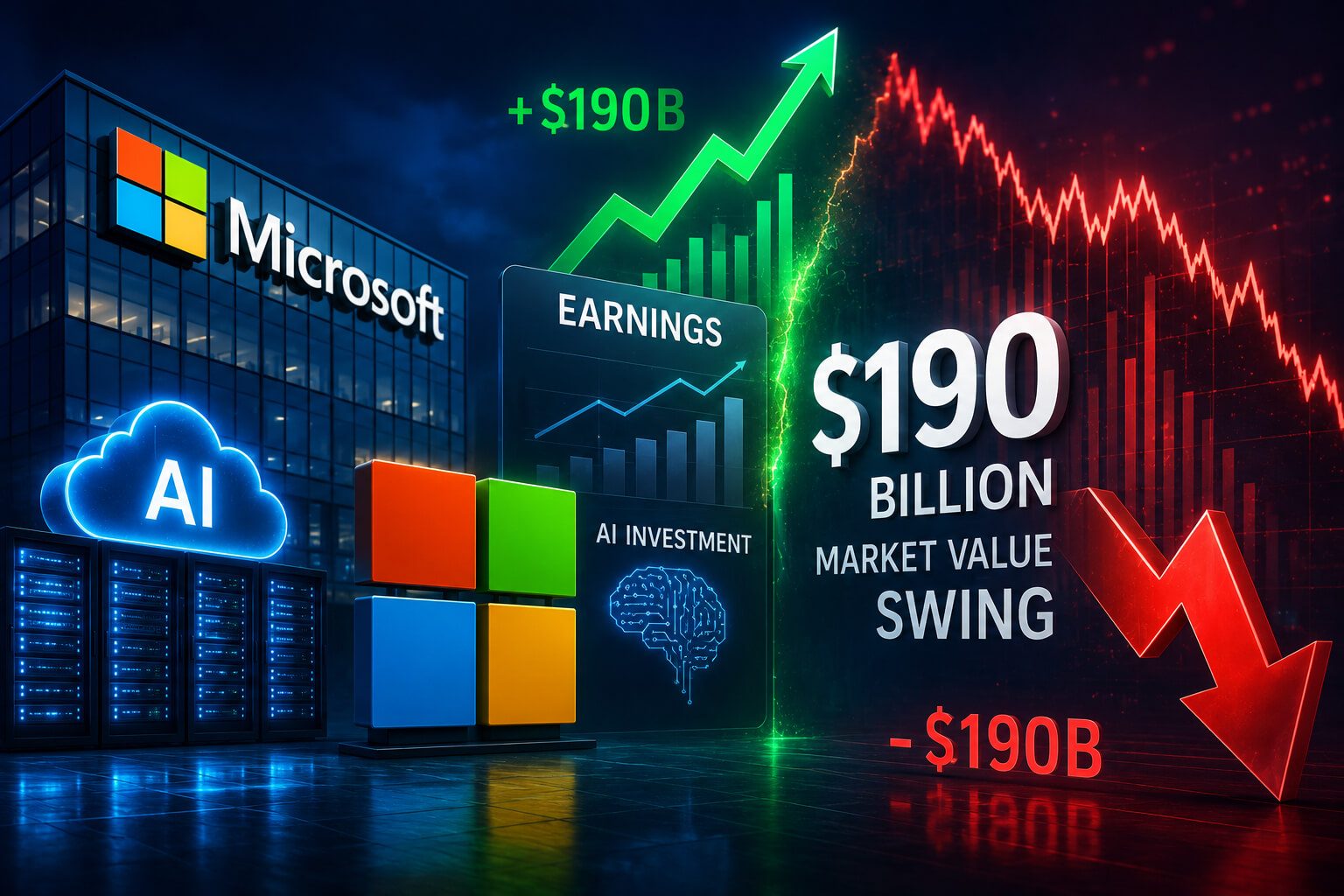
Wall Street is preparing for one of the largest post-earnings reactions the company has seen in years. Options traders are pricing in a move that could add or erase roughly $190 billion in Microsoft’s market value, reflecting growing uncertainty around whether its enormous investment in artificial intelligence is finally translating into meaningful financial returns.
That number tells its own story. Investors are no longer asking whether Microsoft will keep spending on AI. They already know the answer. What they want now is evidence that those billions are turning into faster revenue growth and stronger profits.
AI Investment Is No Longer the Debate
Microsoft has spent the past several years building one of the world’s largest AI infrastructures. New data centers, advanced chips, Azure expansion and Copilot development have required capital on a scale that would have seemed extraordinary only a few years ago.
The market accepted those costs when generative AI first exploded. Expectations have changed.
Today, investors want measurable returns. Azure cloud growth, enterprise AI adoption and Copilot subscriptions have become the numbers that matter most. Strong results could reinforce Microsoft’s leadership in enterprise AI. Weak guidance would likely renew questions about how quickly these investments can pay for themselves.
Options Market Signals Rare Volatility
A projected $190 billion swing sounds dramatic because it is.
Options pricing suggests Microsoft’s stock could move around 6.6% in either direction after earnings, noticeably higher than its historical average following quarterly reports. That reflects unusually high uncertainty rather than a prediction about which direction the stock will move.
For a company valued in the trillions of dollars, even a single-digit percentage move translates into hundreds of billions of dollars in market capitalization.
The reaction will likely influence broader technology markets as well. Microsoft remains one of the largest components of major U.S. stock indexes, meaning its performance often shapes overall market sentiment.
Azure and Copilot Will Be Under the Microscope
Revenue and earnings are important. Investors, however, are expected to spend just as much time listening to management’s commentary.
Azure remains Microsoft’s primary AI growth engine. Analysts will be watching whether AI-related cloud demand continues accelerating and whether enterprise customers keep expanding their use of Microsoft’s AI services.
Copilot adoption also matters.
Businesses have shown interest in embedding AI assistants into everyday workflows, but investors want clearer evidence that those subscriptions are becoming a meaningful source of recurring revenue rather than an early experiment.
Microsoft Is Setting the Tone for Big Tech
Microsoft’s earnings arrive during a period when investors have become increasingly selective about AI spending.
Alphabet, Meta and other technology giants continue investing heavily in AI infrastructure, yet markets have become less willing to reward spending without visible financial gains. That shift has placed Microsoft in an unusually important position.
A strong report could reassure investors that large-scale AI investments are beginning to generate sustainable business growth. A disappointing update could increase pressure across the technology sector as shareholders reassess how quickly AI spending can deliver returns.
Why This Earnings Report Matters Beyond Microsoft
This isn’t simply about one quarter.
Microsoft has become one of the clearest indicators of how enterprise AI is evolving. Companies around the world are buying cloud computing, deploying AI assistants and building new applications on Azure. Microsoft’s financial results offer one of the earliest real-world measurements of whether those investments are accelerating or slowing.
The options market may be anticipating volatility, but the bigger takeaway will be the direction of AI adoption itself. Investors are looking beyond headline revenue numbers. They’re searching for proof that the AI era is becoming a durable business model rather than an expensive promise.
