


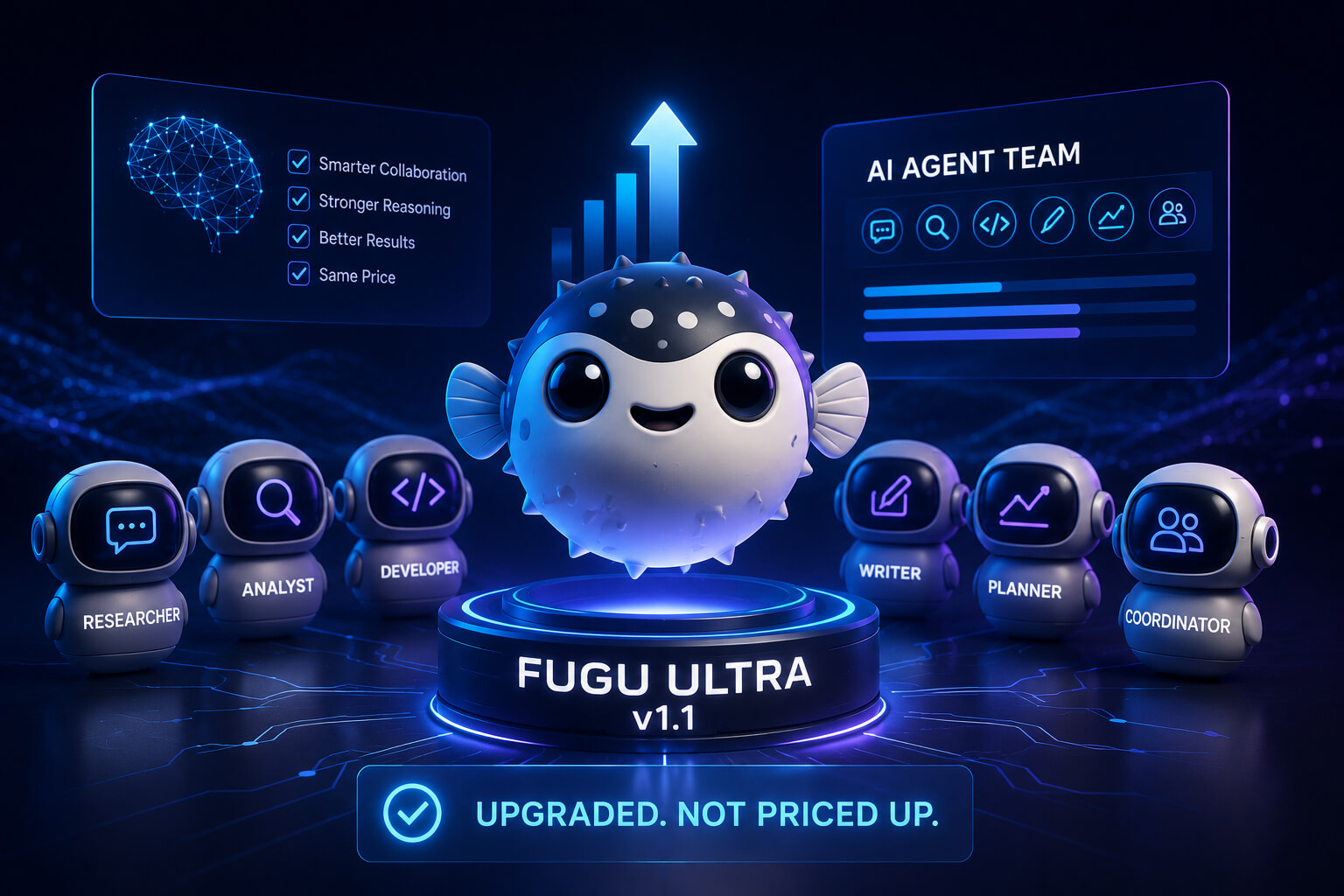
Sakana AI has released Fugu Ultra v1.1, an updated version of its multi-agent AI system built for difficult coding, research and reasoning tasks.
It is not a dramatic rebuild. There is no new architecture to learn, no fresh API migration and, perhaps more importantly, no price increase.
Instead, Sakana AI has changed the models working behind the scenes. Fugu Ultra v1.1 now incorporates newer frontier models inside its orchestration system, allowing the platform to improve without forcing developers to rebuild their integrations.
That may sound like a routine update. It is not quite that simple.
Fugu Ultra does not behave like a conventional large language model. It works more like an AI project manager, assigning parts of a problem to different models before reviewing and combining their work into a final response.
Fugu Ultra v1.1 Is an Orchestrator, Not One Giant Model
Most AI platforms still revolve around choosing a single model. A developer sends a prompt, the model processes it and one response comes back.
Fugu Ultra takes another route.
The system can examine a request, create a working strategy and coordinate several AI agents to complete different parts of the task. One agent might develop a plan. Another could write or test code. A separate agent may inspect the answer for mistakes before Fugu assembles the final result.
Users do not have to manage that workflow manually. They interact with Fugu through one OpenAI-compatible API while the orchestration happens underneath.
Sakana AI describes Fugu Ultra as the performance-focused member of the Fugu family. The standard Fugu model aims to balance quality and latency, while Fugu Ultra prioritizes stronger answers for problems that need deeper reasoning or several stages of work.
This setup will not make sense for every prompt. Asking several models to solve a basic rewriting task would probably be excessive. Complex software engineering, scientific analysis and multi-step research are where the approach becomes more interesting.
Sakana AI Claims Gains of Up to 7.9 Points
The headline figure attached to Fugu Ultra v1.1 is a performance improvement of up to 7.9 points over the original release.
Sakana AI says the upgraded system performed better across every benchmark it tracks, with particularly strong gains on ProgramBench and Terminal Bench 2.1. Those evaluations focus on programming and agent-style tasks that require a model to work through a sequence of actions rather than generate one quick answer.
That fits the product’s design. Multi-agent orchestration should be most useful when a problem can be divided, checked and revised.
There is a caveat, though.
The 7.9-point improvement comes from Sakana AI’s own testing. The company has not published a detailed public table showing the score of v1.0 beside v1.1 for every benchmark. ProgramBench, despite being named as one of the strongest areas of improvement, is also missing from the public scorecard referenced in reporting about the release.
That does not mean the gain is inaccurate. It simply means developers should treat it as a provider-reported result until broader testing becomes available.
Real workloads will matter more anyway. A coding team should compare both versions using its own repositories, bug reports and development tasks rather than assuming a benchmark increase will translate perfectly into production.
New Frontier Models Do the Heavy Lifting
Fugu Ultra v1.1 shows one of the main advantages of building an orchestration layer rather than tying a product to one foundation model.
Sakana AI can update the pool of frontier models inside Fugu while keeping the external service relatively stable. As the underlying models improve, the orchestrator gains access to better reasoning, coding and verification capabilities.
The user still calls the same type of API.
That makes Fugu less dependent on one AI provider winning every category. One model may perform well in coding, another in scientific reasoning and another in reviewing long documents. Fugu can coordinate those strengths instead of forcing every task through a single system.
Of course, there is a trade-off. Developers get less visibility into which model handles each step and why the orchestrator chose it. A manually built agent workflow offers more control. Fugu offers convenience.
The choice depends on how much infrastructure a team wants to manage.
Claude Code Support Brings Fugu Into Developer Workflows
Alongside Fugu Ultra v1.1, Sakana AI has introduced an interface for using Fugu through Claude Code.
Developers can configure the command-line coding environment to route requests through Fugu’s API. That puts the multi-agent system inside a familiar development workflow rather than limiting it to a standalone playground or custom application.
The integration could be useful for debugging complicated code, planning larger changes or reviewing work across several files. Instead of relying on one model response, Fugu can coordinate multiple agents before returning an answer to the developer.
Existing users may need to reinstall or redeploy the claude-fugu launcher configuration to gain support for newly released Fugu models because the launcher does not update itself automatically.
This part of the announcement may be more practical than the benchmark headline. AI coding tools become far more useful when developers can access them without leaving the terminal or changing their normal workflow.
Fugu Ultra v1.1 Pricing Remains Unchanged
Sakana AI has kept Fugu Ultra v1.1 at the same rates as the previous version.
The standard pay-as-you-go price is $5 per million input tokens and $30 per million output tokens. Cached input costs $0.50 per million tokens.
Requests that exceed 272,000 tokens move into a higher pricing tier. At that level, the rates rise to $10 per million input tokens, $45 per million output tokens and $1 per million cached input tokens.
There is one detail developers should not overlook: orchestration activity is billable.
Fugu may call several agents while processing one request. The tokens used by those agents count toward usage, not just the original prompt and final response. A request that looks small from the outside can therefore consume more tokens once the internal workflow is included.
The advertised token rate is only part of the cost calculation. Teams need to measure the total price per completed task.
For a difficult coding problem that would otherwise require repeated prompts, manual checking and several separate model calls, the higher cost may still be reasonable. For basic content generation or simple questions, Fugu Ultra could be more capability than the job needs.
Developers Can Upgrade Without Rebuilding Their Applications
Sakana AI kept the architecture and API structure unchanged, so moving to the new release should be relatively straightforward.
Developers can use the versioned model identifier fugu-ultra-v1.1. Those using an unversioned Fugu Ultra alias may receive the latest available build automatically, depending on how their integration is configured.
Keeping the previous version pinned can still make sense.
AI orchestration updates may alter outputs even when the API remains the same. A new group of underlying models could approach prompts differently, choose different tools or produce different code. Teams that require consistent results should run regression tests before replacing a pinned production model.
“Same API” does not always mean “same behavior.”
Multi-Agent AI Is Becoming a Product, Not Just an Experiment
The more interesting part of Fugu Ultra v1.1 is not the version number.
Sakana AI is trying to package multi-agent coordination as a model service. Developers do not have to build planners, routers, reviewers and fallback systems from scratch. They send one request and let Fugu decide how much coordination the problem requires.
This pushes AI competition beyond the usual question of which individual model has the highest benchmark score.
The next question is whether several strong models, managed by a trained orchestrator, can outperform a more powerful standalone system without becoming too slow or expensive.
Sakana AI’s technical report argues that query-adaptive agent teams could offer another path for scaling AI performance. Rather than making one model larger, the system learns how to combine the capabilities of multiple models.
Fugu Ultra v1.1 is an early commercial test of that idea.
The update gives existing users newer frontier capabilities at the same listed price. Still, the real verdict will not come from Sakana AI’s internal benchmarks. It will come from developers testing whether the orchestrator solves hard problems more reliably than one frontier model—and whether that improvement justifies the added tokens, latency and reduced control.
