


Japan has always had the hardware story.
Factories. Robots. Cars. Medical devices. Semiconductors. Gaming machines. The kind of industries where precision is not a marketing word, but a requirement.
Now NVIDIA wants to plug AI into that entire base.
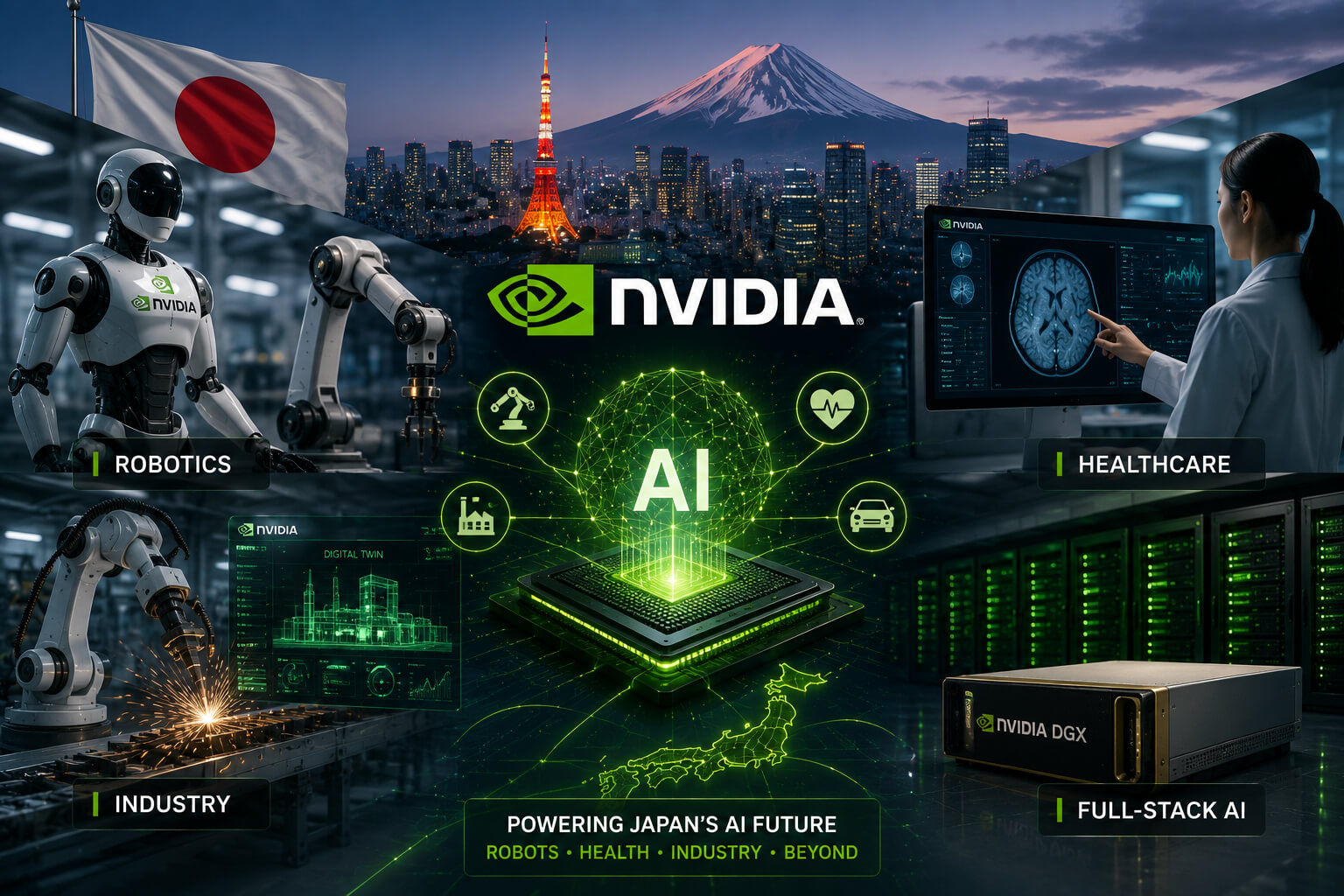
In a new NVIDIA blog post, the company outlined a wide Japan-focused AI push covering robotics, healthcare, finance, telecom, quantum computing, automotive systems, manufacturing and gaming. It is not one announcement. It is more like NVIDIA walking through Japan’s industrial map and saying: this is where full-stack AI goes next.
The timing matters. AI is no longer just about chatbots, cloud assistants or office productivity tools. The next fight is physical AI: machines that see, reason, move, simulate and act in real-world environments.
Japan is a natural place for that fight to get serious.
NVIDIA Sees Japan as a Full-Stack AI Country
NVIDIA described Japan as one of the world’s AI centers, pointing to its mix of manufacturers, robotics companies, infrastructure builders and gaming firms. The company said its partners in Japan are building across the full stack with NVIDIA technologies.
That phrase, “full stack,” gets thrown around a lot. Here it actually means something.
NVIDIA is not only selling chips into Japanese companies. It is pushing GPUs, AI models, simulation tools, robotics platforms, enterprise software and agent-building frameworks into the same ecosystem. The company wants its technology to sit under the model, the robot, the digital twin, the medical scanner, the bank workflow and the telecom network.
That is the bigger story.
Japan already knows how to manufacture physical things at scale. NVIDIA is betting that the next step is making those physical things intelligent.
Physical AI Moves From Demo Floor to Factory Floor
During NVIDIA CEO Jensen Huang’s visit to Tokyo, physical AI became the headline theme.
At NVIDIA’s Build-a-Claw event, Japanese developers used open models and NVIDIA’s platform to build robotic claw systems that could pick up objects. Huang framed the moment as part of a broader shift from personal computers to “personal AI,” with builders creating their own agents and robotic systems.
That sounds playful. A claw machine. A room of builders. A surprise CEO visit.
But underneath it is a very serious industrial message. NVIDIA wants developers to treat robots as AI agents with bodies. Not fixed automation. Not old industrial arms doing the same motion forever. Machines that can understand their surroundings, adjust to new inputs and perform useful tasks in messy real-world environments.
Japan has the industrial base for that. FANUC, Yaskawa, Kawasaki Heavy Industries and Fujitsu are not lightweight names. NVIDIA said leaders from those companies discussed how physical AI can move into Japanese factories and industrial systems.
This is where Japan’s manufacturing advantage becomes interesting again. If AI stays inside screens, Silicon Valley has the strongest story. If AI moves into factories, vehicles, hospitals and cities, Japan suddenly looks much more central.
Japan Launches a Government-Backed Physical AI Initiative
The public sector is also stepping in.
NVIDIA said Huang joined Ryosei Akazawa, Japan’s Minister of Economy, Trade and Industry, at the launch of a government-backed Physical AI Initiative in Tokyo. The initiative aims to bring together manufacturing expertise, real-world industrial data and global technology partners to develop open multimodal foundation models for AI agents, digital twins, robotics and physical AI applications.
That is a long sentence, but the idea is simple enough.
Japan does not want to simply import AI tools and bolt them onto old systems. It wants to build models and infrastructure that fit its own industrial strengths. Open models matter here because companies and governments want more control, especially when AI touches factories, healthcare, finance and national productivity.
There is also a labor angle. Huang said AI and robotics could help Japan augment workers and increase national productivity.
Japan’s aging workforce problem has been discussed for years. Physical AI gives that conversation a more concrete direction. Robots may not replace the human workforce overnight, but they can help stretch limited labor across manufacturing, logistics, healthcare and infrastructure.
SoftBank and NVIDIA Push AI-Native Networks
Telecom is part of the story too.
NVIDIA said SoftBank is using its full stack, including GB200-class AI infrastructure, NVIDIA AI Aerial and NVIDIA Nemotron-based large telecom models, as part of work to turn communications networks into intelligence delivery networks.
That wording sounds futuristic, but the shift is practical. Telecom networks are no longer just pipes for data. They are becoming platforms for AI workloads, edge computing, robotics, connected vehicles and industrial automation.
SoftBank and NVIDIA also confirmed joint initiatives involving NVIDIA Nemotron, SB Intuitions’ Sarashina generative AI model series, and physical AI work with partners such as Yaskawa using NVIDIA Cosmos and Isaac GR00T.
This is not just about faster mobile service. It is about building network infrastructure that can support AI systems close to where action happens.
Factories need low latency. Robots need fast response. Smart cities need local intelligence. Telecom companies want to be more than connectivity providers.
NVIDIA knows that.
Healthcare Gets Agentic AI and Surgical Robotics
Japan’s healthcare sector is another major piece of the update.
NVIDIA said Japanese healthcare leaders are deploying its technology across autonomous surgical robots, AI-accelerated CT systems, agentic drug discovery platforms and virtual cell models.
Drug discovery is one of the clearest examples. Tokyo-1, an AI drug discovery consortium operated by Xeureka, now includes Eisai alongside Astellas, Daiichi Sankyo and Ono Pharmaceuticals. These companies are using NVIDIA BioNeMo and related tools to accelerate discovery workflows.
Astellas has deployed nearly all BioNeMo NIM microservices in NVIDIA’s digital biology portfolio, while Ono Pharmaceuticals is using the Boltz-2 NIM microservice. Daiichi Sankyo is running ultralarge-scale virtual screening on Tokyo-1 and using NVIDIA RAPIDS for large-scale data processing.
That is the less flashy side of AI, but it may be one of the most important. Faster discovery workflows can change how pharmaceutical teams search for promising molecules, test hypotheses and reduce wasted time in early research.
There is also physical AI inside hospitals. Kawasaki Heavy Industries plans to use NVIDIA Holoscan IGX, Isaac for Healthcare, Isaac GR00T and Cosmos for surgical support functions, nursing assistant robots and hospital transport robots.
Medical imaging is moving too. Canon launched Japan’s first NVIDIA-accelerated photon-counting CT system, while Fujifilm commercialized Japan’s first whole-body CT system powered by NVIDIA Blackwell.
Healthcare AI is usually discussed as software. In Japan, NVIDIA is showing a more hardware-heavy version: scanners, robots, hospital systems and research platforms.
Vision AI Agents Enter Factories, Buildings and Public Spaces
NVIDIA also used the Japan ecosystem update to highlight Metropolis, its platform for vision AI.
The company said NVIDIA Metropolis now includes more than 80 new skills, including VSS Blueprint 3.2, DeepStream 9.1, TAO 7 and Physical AI Data Factory tools. These are designed to help developers use coding agents to speed the creation of production-ready vision AI systems by at least 6x.
The key phrase here is “vision AI agents.”
Older video analytics systems mostly detected things. A person. A vehicle. A defect. A motion pattern.
The new pitch is different. Vision AI agents should be able to see, reason, summarize, search and act across live or recorded video. That matters for factories, construction sites, rail systems, buildings, stores and public spaces.
NVIDIA said companies including Asilla, AWL, Fujitsu, Hitachi, OMRON, Shimizu Corporation and Yazaki North America are using Metropolis technologies in real-world operations.
OMRON is using VSS-powered video analytics agents for automated inspection. DeepHow is helping Yazaki North America reduce time and motion studies from weeks to days. Hitachi HMAX solutions use VSS-powered agents to generate insights for building and rail infrastructure, with NVIDIA saying the approach can help reduce maintenance costs and energy consumption by 15% in rail applications.
This part of the story feels less glamorous than humanoid robots. But it may arrive faster.
Factories already have cameras. Buildings already have sensors. Rail systems already have inspection processes. Vision AI agents do not need to invent a new physical world. They can start by making the existing one easier to understand.
Japanese Megabanks Build AI Factories
Finance is not being left out.
NVIDIA said Japanese banks and fintech companies are building AI factories and financial intelligence systems using NVIDIA Nemotron open models and NVIDIA Agent Toolkit.
Mizuho plans to build what NVIDIA described as the largest on-premises AI factory in Japan’s financial industry, beginning with NVIDIA DGX B200 systems and scaling toward a larger cluster. The point of keeping it on premises is clear: banks want AI capability without losing control of sensitive data.
SMBC Group is also moving through the Japan Research Institute, which deployed an AI factory using NVIDIA Nemotron open models. Rakuten Bank, meanwhile, plans to build transaction foundation models using NVIDIA Agent Toolkit, drawing on Rakuten Group’s large ecosystem of banking accounts, credit cards and brokerage accounts.
This shows how enterprise AI is changing inside finance.
Banks are not just testing chat assistants anymore. They are building infrastructure for document generation, analysis, coding support, fraud detection, transaction intelligence and secure internal agents.
The pressure is different in finance. Mistakes are expensive. Data is regulated. Trust matters. That explains why on-premises AI factories and open models are getting attention.
Quantum and AI for Science Get a Japan Boost
NVIDIA’s Japan push also includes research infrastructure.
At RIKEN, two supercomputers powered by NVIDIA technologies are beginning operations. RIKYU, built for AI for Science development, uses 1,600 NVIDIA Blackwell GPUs on the GB200 NVL4 platform. ROQUO, a quantum-HPC system, integrates quantum processors with accelerated computing from 540 Blackwell GPUs.
That combination matters because AI and quantum computing are starting to overlap more seriously. AI can help design circuits, calibrate quantum processors, support quantum error correction and accelerate scientific workloads.
NVIDIA also said Mitsubishi Chemical, Mizuho Bank, Keio University, AIST, the University of Toronto and NVIDIA demonstrated an AI- and GPU-driven workflow for molecular spectral analysis, with NVIDIA GPUs delivering a 13.4x speedup over CPU-only nodes.
This is not consumer AI. It will not trend like a chatbot launch.
But if AI for science becomes a real industrial advantage, countries that invest early in GPU-supercomputing and quantum-AI infrastructure may gain leverage in materials, chemistry, drug discovery and semiconductor research.
Japan clearly wants to be in that race.
Toyota, NVIDIA and the Physical AI Mobility Stack
Toyota is another major name in the update.
NVIDIA said it is expanding its partnership with Toyota across automotive, robotics and cities. The work builds on Toyota’s plan to develop next-generation vehicles with advanced driver-assistance capabilities using NVIDIA DRIVE AGX and the safety-certified NVIDIA DriveOS operating system.
The partnership now spans intelligent vehicles, software engineering, factory simulation and urban intelligence systems.
Toyota is using NVIDIA tools to build L2++ driver assistance capabilities, accelerate safety-critical automotive code generation and review, simulate factory and robotics workflows with NVIDIA Omniverse and Isaac Sim, and develop a multimodal vision language model for urban traffic intelligence through Woven by Toyota.
This is the physical AI idea again, but applied to mobility.
Cars are becoming software-defined. Factories are becoming simulated before they are changed. Cities are becoming data-rich environments that need AI to interpret traffic and infrastructure conditions.
For Toyota, the opportunity is not only autonomous driving. It is the broader system around mobility: vehicles, factories, roads, logistics and urban operations.
Even Gaming Fits the Japan AI Story
The Japan update also included SEGA.
NVIDIA and SEGA are celebrating more than 30 years of collaboration by bringing VIRTUA FIGHTER CROSSROADS and future SEGA titles to NVIDIA RTX Spark, a new superchip for slim Windows laptops and compact desktop PCs.
That may seem like a separate gaming announcement, but it fits the broader NVIDIA pattern. AI PCs, personal agents, gaming graphics, ray tracing and creative workloads are all being folded into the same hardware story.
Japan’s gaming heritage gives NVIDIA another cultural anchor. The company is not just talking about industrial AI in boardrooms. It is connecting AI-era computing back to Japan’s arcade and console history.
There is a nice symmetry there. NVIDIA’s early history includes SEGA. Now the two companies are talking about AI-capable personal computing and next-generation game experiences.
Why This Matters for AI Infrastructure
The real takeaway is not that NVIDIA has many partners in Japan. That part is obvious.
The bigger point is that AI infrastructure is spreading into national industrial systems.
Japan is not being framed as a simple customer market. It is being positioned as a place where AI can enter manufacturing, robotics, healthcare, finance, telecom, mobility, scientific research and gaming at once.
That is much bigger than one cloud deal.
NVIDIA’s role is also becoming clearer. The company wants to be the platform layer for countries and industries trying to move from AI experiments to AI operations. Chips are only the entry point. The larger play is models, software, simulation, agent tools, robotics frameworks and full-stack infrastructure.
For Japan, the pitch is straightforward: take what the country already does well, then make it intelligent.
That could include factories. Medical imaging is another possibility. Bank workflows may also benefit. Telecom networks could use it too. So could autonomous machines moving through hospitals, roads, and industrial sites.
The AI race is no longer just about who builds the biggest model.
It is also about who can make AI useful in the physical economy.
Sources
- NVIDIA Blog: https://blogs.nvidia.com/blog/japan-ecosystem-2026/
- SoftBank Corp. AI-RAN and NVIDIA AI Aerial reference: https://www.softbank.jp/
- NVIDIA DRIVE AGX: https://developer.nvidia.com/drive/agx
- NVIDIA Omniverse: https://www.nvidia.com/en-us/omniverse/
- NVIDIA Isaac Sim: https://developer.nvidia.com/isaac/sim
