


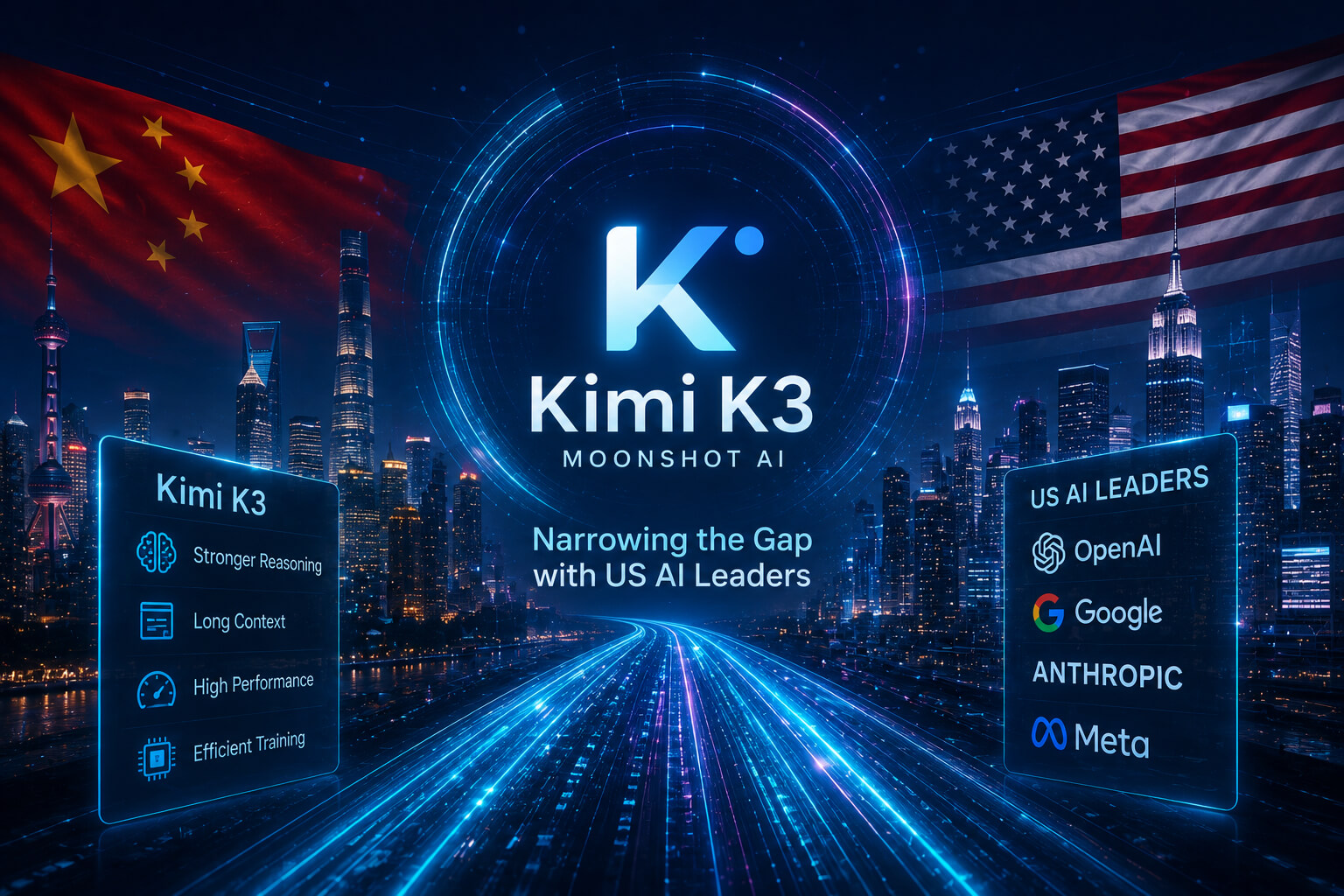
China’s AI race just got louder.
Moonshot AI, one of China’s most closely watched artificial intelligence startups, has released Kimi K3, a new open-weight model that it says can compete with some of the strongest systems from OpenAI and Anthropic. The claim is bold, of course. AI companies love bold claims. But this one is getting attention because Kimi K3 is not being positioned as a small experimental model or a cheap local alternative.
It is being pitched as a serious frontier-level system from China.
According to reports, Kimi K3 comes with 2.8 trillion parameters, making it one of the largest open-weight AI models announced so far. Moonshot says the model performs near the level of leading US models, with strong results in coding, reasoning, and general capability benchmarks. That alone makes it harder to keep repeating the old idea that Chinese AI labs are always several steps behind American rivals.
Moonshot AI Pushes China Deeper Into the Frontier Model Race
Moonshot AI is not new to the Chinese AI scene, but Kimi K3 gives the company a different kind of visibility.
The Beijing-based startup has already been part of China’s fast-moving large language model market, alongside names such as DeepSeek, Z.ai, MiniMax, Alibaba, and ByteDance. What makes Kimi K3 stand out is scale. A 2.8 trillion-parameter open-weight model is not a casual release. It is a statement.
Moonshot claims Kimi K3 can hold its own against high-end models from US companies, with Bloomberg-linked reports noting that the model reportedly trails only top offerings from OpenAI and Anthropic on overall capability. That does not automatically mean it beats every US model in real-world use. Benchmarks are messy. Leaderboards shift. Companies choose the tests that make them look good.
Still, the direction is obvious. China’s AI labs are no longer just chasing cheaper chatbots. They are trying to build models that can sit near the top table.
Kimi K3 Is Open-Weight, and That Matters
The open-weight part is important.
Open-weight models allow developers and companies to access model weights, making them easier to inspect, customize, fine-tune, and deploy outside a fully closed commercial platform. That does not always mean truly “open source” in the pure software sense, but it does change the power dynamic.
Closed models from OpenAI, Anthropic, and Google still dominate much of the premium AI market. They are polished, deeply integrated, and backed by massive infrastructure. But open-weight models are gaining ground because businesses want more control. They want pricing flexibility. They want to avoid sending everything through someone else’s API. Some also want models that can be adapted to specific workflows without waiting for a US lab’s product roadmap.
Kimi K3 lands right in that tension.
If the model performs close enough to US frontier systems while giving developers more freedom, it could pull more attention toward China’s open AI ecosystem. Not overnight. Not magically. But enough to make investors and competitors uncomfortable.
The US-China AI Gap Looks Smaller Than Before
For years, the common assumption was simple: the US had the best models, China had fast followers.
That picture is getting harder to defend.
Kimi K3 follows a broader pattern. DeepSeek already shocked the market with efficient AI models. Z.ai and MiniMax have pushed aggressively on performance and price. Now Moonshot is trying to prove China can compete not just on cost, but on capability.
This is why the release matters beyond one model name. It suggests the AI gap between China and the US is becoming more uneven, more specific, and more difficult to measure. Maybe the US still leads in the strongest closed systems. Maybe China is gaining faster in open-weight models, efficiency, and developer accessibility. Both things can be true at the same time.
That is the part markets do not like. Clear narratives are easier to price. Messy competition is not.
Investors Are Watching the Chip Story Too
Kimi K3 also arrived at a sensitive moment for AI hardware stocks.
Powerful Chinese models raise an awkward question for Wall Street: what if leading AI systems do not always require the most expensive US infrastructure stack? That question has already pressured chip shares before, especially after earlier Chinese model releases triggered fears that AI development could become more efficient than investors expected.
Reports said Moonshot’s Kimi K3 added to concerns around semiconductor stocks, with investors weighing whether cheaper and more capable open models could reduce demand for premium proprietary systems and the chips behind them. That does not mean Nvidia or other chipmakers are suddenly in trouble. AI infrastructure demand is still enormous.
But the story is shifting. It is no longer just “bigger models need more chips.” It is also “smarter model design may change who needs what.”
Kimi K3 Still Has Questions Around It
The excitement around Kimi K3 comes with a few obvious caveats.
First, company benchmarks need independent testing. AI model launches often look strongest on release day, before developers push them into strange, messy, real-world use cases.
Second, open-weight does not automatically mean easy to run. A model this large can still require serious computing resources. Smaller companies may access it through apps or APIs rather than running it locally.
Third, Chinese AI models face extra scrutiny around security, censorship, data governance, and geopolitical risk. Those concerns will not disappear just because the benchmarks look impressive.
There are also accusations and debate around model training practices in the industry, including whether Chinese labs are benefiting from outputs or behavior patterns of US frontier systems. That issue is not unique to Moonshot, but Kimi K3’s rise puts the question back in the spotlight.
Why Kimi K3 Matters for the AI Industry
Kimi K3 may not replace OpenAI or Anthropic. That is probably the wrong way to look at it.
Its bigger impact is pressure.
Pressure on US labs to justify premium pricing. Pressure on chip investors to rethink assumptions about AI compute demand. Pressure on enterprise buyers to consider open-weight alternatives. Pressure on governments that still see AI leadership as a national advantage.
Moonshot AI has not ended the US lead in artificial intelligence. But it has made the race harder to dismiss as one-sided.
That may be the real story here. Not that China has suddenly won. Not that Silicon Valley is doomed. Just that another Chinese model has arrived looking more capable than many expected, and the old comfort gap is getting thinner.
Sources
- Bloomberg via The Edge Singapore: China’s powerful new Moonshot AI model closes gap with US rivals
- Reuters via GMA Network: China’s Moonshot unveils AI model that rivals US systems
- The Business Times: Chinese startup Moonshot’s powerful new AI model closes gap with US rivals
- Wall Street Journal: China’s Moonshot AI adds to chip investors’ worries
- MarketWatch: Meet Kimi K3, the newest Chinese AI model haunting Silicon Valley
