


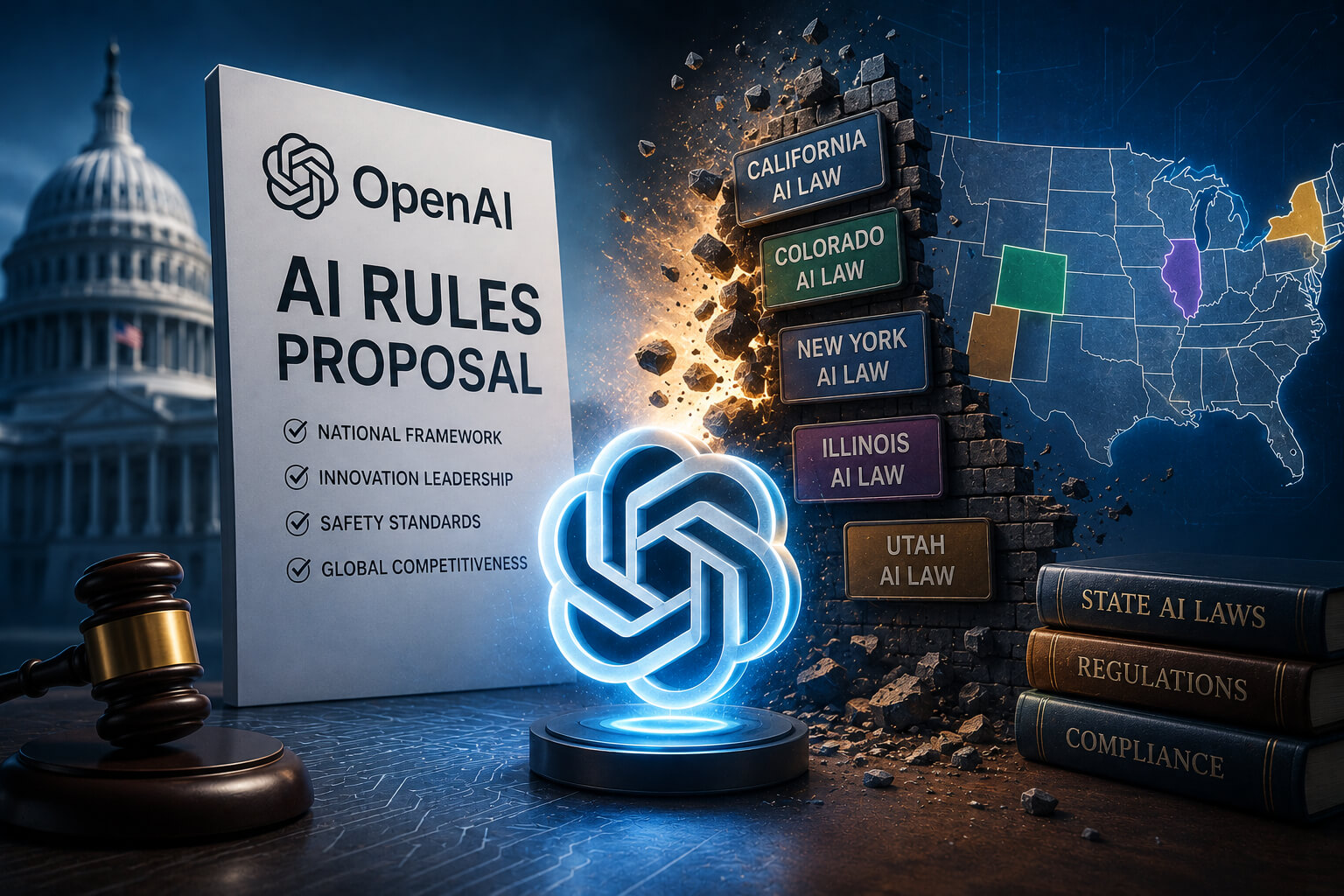
OpenAI wants AI rules in the United States to stop looking like a messy state-by-state experiment. The company is pushing for a single federal framework for frontier AI, one that could override some state laws already moving through places like California, New York, Illinois, and Massachusetts. That sounds like normal policy language. It is not. This is one of the biggest fights in AI regulation right now: who gets to write the rules, Washington or the states?
OpenAI is calling its idea “reverse federalism.” Basically, states can test early laws, Congress can take what works, and then the federal government can turn that into one national standard. Clean, predictable, easier for AI companies to follow. That is the pitch. But critics hear something else. They hear preemption. They hear big AI labs asking Congress to flatten tougher state rules before those rules have a chance to bite.
OpenAI Wants One National AI Rulebook
OpenAI’s proposal asks Congress to create a federal AI framework focused on frontier AI systems, the most powerful models being built by companies like OpenAI, Anthropic, Google, Meta, and xAI.
The company argues that a patchwork of state laws could create confusion, slow down safety work, and force developers to spend more time on conflicting compliance requirements than on actual risk management. In OpenAI’s version, state laws would help shape the federal standard first. After that, rules covering the same frontier AI safety risks could be preempted by Washington.
It is a clever framing. Not “kill state laws.” More like, “let state laws become the draft, then make one final federal copy.” Still, the final copy would matter most.
Why State AI Laws Are Suddenly So Important
States are not waiting quietly for Congress anymore. California already has AI-related rules coming into force, including frontier AI safety requirements, training data transparency rules, and AI-generated content disclosure measures. Texas, Illinois, Nevada, Montana, and Colorado also have AI-related laws or requirements moving across areas like high-risk AI, employment decisions, synthetic media, and consumer disclosures.
That is the problem for AI companies. The United States is becoming a map of different AI obligations.
One state may focus on watermarking. Another may focus on safety plans. Another may require risk assessments. Another may target discrimination in automated decision-making. For companies building nationwide AI products, that becomes a compliance maze fast. OpenAI is not wrong about that. The uncomfortable part is what happens when a federal standard is weaker than the state rules it replaces.
The Anthropic Split Makes This Fight More Interesting
OpenAI is not the only AI company trying to shape regulation. Anthropic is taking a very different route. While OpenAI has pushed for alignment around a national framework, Anthropic has supported stronger state-level AI safety rules. According to Business Insider, Anthropic has backed more ambitious measures in states including New York, Illinois, and Massachusetts, with its policy team arguing that transparency and self-reporting are no longer enough.
That split is revealing. Two of the most important AI labs are not just competing on models. They are competing on the future legal structure around those models. OpenAI wants consistency. Anthropic wants states to keep raising the bar. Both say they care about safety. They just disagree on where the pressure should come from.
The Safety Institute Question
OpenAI’s proposal also points toward a stronger federal role for AI model evaluation. The company wants the Center for AI Standards and Innovation, or CAISI, to play a bigger role in evaluating frontier models before release. But there is a catch. The proposal says CAISI should evaluate models and recommend mitigations, not approve or block deployments. Developers would still keep the final release decision.
That detail matters. A review system that cannot stop deployment is not the same as a regulator with hard authority. It can create pressure. It can create documentation. It can create warnings. But the company still decides whether the model goes out.
For lawmakers worried about catastrophic AI risks, that may not feel strong enough. For AI companies worried about government bottlenecks, it may feel like the only workable compromise. Nobody is fully happy here. Which usually means the real fight has started.
Why OpenAI Says the Clock Is Ticking
OpenAI is framing the issue around frontier AI risk and rapid model improvement. The company has warned about early signs of recursive self-improvement, meaning AI systems that could help accelerate their own development. That is the kind of claim that makes regulators listen, even if they do not fully know what to do with it yet.
The message is simple enough: if powerful AI systems are moving quickly, the rules cannot arrive five years late. But there is another reading too. The same urgency that supports stronger oversight can also be used to justify moving rulemaking away from states and into one federal system that large companies can lobby, shape, and navigate more easily. That is why this debate feels slippery.
Federal AI Rules Could Help Startups, or Hurt Them
A single national framework could be useful for smaller AI companies. Nobody wants to hire a legal team just to figure out whether a model can launch in 12 different states. But big companies are usually better at surviving regulation. They have lawyers. They have policy teams. They have Washington relationships. They can sit in the room while the rules are written.
Smaller developers may benefit from fewer conflicting laws, but they may also end up living under a framework designed around frontier labs with massive resources. That is the quiet risk inside federal AI regulation. It may reduce chaos. It may also harden the lead of the companies already at the top.
The Bigger Issue Is Trust
The public debate around AI rules is not only about innovation. It is about trust. People want AI systems that do not quietly discriminate, manipulate, hallucinate in critical settings, expose private data, or generate harmful outputs at scale. States have stepped in partly because federal action has been slow.
OpenAI’s proposal tries to answer that with a national safety framework. But state lawmakers may not want to give up authority unless the federal version has real enforcement power. That is the real test. Not whether the rulebook is federal or state. Whether it actually has teeth.
What Happens Next
Congress now has to decide whether AI regulation should become one national system or remain a state-driven experiment. OpenAI is betting that the federal government eventually steps in. Anthropic is betting that states can push the industry harder and faster. Lawmakers are stuck between both visions, while AI models keep getting more capable.
The result will shape more than compliance paperwork. It will decide whether U.S. AI governance becomes a ceiling, a floor, or another political compromise that arrives after the technology has already moved on.
Sources
- Times of AI – OpenAI’s AI Rule Proposal Raises Questions Over State Laws
- Implicator AI – OpenAI Wants Congress to Preempt State AI Safety Laws
- Business Insider – Inside Anthropic’s State-by-State Plan to Ratchet Up AI Rules
- Baker Botts – U.S. Artificial Intelligence Law Update
