


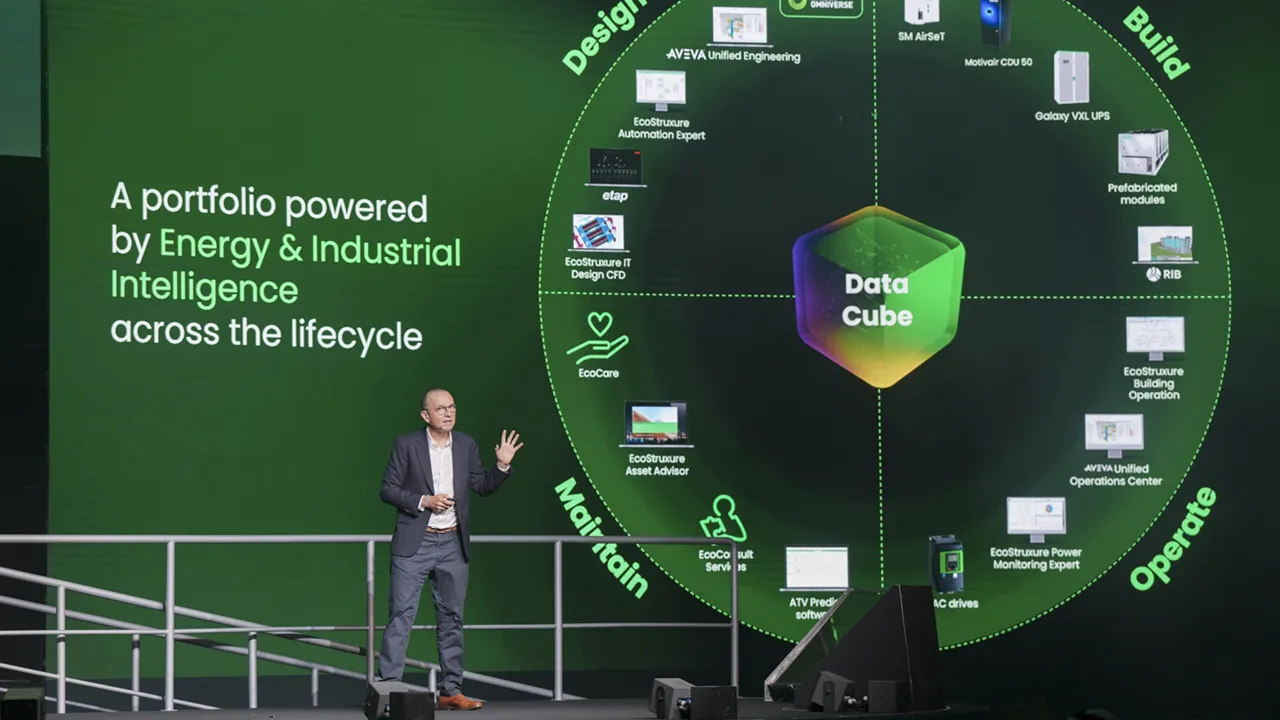
The UAE is moving faster than other surveyed markets in bringing artificial intelligence into food and beverage manufacturing, according to new research from Schneider Electric.
The 2026 Industrial AI in CPG Study found that 23% of UAE food and beverage manufacturers already consider AI a core part of their operations and decision-making. The global figure stands at 16.3%.
The gap could widen. By 2030, 59% of UAE respondents expect AI to reach a transformational level across their businesses, compared with 42.2% globally.
Those numbers suggest something important is happening inside UAE factories. AI is moving beyond isolated trials and into the machinery of everyday industrial operations.
UAE Industrial AI Adoption Moves Beyond Pilot Projects
Industrial AI can cover everything from predictive maintenance and automated quality inspection to production planning, energy management and real-time operational intelligence. In the UAE, adoption is already spreading across factory environments rather than remaining limited to small experimental projects.
Schneider Electric’s research found that 29% of UAE manufacturers have deployed AI across multiple sites or processes. The comparable global figure is 25.3%. Another 23% of UAE respondents said AI has become central to operations and decision-making.
That distinction matters because running an AI pilot on one production line is relatively easy. Connecting AI with several processes, facilities and business decisions requires far more investment, integration and operational planning.
UAE manufacturers also expect the pace to pick up quickly. Around 57% believe AI will be significantly scaled across their operations by 2027. Globally, 40.5% expect to reach that stage within the same period.
Manufacturers Are Betting on AI Returns
The enthusiasm around industrial AI is not just about deploying new technology. UAE manufacturers expect those investments to produce measurable financial results and operational gains.
According to the study, 96% of UAE respondents are confident AI will deliver a return on investment by 2027. That compares with 88.2% globally. Confidence remains high further out, with 92% of UAE manufacturers expecting AI to deliver ROI by 2030, compared with 79.3% globally.
The expected size of those returns is also substantial. UAE respondents forecast an average ROI of 42.4% from AI investments by 2027, compared with 38.1% globally. By 2030, the expected UAE return climbs to 59%, slightly above the 56.9% global average.
These remain expectations rather than guaranteed outcomes. Still, they show how manufacturers increasingly view AI as an investment linked to productivity, efficiency and business performance rather than simply another technology experiment.
Cost Is Becoming a Bigger Obstacle Than AI Readiness
There is a catch. Scaling industrial AI across factories is expensive, and that appears to be one of the biggest concerns for UAE manufacturers.
High implementation costs emerged as the leading obstacle in the UAE, cited by 46% of respondents. Globally, only 19.1% identified cost as a major barrier. Another 23% of UAE respondents pointed to unclear business ownership as a challenge, compared with just 3.1% globally.
Some of the problems slowing AI adoption elsewhere appear slightly less severe in the Emirates. Skills shortages were cited by 40% of UAE respondents, below the 43.6% global result. Legacy infrastructure was identified by 32%, compared with 37.1% globally.
The picture is unusual but telling. UAE manufacturers appear relatively ready to use industrial AI, yet the cost of scaling it across production environments remains difficult to ignore.
Cybersecurity Moves Alongside Industrial AI Expansion
More connected factories also create more digital entry points, which means cybersecurity is becoming part of the industrial AI conversation rather than an issue handled separately.
Schneider Electric found that 38% of UAE manufacturers consider cybersecurity a top focus as they scale AI. That was the highest proportion among the markets surveyed and well above the global average of 21.6%.
Industrial AI often depends on connected sensors, operational technology, production data and software platforms. Expanding that AI footprint can also expand the potential attack surface if systems are not properly secured.
For manufacturers, that means cybersecurity has to be built into the deployment process itself. Faster decisions and automated operations offer little value if the underlying industrial systems become vulnerable.
UAE Factories Already Operate From a Relatively Efficient Base
The study also offers a look at the economics surrounding manufacturing in the UAE and how AI could fit into efforts to reduce costs.
Energy represents an average 11.5% of manufactured-goods costs among UAE respondents, compared with 13.57% globally. That was the lowest energy cost share reported among the markets covered in the study.
Raw materials tell a different story. They account for 21.75% of manufacturing costs in the UAE sample, compared with a global average of 15.31%.
Operational inefficiency remains costly as well, although UAE respondents reported a smaller impact than the wider survey. Food and beverage manufacturers in the Emirates estimated that inefficiencies cost them 15.7% of potential revenue, compared with 17.1% globally.
AI has an obvious opening here. Even relatively efficient factories still have room to improve production schedules, maintenance cycles, quality control, energy consumption and supply-chain decisions.
UAE Government Is Pushing Factory Digitalisation Further
The growth of industrial AI is developing alongside a wider government effort to modernise the country’s manufacturing sector.
The UAE Ministry of Industry and Advanced Technology has introduced Factory Forward UAE, bringing industrial technology transformation programmes together through a national platform. The initiative is designed to help manufacturers access expertise, financing and support for AI and other Fourth Industrial Revolution technologies.
More than 700 factories have already been reached through related industrial transformation programmes, while more than 620 have undergone assessments through the Industrial Technology Transformation Index.
Industrial AI is also moving into real production environments. Earlier in 2026, UAE telecom operator du and Al Gharbia Pipe Company announced an Industrial AI Vision Platform for steel pipe manufacturing. The system uses AI for areas including quality inspection, traceability and real-time production intelligence.
The direction is becoming clearer. Industrial AI is no longer sitting on the sidelines of the UAE’s manufacturing strategy. It is increasingly becoming part of how factories are expected to compete, automate and scale.
What the Schneider Electric Study Covers
The findings come from Schneider Electric’s 2026 Industrial AI in CPG Study, which focuses on consumer packaged goods and food and beverage manufacturing.
Research firm Censuswide surveyed 100 food and beverage decision-makers in the UAE as part of a broader sample of 676 respondents across 15 countries, including the United States, United Kingdom, Germany, Saudi Arabia and Egypt.
Schneider Electric released the UAE findings during its Innovation Summit Middle East and Africa in Abu Dhabi.
The scope of the survey is important. The results show the UAE leading the markets included in this particular study, rather than providing a measurement of every manufacturer or industrial sector worldwide.
Even with that caveat, the findings offer a strong snapshot of where industrial AI adoption is heading. In the UAE, the conversation is already shifting from whether factories will use AI to how quickly they can scale it and whether the economics will justify the investment.
UAE Industrial AI Push Signals a Bigger Manufacturing Shift
What stands out is not just the level of adoption. It is the speed at which UAE manufacturers expect AI to become embedded across operations.
Factories are starting to treat AI as part of production strategy rather than a separate innovation project. Cost remains a problem, cybersecurity is becoming more important and ROI expectations are high, but the overall direction is hard to miss.
For the UAE, industrial AI is becoming another piece of a much larger manufacturing ambition: more automation, better efficiency and factories that can make decisions faster with less manual intervention.
Sources
Middle East AI News — UAE Leads World on Industrial AI in F&B
https://www.middleeastainews.com/p/uae-leads-world-on-industrial-ai
Schneider Electric
https://www.se.com/
UAE Ministry of Industry and Advanced Technology
https://moiat.gov.ae/
Middle East AI News — du and AGPC Industrial AI Platform
https://www.middleeastainews.com/p/du-agpc-industrial-ai-platform
