


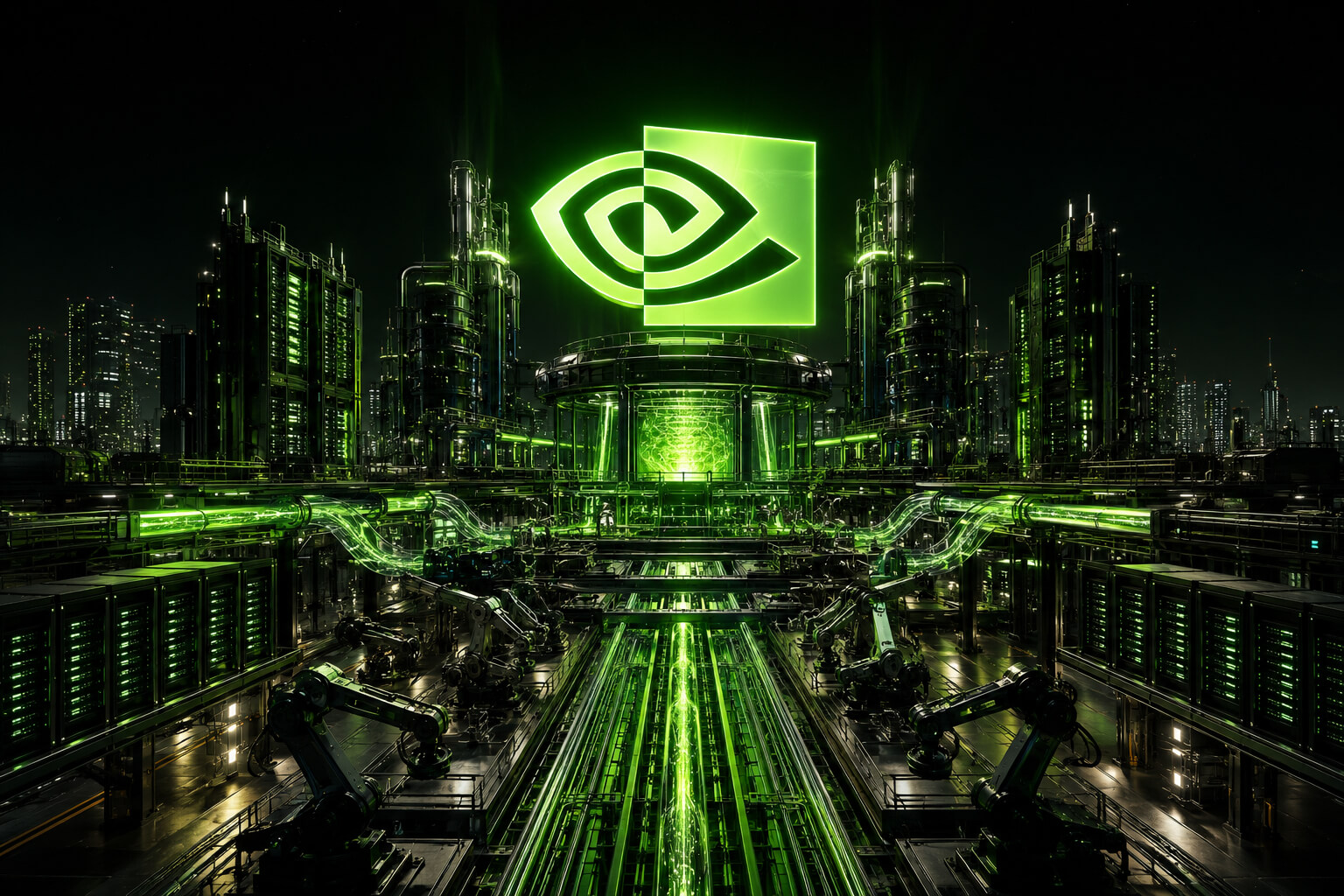
NVIDIA is pushing for AI factories as the next wave of computing infrastructure, which it defines as systems that provide intelligence at scale on a continuous basis.
In the industrial age, power plants converted energy into electricity. In the AI age, NVIDIA argues that AI factories convert energy into tokens, the basic unit used by reasoning models, AI agents, and intelligent applications.
This is a fundamental shift in the construction, deployment and measurement of artificial intelligence. AI is no longer just software running in the cloud. It is becoming a form of essential infrastructure that requires massive compute, advanced networking, real-time orchestration, and energy-efficient hardware.
What Is an AI Factory?
An AI factory is a full-stack infrastructure system built to run AI workloads continuously. It doesn’t just store data or act as an application server it pumps out AI generated output 24/7.
By integrating GPUs, CPUs, memory, networking, storage, software, cooling and orchestration tools into one optimized environment, they aim to deliver intelligence efficiently, reliably and at huge scale.
For NVIDIA, the key business metrics of an AI factory are:
- Tokens per second
- Tokens per watt
- Cost per token
- System utilization
- Uptime
- Real-time responsiveness
These metrics are becoming more and more important as companies move from simple AI chatbots to more complex agentic AI systems which can reason, plan, search, retrieve information, write code, and take action.
Agentic AI Is Changing Infrastructure Demands
The rise of agentic AI is one of the main reasons NVIDIA believes AI factories are necessary.
Traditional AI inference often involved a user submitting a prompt and receiving a response. Agentic AI is different. These systems may perform multiple steps, use tools, call external data sources, create sub-agents, and complete complex workflows.
That makes AI workloads longer, more interactive, and more compute-intensive.
To support these workloads, AI infrastructure must handle low latency, high throughput, memory management, fast data movement, and continuous coordination across hardware and software layers.
In other words, AI factories are not just bigger data centers. They are purpose-built environments for producing real-time intelligence.
Why Cost Per Token Matters
As AI adoption grows, the economics of inference are becoming critical.
“The cost of creating each token has a direct impact on the potential profitability and scalability of AI systems,” says NVIDIA. For companies building or renting AI infrastructure, lower cost per token can make large-scale AI deployment more practical.
Performance per watt is also becoming a key measure of competitiveness. Since AI factories require major power and cooling resources, the ability to generate more tokens from the same energy footprint can directly improve business efficiency.
This is why NVIDIA is focusing heavily on full-stack optimization, from chips and networking to inference software and data center design.
NVIDIA Blackwell Ultra and GB300 NVL72
NVIDIA says its Blackwell Ultra platform is designed to improve AI factory economics by increasing throughput while lowering token costs.
According to NVIDIA, its GB300 NVL72 systems can generate significantly more tokens per megawatt than previous-generation Hopper-based systems. The company says this can help AI factories produce more intelligence from the same power envelope.
NVIDIA also highlights its Dynamo framework, which is designed to help orchestrate long-context reasoning and high-throughput inference. This software layer is important because AI factories need to route requests, manage memory, balance latency and throughput, and keep utilization high across the entire system.
Vera Rubin Extends NVIDIA’s AI Factory Roadmap
NVIDIA is also pointing to its Vera Rubin platform as part of the next phase of AI factory development.
As reasoning models and agentic AI systems continue to scale, NVIDIA says Vera Rubin-based systems are designed to push performance-per-watt higher and drive token costs lower through deeper full-stack optimization.
This reflects a broader industry trend: AI performance is no longer only about having faster chips. It is about designing the entire system — compute, networking, memory, storage, software, power, and cooling — to work together efficiently.
From data centers to AI factories
The AI factory concept is a significant evolution from traditional data centers.
Older data centers were primarily built to store files, host applications, and process conventional workloads. AI factories are designed to continuously generate intelligence for enterprises, developers, researchers, robots, autonomous systems, and AI agents.
NVIDIA says these factories can support many use cases, including:
- Enterprise AI assistants
- Agentic AI workflows
- Robotics and physical AI
- Autonomous systems
- Scientific research
- Financial services
- Life sciences
- Manufacturing
- Public sector AI applications
The company believes organizations may either build their own AI factories or rent access to them, depending on their scale, budget, and technical needs.
NVIDIA’s Partner Ecosystem
NVIDIA is working with major global technology partners to bring AI factory infrastructure into enterprise environments. Its ecosystem includes companies such as Cisco, Dell, HPE, Lenovo, and Supermicro.
These collaborations matter because you can’t just throw GPUs at the problem of building AI factories. Enterprises need the whole shebang—networking, servers, cooling, software, reference architectures, and support for deploying.
NVIDIA is also promoting its DSX reference designs and Omniverse DSX Blueprint, which help organizations model AI factory facilities using digital twins to simulate power, cooling, hardware and operations before construction, and optimize systems after deployment.
Why AI Factories Matter
AI factories might turn out to be one of the most important technology infrastructure trends of the next decade.
The move from chatbots to always-on reasoning systems will require infrastructure for continuous intelligence production. Expect a greater focus on real-time inference, energy efficiency, software orchestration and cost-per-token economics.
The message for NVIDIA is clear: the next wave of AI growth will depend not only on better models but the infrastructure capable of running them at industrial scale.
Bigger Picture
The AI industry is on the cusp of a period where infrastructure could be as important as the models themselves.
The vision of an AI factory by NVIDIA for companies means that they will compete more and more on how efficiently they can produce intelligence. Just as factories revolutionized physical production in the industrial revolution, AI factories could revolutionize digital production in the intelligence era.
If NVIDIA’s vision plays out, the future of AI will not be powered by software alone. It will be powered by massive, optimized, always-on systems built to turn energy into intelligence.
For more Breaking AI news visit: https://breakingai.news
