


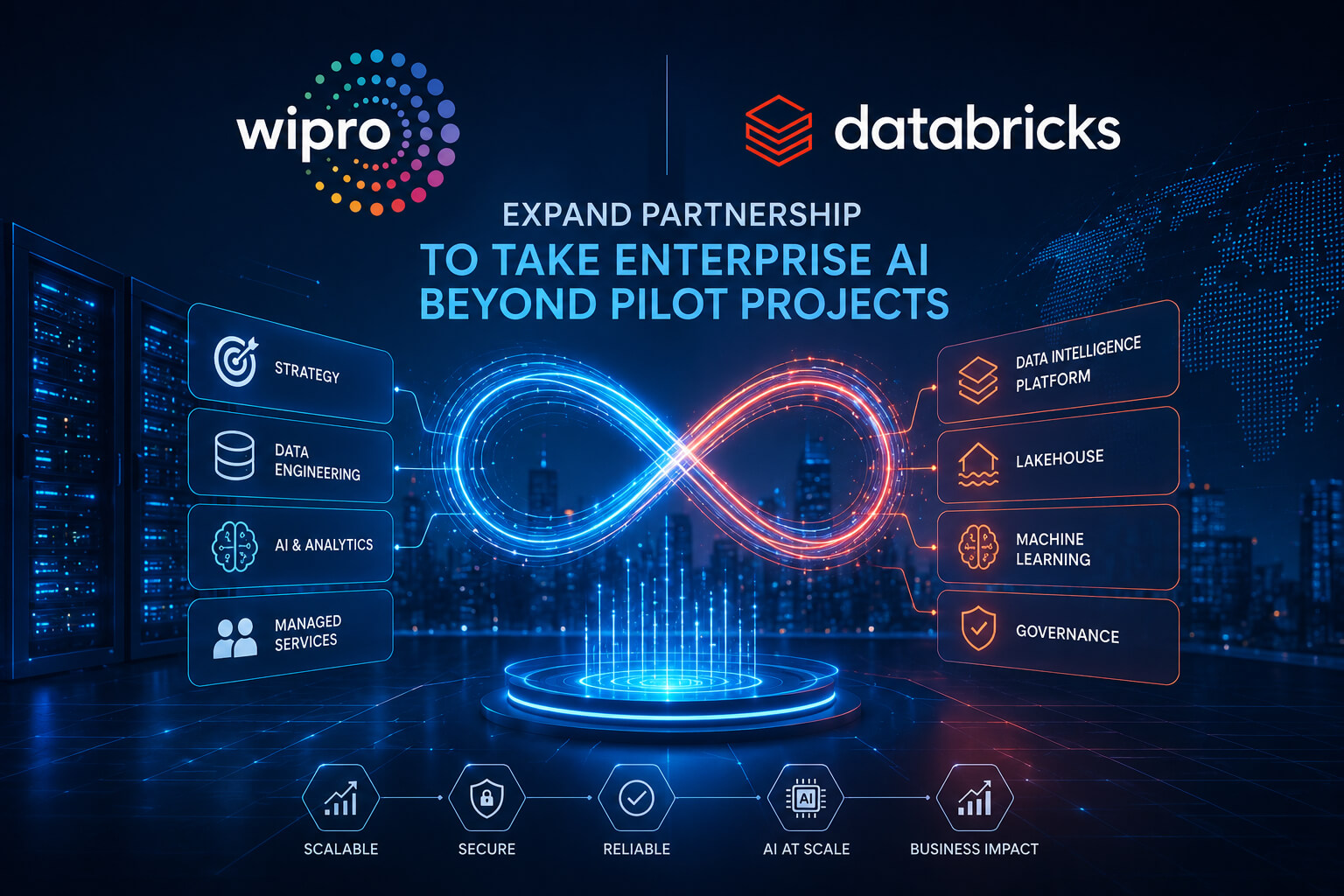
Wipro has expanded its partnership with Databricks, setting up a dedicated global business practice focused on enterprise data modernization and large-scale artificial intelligence deployment. The announcement sounds familiar at first. Another technology services company. Another cloud data platform. Another promise to help enterprises “unlock value” from AI.
The more important detail sits underneath the usual partnership language. Wipro and Databricks are targeting the awkward gap between AI experiments that work during a demonstration and systems that can survive inside a real company. That means dealing with scattered data, older technology, governance requirements and business teams that cannot wait months for every new analytics request.
Wipro Creates a Dedicated Databricks Business Practice
Wipro has established what it describes as a self-contained Databricks business practice. The group will combine consultants, platform specialists and industry teams to develop solutions and implementation tools for shared customers. Rather than treating Databricks as one product inside a much larger consulting catalogue, Wipro appears to be building a more focused operation around the platform.
The practice will support data modernization, application development, analytics and agentic AI projects. Wipro says it will also create industry-specific offerings designed around problems in banking, healthcare, telecommunications, manufacturing, consumer goods and energy.
That structure matters. Large companies rarely struggle because they cannot find an AI model. They struggle because useful data remains trapped inside different departments, outdated applications and incompatible storage systems. A model can generate an impressive answer during a controlled test. Giving it reliable access to company data, applying permissions and keeping the result accurate is the harder part.
The Partnership Targets Fragmented Enterprise Data
Wipro and Databricks say the expanded collaboration will help customers move away from fragmented data foundations and isolated AI pilots. That phrase captures a problem now showing up across the enterprise market. Companies have launched copilots, internal chatbots and generative AI trials, but many still lack a unified data environment behind them.
Without that foundation, AI systems may produce incomplete results, expose information to the wrong users or rely on data that nobody fully trusts. Databricks brings its data, analytics, governance and AI infrastructure to the partnership. Wipro contributes consulting, systems integration and industry knowledge through its Wipro Intelligence suite.
The companies are not pitching one general-purpose AI package. They want to build systems around specific workflows, where the business problem and the underlying data already have a clear connection.
Databricks Genie Brings Natural-Language Data Access to Business Teams
Databricks Genie will form part of the new practice. Genie allows employees to ask questions about enterprise data using natural language instead of writing SQL queries or waiting for an analyst to prepare a report. It can return written answers, tables and visualizations based on information available inside an organization’s governed Databricks environment.
That could make analytics more accessible, although it does not remove the need for careful data preparation. A conversational interface placed over messy or poorly defined data simply makes the mess easier to query. Wipro’s role will likely involve much of the less visible work: migrating systems, defining permissions, organizing datasets and adapting the technology to the language used inside each industry.
For business users, the final experience may feel like chatting with company data. Behind the interface, however, the setup can involve years of information, conflicting definitions and strict access controls.
WEGA Will Support the Move Away From Legacy Systems
Wipro will also use WEGA, its agent-native delivery platform, to help enterprises move from legacy systems to scalable data architectures that can support AI applications. WEGA embeds AI agents across software development workflows, including design, coding, testing, infrastructure, release management and security. Wipro positions the platform as a way to coordinate these stages rather than relying on disconnected development tools.
In the Databricks partnership, WEGA is expected to support migration and implementation work. Legacy modernization is not the glamorous side of enterprise AI, but it often determines whether a project reaches production. An organization cannot easily deploy sophisticated agents when the information they need still lives across outdated databases and manually maintained spreadsheets.
The partnership gives Wipro another platform around which it can package that modernization work.
Banking, Telecom and Energy Use Cases Take Priority
Wipro says the dedicated practice already draws on more than 300 agentic AI and data use cases delivered across multiple industries. Proposed applications include wealth management and portfolio optimization for financial institutions, sales and marketing transformation for telecommunications companies, supply planning for manufacturers and asset performance monitoring for energy businesses.
The companies also highlighted AI-led finance transformation, including changes to financial planning and analysis processes. These are not lightweight chatbot projects. They involve decisions connected to revenue, operational performance, customer relationships and financial controls.
Wipro will need to prove that the solutions create measurable improvements rather than simply adding another AI layer to existing enterprise software.
There is some evidence behind the companies’ longer relationship. Databricks named Wipro its 2026 Innovation Partner of the Year, citing banking solutions built on its platform. One example involved a bill-payment system serving millions of users that Databricks said contributed to a 35% improvement in customer satisfaction.
Enterprise AI Partnerships Are Becoming More Specialized
The Wipro and Databricks partnership reflects a broader change in how large consulting companies approach AI. Early enterprise AI programmes often centered on workshops, proofs of concept and broad transformation plans. The focus is shifting toward dedicated practices, reusable industry tools and production systems connected to governed business data.
That does not mean the experimentation phase has ended. It means customers now expect consulting firms to show how an AI project will move beyond it. A dedicated practice can help by bringing technical and industry teams into the same operating structure. It can also turn successful implementations into repeatable products that Wipro can sell to similar customers.
The danger is that these accelerators become generic templates dressed in industry language. Banking, healthcare and energy companies may use similar data infrastructure, but their regulations, workflows and risk thresholds remain very different.
The Real Test Will Be Production-Scale Results
Wipro and Databricks are positioning their expanded partnership around trusted data, governed AI and measurable business outcomes. The language makes sense. Enterprises have already spent heavily on cloud infrastructure, data warehouses and generative AI pilots. Many now want those investments to work together rather than exist as separate technology programmes.
Still, creating a dedicated practice does not automatically solve the difficult parts of enterprise AI. Success will depend on whether Wipro can shorten migrations, improve data quality and deliver systems that employees genuinely use. Databricks, meanwhile, must make its AI tools accessible without weakening governance or adding unnecessary complexity.
The partnership has the ingredients for larger deployments: a major global systems integrator, a widely used data platform and a growing collection of industry use cases. What comes next is less polished than a launch announcement. It involves integration work, data cleanup, internal politics and proof that AI can produce results after the pilot team leaves the room.
Media Contact:
Dinesh Joshi
Dinesh.joshi@wipro.com
+91 92052 64001
Source: Wipro News
