


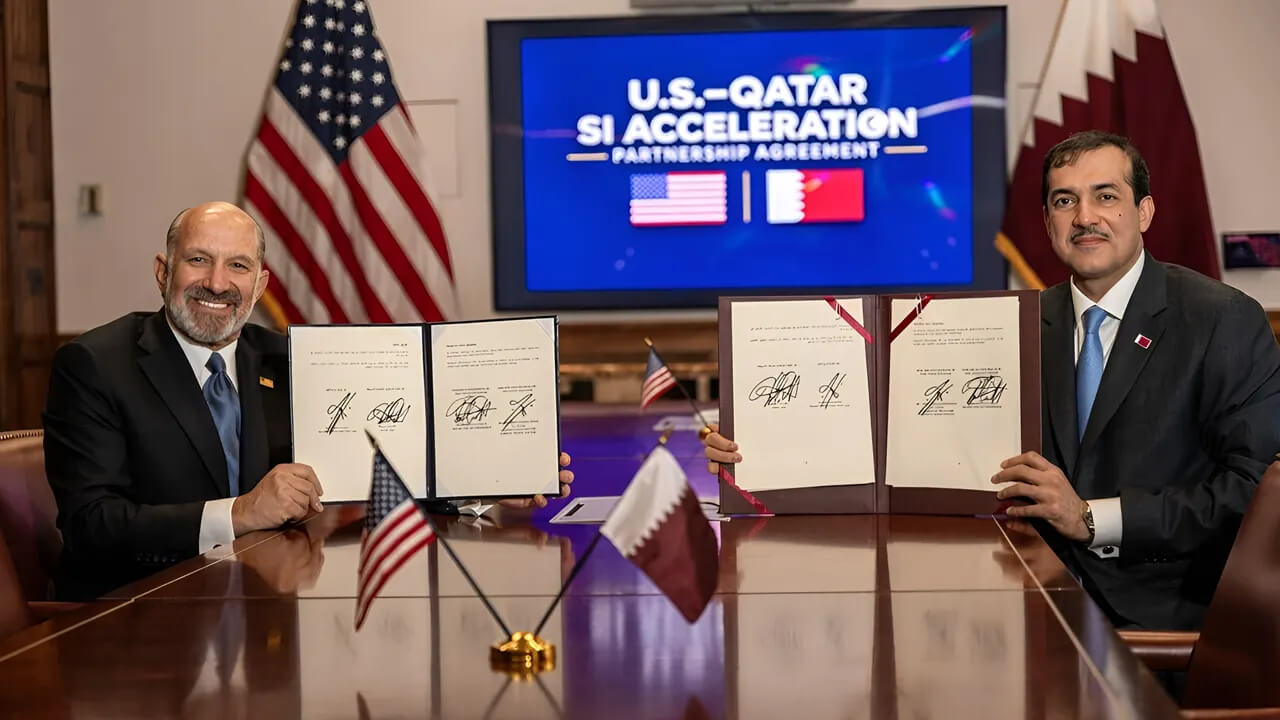
The United States has authorized the export of up to 300,000 advanced artificial intelligence chips to Qatar through 2028. This gives the Gulf nation access to computing technology potentially worth tens of billions of dollars. Announced by the US Department of Commerce on November 23, 2026, the US AI chip deal with Qatar forms part of the Super Intelligence Acceleration Partnership between the two countries. The agreement comes as Qatar looks to expand its digital infrastructure. Moreover, Qatar seeks to establish a stronger position in the rapidly growing global AI industry.
Qatar Secures Access to 300,000 Advanced AI Chips
Under the agreement, Qatar’s national artificial intelligence company, Qai, will be eligible to receive up to 100,000 advanced AI processors. Meanwhile, American companies operating data centers in Qatar will account for the remaining 200,000 chips. The computing hardware could support large-scale AI model development, cloud computing services and enterprise applications. It could also attract international technology companies looking to expand their operations in the Middle East. However, the agreement establishes an export authorization limit rather than confirming that Qatar has already purchased or received all 300,000 processors.
Washington Introduces Strict Security Conditions
Access to American semiconductor technology comes with several restrictions. Qatar must comply with security requirements covering physical access to processors, remote access to computing resources and customer verification procedures. The US Bureau of Industry and Security will oversee compliance as Washington seeks to prevent unauthorized organizations from accessing sensitive American technology. These safeguards reflect growing concerns in the United States about semiconductor diversion and the potential misuse of advanced computing infrastructure overseas.
Qatar Strengthens Its Position in the Gulf AI Race
Qatar joins Saudi Arabia and the United Arab Emirates in securing major semiconductor arrangements with Washington. The country introduced its first national AI strategy in 2019 and launched Qai in December 2025 to support AI infrastructure development and technology investments. In October 2026, Qatar also moved to establish a National Center for AI to oversee national strategy, regulation and adoption. Access to advanced American processors could accelerate these initiatives. This is particularly true as competition for AI infrastructure, international investment and technology talent intensifies across the Gulf.
US and Qatar Expand Strategic Technology Cooperation
The two countries signed the agreement during the eighth Qatar-US Strategic Dialogue in Washington. US Secretary of Commerce Howard Lutnick and Qatar’s Minister of State for Foreign Trade Affairs, Dr. Ahmad bin Mohammed Al Sayed, represented their respective governments. Alongside the AI partnership, both countries reached a separate understanding covering critical minerals and rare earth elements. These play an important role in semiconductor manufacturing and advanced technology supply chains. The agreements build on the broader economic partnership announced in May 2025 and strengthen Qatar’s involvement in Pax Silica, a US-led initiative focused on strategic technology supply chains.
What the US AI Chip Deal Means for Qatar’s Digital Economy
Securing access to advanced processors gives Qatar an opportunity to develop a more competitive artificial intelligence ecosystem. The country has considerable financial resources, but access to high-performance computing remains essential for developing AI models and commercial technology services. The bigger question is how quickly Qatar can turn these export authorizations into operational data centers, research facilities and commercially viable AI applications. With Saudi Arabia and the UAE already pursuing large-scale technology investments, Qatar’s latest agreement adds further momentum to the Middle East’s expanding AI infrastructure market.
