


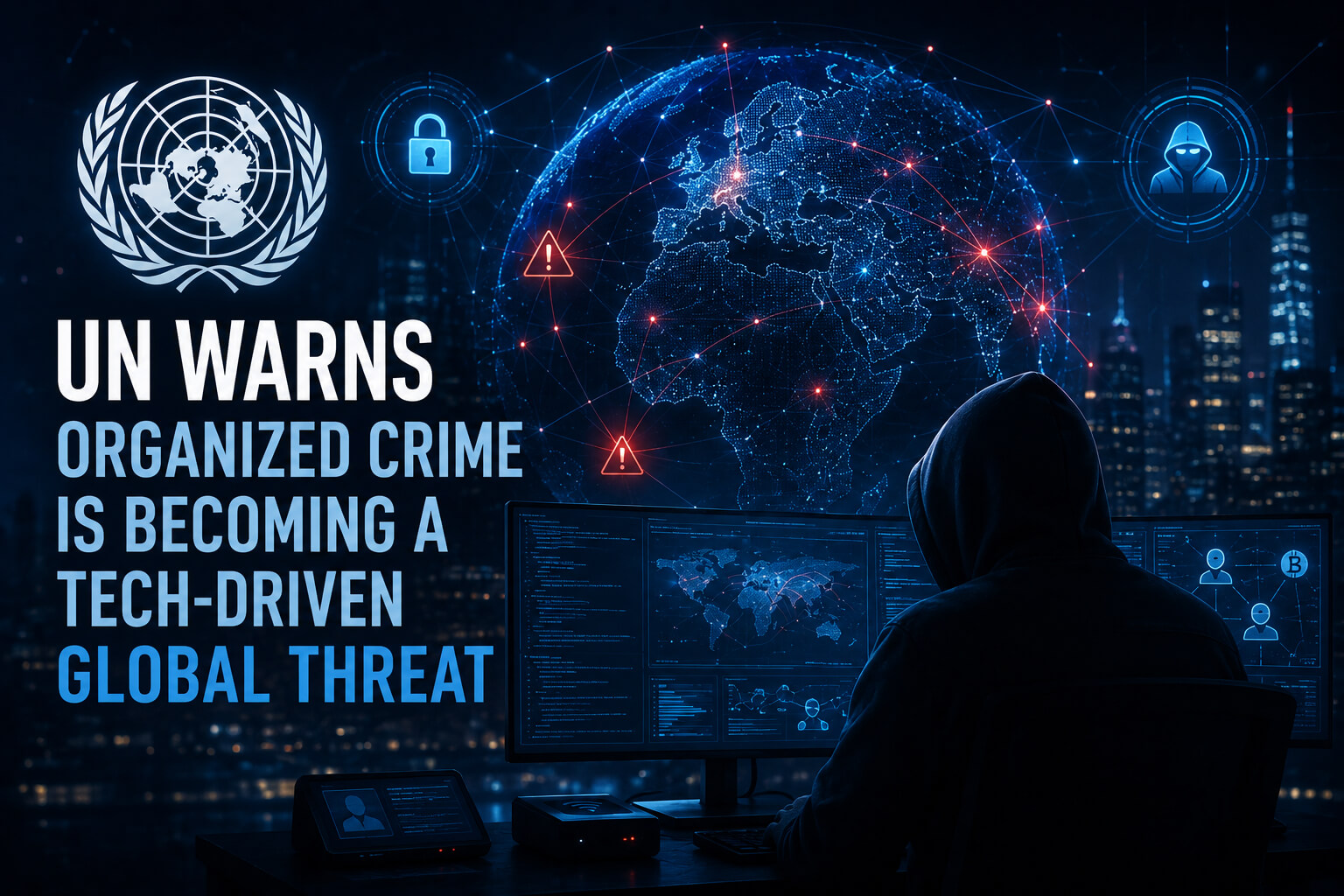
Organized crime does not always look like war. There are no tanks. No official front line appears. And no dramatic press conference takes place with flags behind it.
That may be exactly why the world keeps underestimating it.
A new United Nations report warns that organized criminal networks are causing a level of harm comparable to armed conflict, while hiding inside economies, communities, supply chains, and digital systems. Since 2000, the UN estimates that organized criminal groups have been linked to around 95,000 homicides every year, close to the estimated annual death toll from armed conflicts worldwide.
The uncomfortable part is this: the problem is not only about violence anymore. It is also about technology, online scams, trafficking networks, and criminal systems that move faster than many governments can respond.
Organized Crime Is Not Staying Offline
The UN report points to a major shift. Criminal groups are no longer operating only through street violence, drug routes, and smuggling networks. They are adapting to the same digital tools that power modern business.
Encrypted messaging, online recruitment, digital payments, social platforms, cyber fraud, and cross-border scam operations are giving criminal networks new reach. The UN says technology is transforming organized crime, allowing fraud, extortion, and scam networks to target victims across several countries at the same time.
This is where the AI angle becomes hard to ignore.
The report does not frame artificial intelligence as the only driver of the problem, but the direction is clear. Criminal systems are becoming more automated, more decentralized, and more difficult to trace. Add AI-generated messages, synthetic identities, voice cloning, deepfake video, and automated phishing into that environment, and the threat becomes much bigger than traditional cybercrime.
Not futuristic. Already forming.
Scam Centres Show the Human Cost Behind the Screens
One of the most disturbing parts of the UN report involves scam centres. These are not just anonymous online fraud hubs. In many cases, they are built on human exploitation.
The UN cites findings that people trafficked and forced to work in scam centres have been subjected to torture, sexual abuse, and prison-like conditions. These victims are often promised jobs, travel opportunities, or a better future, only to be trapped inside criminal operations.
That changes how people should think about online scams.
Behind a fake investment message, romance scam, phishing link, or crypto fraud campaign, there may be another victim being forced to carry it out. The person sending the scam may not be free either.
This is the darker side of the digital economy. Criminal groups are not only stealing money. They are building systems where exploitation feeds fraud, and fraud funds more exploitation.
Cybercrime Is Becoming Big Business
The money involved is huge.
According to the UN, online scams in East and Southeast Asia alone caused an estimated $18 billion to $37 billion in losses in 2023.
That kind of figure explains why criminal networks keep scaling. Cyber-enabled crime is profitable, borderless, and often harder to prosecute than traditional organized crime. A scam operation can target people in multiple countries without needing to physically move across borders.
For governments, banks, platforms, and law enforcement agencies, this creates a messy problem. The criminal network may sit in one country. The victims may live in another. The money may move through crypto wallets, shell companies, mule accounts, or informal transfer systems. Evidence may vanish quickly.
And now AI can make the front end of scams more convincing.
A badly written scam email used to be easier to spot. Today, generative AI can clean up the grammar, imitate local writing styles, translate messages instantly, and personalize attacks at scale. That does not mean every scam is AI-powered. It means the barrier to creating believable fraud has dropped.
Criminal Networks Are Starting to Look Like Shadow Governments
The UN report also warns that organized criminal groups can become powerful enough to rival the state itself.
In some regions, these networks control territory, enforce rules, settle disputes, corrupt officials, dominate markets, and provide selective services. The UN points to Haiti, where gangs reportedly controlled around 85 percent of Port-au-Prince by 2024.
That matters because organized crime is not only a policing issue. It becomes a governance issue.
When criminal groups control roads, ports, neighborhoods, recruitment networks, digital fraud centres, or local economies, they do not need to formally take power. They already have influence. Quiet influence, but real.
Technology can make that influence even stronger. Digital finance moves money. Social media spreads intimidation or recruitment. AI tools can help produce fake documents, impersonate people, or coordinate scams more efficiently.
The threat is not one dramatic AI supercriminal. It is something more practical and more dangerous: existing criminal systems using better tools.
Why the World Keeps Missing the Scale of the Problem
War gets attention because it is visible. Explosions are filmed. Cities are destroyed on camera. Leaders respond publicly.
Organized crime works differently.
It hides inside legal businesses, recruitment agencies, professional services, logistics networks, financial systems, and online platforms. The UN notes that criminal networks often operate through legitimate-looking structures, which makes them harder to detect and dismantle.
That is why the problem can feel smaller than it is.
A trafficking victim disappears from public view. A scam victim feels ashamed and stays silent. A journalist is threatened. A community leader is killed. A government office becomes compromised. A young person is recruited online. A small business loses money to fraud.
No single moment explains the whole system. That is the trick.
AI Makes the Next Phase More Complicated
The rise of AI does not create organized crime from scratch. These networks already existed. They already had money, routes, recruiters, corrupt links, and methods for hiding.
But AI can improve parts of their operation.
It can help scammers write better messages. Fake images and documents become easier to generate. Voices can also be imitated. Believable customer service scripts can be produced quickly. Targeting can become automated. As a result, criminals can test different versions of fraud campaigns faster than before.
That should worry policymakers and tech companies.
AI safety is often discussed around misinformation, copyright, jobs, and national security. Those debates matter. But organized crime deserves a bigger place in the conversation. Criminal networks are practical. They adopt whatever works.
If AI makes fraud cheaper, faster, and more convincing, they will use it.
The Bigger Lesson
The UN’s warning is not just about crime statistics. It is about visibility.
Organized crime kills, exploits, corrupts, and destabilizes, but it often does so quietly. Now, with technology reshaping how criminal groups operate, the quiet threat is becoming more scalable.
Governments will need stronger cybercrime cooperation. Platforms will need better detection. Banks and fintech firms will need faster fraud intelligence. AI companies will need to think harder about misuse. And the public needs to understand that online scams are not isolated annoyances. They may be connected to global criminal systems.
The old image of organized crime is outdated.
Today, it can look like a fake job ad, a polished investment pitch, a social media message, a cloned voice, a crypto wallet, or a scam centre hidden behind a normal building.
That is the part worth paying attention to.
