


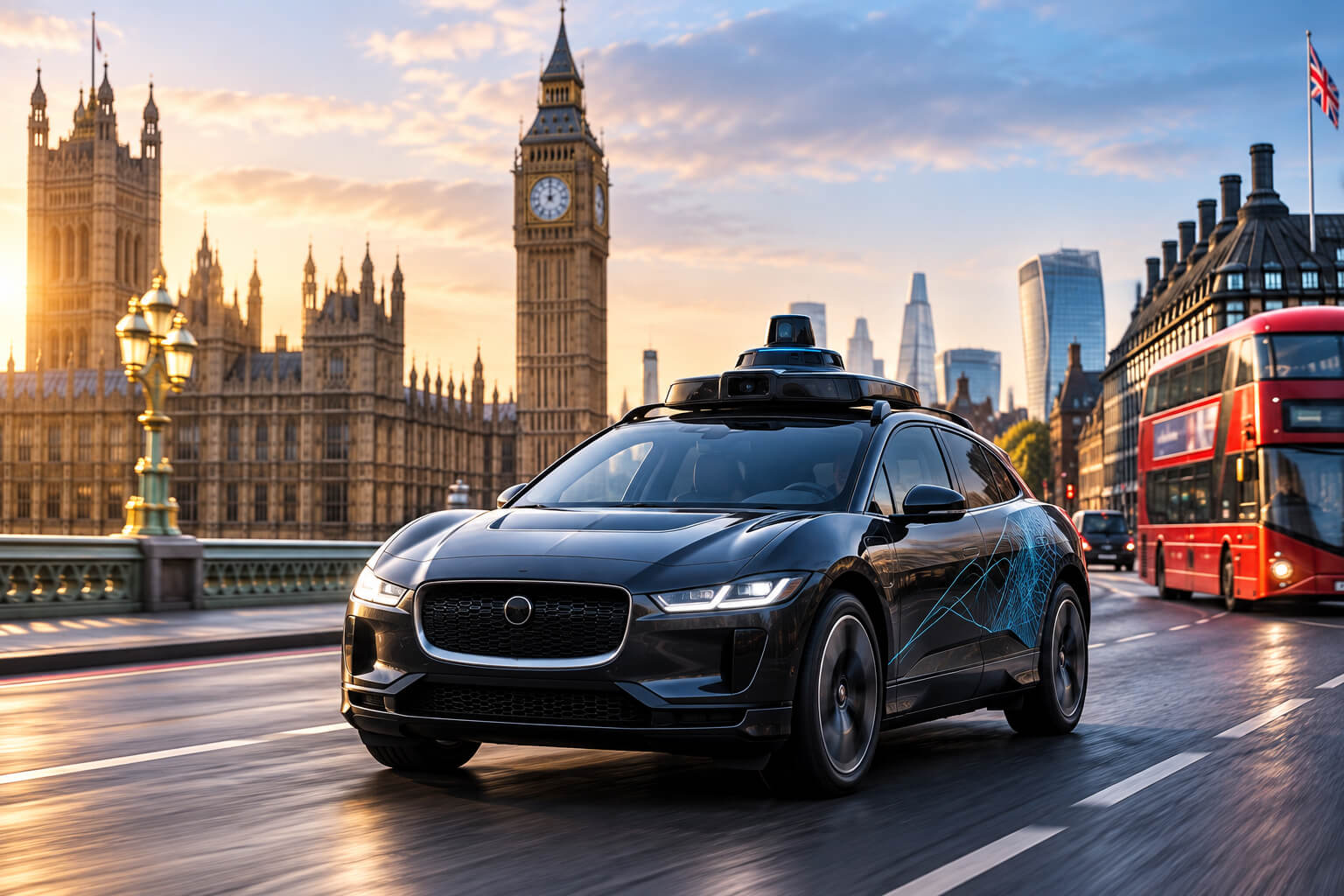
London is becoming a real-world test bed for autonomous transport, and Uber is now part of that shift. The ride-hailing company has partnered with British autonomous driving firm Wayve to launch supervised robotaxi rides across the capital, giving passengers the chance to experience AI-powered driving through the regular Uber app.
The service is starting small, with 15 all-electric Ford Mustang Mach-E vehicles equipped with Wayve’s AI Driver technology. A licensed safety driver remains behind the wheel, but the cars handle much of the driving themselves. It is an early step, although one that puts autonomous ride-hailing much closer to ordinary daily travel.
London Passengers Can Now Be Matched With a Robotaxi
Passengers ordering UberX, Uber Electric or Uber Comfort can now potentially be matched with one of Wayve’s autonomous vehicles. There is no separate booking process and no special robotaxi app. The experience is designed to feel like a normal Uber journey, with the fare shown upfront and the autonomous vehicle arriving through the same platform customers already use.
Passengers still have control over whether they want to take the ride. If Uber matches them with a Wayve vehicle, they can accept it or switch back to a conventional car before pickup. Uber says the vehicles can travel across most of London, excluding airports, and customer interest appears strong, with more than 140,000 users reportedly adjusting their ride preferences to improve their chances of being matched with an autonomous vehicle.
Inside the car, passengers can follow the route through an interactive display that shows what the vehicle is doing and where it plans to go. The interface supports dozens of languages, while the Uber app continues to handle the familiar parts of the experience, including unlocking the vehicle and starting the journey.
There Is Still a Human Behind the Wheel
The term robotaxi makes the service sound fully driverless, but that is not quite where the technology is yet. Every Wayve vehicle currently operating through Uber carries a licensed safety driver who supervises the trip and can take control whenever necessary.
That distinction matters because the technology is still being tested under real traffic conditions. During early media demonstrations, safety drivers reportedly intervened in certain situations, including heavy traffic and interactions with parked vehicles. Those moments show why autonomous driving remains difficult. London roads are unpredictable, and the system has to interpret human behaviour, moving vehicles, cyclists and pedestrians in real time.
Wayve has argued that some interventions come from cautious safety procedures rather than a failure of the AI itself. Even so, supervised operation gives the company an opportunity to learn from these situations before removing the human driver completely.
Wayve Is Taking a Different Approach to Autonomous Driving
Wayve’s autonomous driving system is built around a different philosophy from many earlier self-driving projects. Instead of relying heavily on detailed high-definition maps and manually programmed rules for every possible road situation, Wayve uses an AI-first system that learns from driving data and adapts to what it sees.
The company refers to this approach as AV2.0. Its AI Driver uses onboard sensors and machine learning models to understand traffic, road layouts and surrounding behaviour. The aim is to make the system more flexible when it encounters situations or locations it has not seen exactly before.
This matters because autonomous vehicles will eventually need to work across thousands of streets without engineers mapping every road or programming every edge case. Wayve is betting that a more generalised AI system can make that expansion easier.
The technology has also been designed to work across different vehicle types and hardware configurations. That could make it easier for automakers and fleet operators to integrate the system without developing an entirely new autonomous vehicle platform from scratch.
London Gives the AI a Difficult Place to Prove Itself
London is not an easy city for autonomous driving. Narrow streets, cyclists, buses, pedestrians, delivery vehicles, roadworks and constantly changing traffic conditions make the capital a demanding environment for any self-driving system.
That difficulty is part of the appeal for Wayve. The company has been testing its technology on London roads for years, giving its AI exposure to the kind of complicated situations that are hard to recreate in controlled environments.
Operating with paying passengers raises the stakes further. The system now has to perform consistently while dealing with ordinary traffic rather than carefully selected test routes. If Wayve can make autonomous driving work reliably in London, it strengthens the case that its technology could adapt to other complex cities.
The current deployment should therefore be viewed as more than a small commercial launch. It is also a large-scale test of whether Wayve’s AI-first approach can operate safely in one of Europe’s busiest urban environments.
Uber Is Building a Platform for Autonomous Vehicles
Uber’s role in the partnership is slightly different from Wayve’s. Rather than trying to build the autonomous driving technology itself, Uber increasingly appears focused on becoming the platform that connects self-driving vehicle operators with passengers.
That strategy allows Uber to work with multiple autonomous driving companies at the same time. The company already has partnerships across mobility, delivery and freight, and autonomous vehicles could eventually become another type of driver operating through the Uber network.
The Wayve partnership fits neatly into that model. Wayve provides the autonomous driving technology, while Uber brings the app, customer base, payments system and ride-hailing infrastructure.
Uber expects human drivers and autonomous vehicles to operate side by side for some time. Instead of replacing all drivers immediately, the platform could gradually introduce more self-driving vehicles in markets where regulations and technology allow them.
Fully Driverless Rides Are the Real Next Step
The current London launch is still supervised, but the long-term goal is fully driverless passenger service. That will require further regulatory approval before Wayve and Uber can remove the safety driver from the vehicle.
The UK has been building a legal framework for autonomous transport, including pilot programmes that allow companies to test self-driving taxi and bus services under controlled conditions. Local transport authorities will also play an important role in deciding how these services operate.
Until those approvals arrive, the London fleet will continue functioning as a supervised service. That gives Uber and Wayve more time to collect driving data, understand passenger behaviour and demonstrate that the system can operate safely across a wide range of conditions.
Competition is also growing. Other autonomous driving companies are preparing or exploring robotaxi deployments in London, which could turn the city into one of Europe’s most important testing grounds for commercial autonomous transport.
Wayve Plans to Take Its AI Driver Beyond London
London is only one part of Wayve and Uber’s wider partnership. The companies have already discussed bringing Wayve-powered vehicles to multiple international markets, which will test whether the AI Driver can adapt to very different road systems.
Future deployments are expected to involve other vehicle models as well. Wayve has designed its technology to work across different manufacturers, which could allow its autonomous system to appear in a broader range of cars instead of being tied to one specific platform.
Expansion into cities outside the UK will be particularly important because it will test whether Wayve’s generalised AI approach can handle different road markings, traffic rules, driving cultures and urban layouts.
If that works, the company could have an advantage over autonomous systems that require extensive mapping and city-specific engineering before they can operate.
Why the Uber and Wayve Robotaxi Launch Matters for AI
The Uber and Wayve launch matters because it moves artificial intelligence beyond software and into the physical world. Much of the AI boom has centred on chatbots, image generation, coding assistants and business software. Autonomous vehicles introduce a very different challenge because the AI has to interpret the real world and make decisions with immediate consequences.
Wayve is effectively testing whether a machine learning system can develop enough general driving intelligence to handle messy, unpredictable urban environments. That is a much harder problem than operating inside a controlled digital platform.
For Uber, the shift could also reshape ride-hailing over time. The company does not necessarily need to own the autonomous technology if it can become the marketplace where multiple robotaxi providers compete for passengers.
The first 15 vehicles will not transform London transport overnight. Their real significance lies in what comes next. If safety drivers eventually disappear and autonomous vehicles begin operating at scale, this early rollout could look like the start of a much bigger change in how people move through cities.
Sources
TechRepublic: Uber and Wayve launch supervised robotaxi rides in London
https://www.techrepublic.com/article/news-uber-wayve-robotaxi-london-emea-uk/
Uber Investor Relations: Wayve and Uber Launch First-Ever Autonomous Rides in the UK
https://investor.uber.com/news-events/news/press-release-details/2026/Wayve-and-Uber-Launch-First-Ever-Autonomous-Rides-in-the-UK-2026-VoFQI1WbQi/default.aspx
UK Government: Passengers one step closer to booking taxi and bus-style self-driving vehicles
https://www.gov.uk/government/news/passengers-one-step-closer-to-booking-taxi-and-bus-style-self-driving-vehicles
