


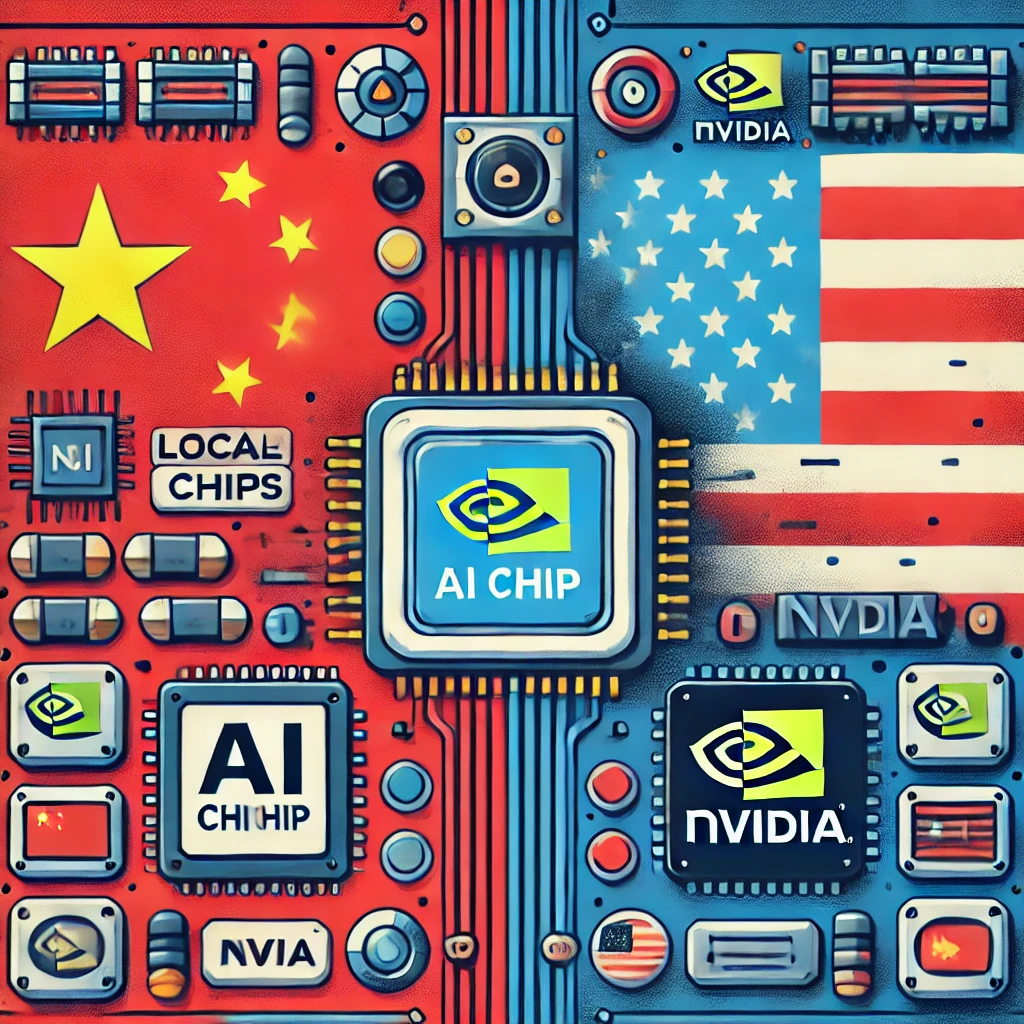
As the tech rivalry between the United States and China intensifies, Chinese authorities have informally advised local companies to prioritize the use of domestically produced artificial intelligence (AI) chips over those made by the US-based tech giant Nvidia. According to sources familiar with the matter, this push is part of China’s broader effort to reduce its dependence on foreign technology and foster a self-reliant semiconductor industry capable of competing with global leaders like Nvidia.
The Context Behind the Move
Nvidia, renowned for its cutting-edge AI chips, has long dominated the global market with its powerful graphics processing units (GPUs) that drive advancements in AI, machine learning, and deep learning. These chips are essential for training large language models, processing vast amounts of data, and powering AI-driven innovations in industries ranging from healthcare to autonomous vehicles.
However, rising geopolitical tensions and increasing scrutiny on technology exports between the US and China have motivated Chinese authorities to accelerate their efforts to build a more self-sufficient semiconductor ecosystem. With the US imposing export restrictions on advanced technologies, including high-performance AI chips, China’s reliance on companies like Nvidia poses both economic and national security risks.
To mitigate these risks, Chinese authorities have urged local firms to shift their focus toward homegrown chipmakers and reduce their dependence on Nvidia’s products. While no formal mandates have been issued, the guidance reflects China’s long-term strategy to strengthen its domestic chip industry and ensure technological independence in critical sectors.
Domestic Chipmakers Look to Catch Up
China’s semiconductor industry has grown significantly over the past decade, but its AI chipmakers still lag behind global leaders in terms of performance, efficiency, and scalability. Companies like Nvidia, AMD, and Intel have decades of research and development under their belts, giving them a substantial edge over their Chinese counterparts.
Nevertheless, several Chinese chipmakers are making progress. Companies such as Huawei’s HiSilicon, Cambricon Technologies, and Horizon Robotics are working to develop AI chips capable of competing with Nvidia’s GPUs. These firms are receiving increased support from the Chinese government, which views semiconductor development as a key priority under its “Made in China 2025” initiative—a strategic plan to reduce China’s reliance on foreign technology and bolster its domestic high-tech industries.
While Chinese AI chips have yet to match Nvidia’s in terms of performance, Chinese tech firms are exploring ways to integrate domestic chips into their AI systems. This shift is not only a response to government pressure but also a pragmatic move to safeguard against potential disruptions in chip supply caused by geopolitical developments.
The Challenge of Competing with Nvidia
Nvidia’s dominance in the AI chip market presents a formidable challenge for China’s chipmakers. Nvidia’s GPUs, especially the A100 and H100 models, are considered the gold standard for AI processing, offering unmatched performance and scalability for training and deploying complex AI models. The company’s deep integration with global AI ecosystems has further entrenched its position as the go-to supplier for AI hardware.
Chinese firms looking to adopt domestic chips must contend with potential trade-offs in performance and efficiency, as the local alternatives are still catching up in terms of technological sophistication. However, some Chinese tech companies, eager to align with the government’s push for technological self-sufficiency, are willing to explore the use of domestic AI chips, even if it means accepting temporary compromises in performance.
To remain competitive, Chinese AI chipmakers are investing heavily in research and development. Cambricon Technologies, for example, has rolled out its cloud-based AI chips designed for data centers, while Horizon Robotics is focusing on AI chips for autonomous driving and smart devices. Despite their smaller scale and more limited global reach, these firms aim to leverage China’s vast domestic market to gain traction and improve their products over time.
The US-China Tech War: A Long-Term Rivalry
China’s informal push for local firms to prioritize domestic AI chips is emblematic of the broader tech war between the US and China. In recent years, the US government has imposed several rounds of export restrictions targeting critical technologies, including semiconductors, 5G, and AI, in an effort to prevent China from gaining access to key components that could enhance its technological and military capabilities.
In response, China has doubled down on its efforts to develop a robust domestic semiconductor industry. The government has funneled billions of dollars into research, manufacturing, and talent development for chipmaking, and Chinese companies are increasingly focusing on building AI hardware solutions that cater to the country’s growing AI market.
The rivalry between the US and China extends beyond AI chips. Both nations are competing for leadership in other strategic technologies, such as quantum computing, 5G networks, and biotechnology. The outcome of this tech competition will have far-reaching implications for global supply chains, international trade, and the future balance of technological power.
The Path Forward: Challenges and Opportunities
While China’s push to promote local AI chips represents an important step toward technological independence, significant challenges remain. Competing with global leaders like Nvidia will require not only substantial investments in research and development but also improvements in manufacturing capabilities and talent acquisition. China’s domestic semiconductor industry is still dependent on foreign technology in key areas, such as advanced lithography equipment used for chip fabrication, which limits its ability to produce cutting-edge chips.
However, the global demand for AI technologies continues to grow, offering Chinese chipmakers opportunities to carve out niches in emerging sectors such as smart cities, autonomous driving, and healthcare. By developing specialized AI chips for these applications, Chinese firms could gradually gain market share and improve their products’ competitiveness.
In the long term, China’s success in developing a world-class AI chip industry will depend on its ability to overcome technological hurdles, foster innovation, and continue building strategic partnerships with other nations. As the tech war with the US unfolds, the race to dominate the AI hardware market will be a critical front in the broader battle for technological supremacy.
Conclusion
China’s push to promote domestic AI chips over Nvidia’s products highlights the growing importance of technological independence in the face of geopolitical tensions. While China’s local chipmakers still have a long way to go before they can compete head-to-head with Nvidia, the government’s support and the country’s vast AI market present significant opportunities for growth. As the global tech war continues, the development of advanced AI chips will remain a key priority for both China and the US, with far-reaching implications for the future of global technology leadership.
