


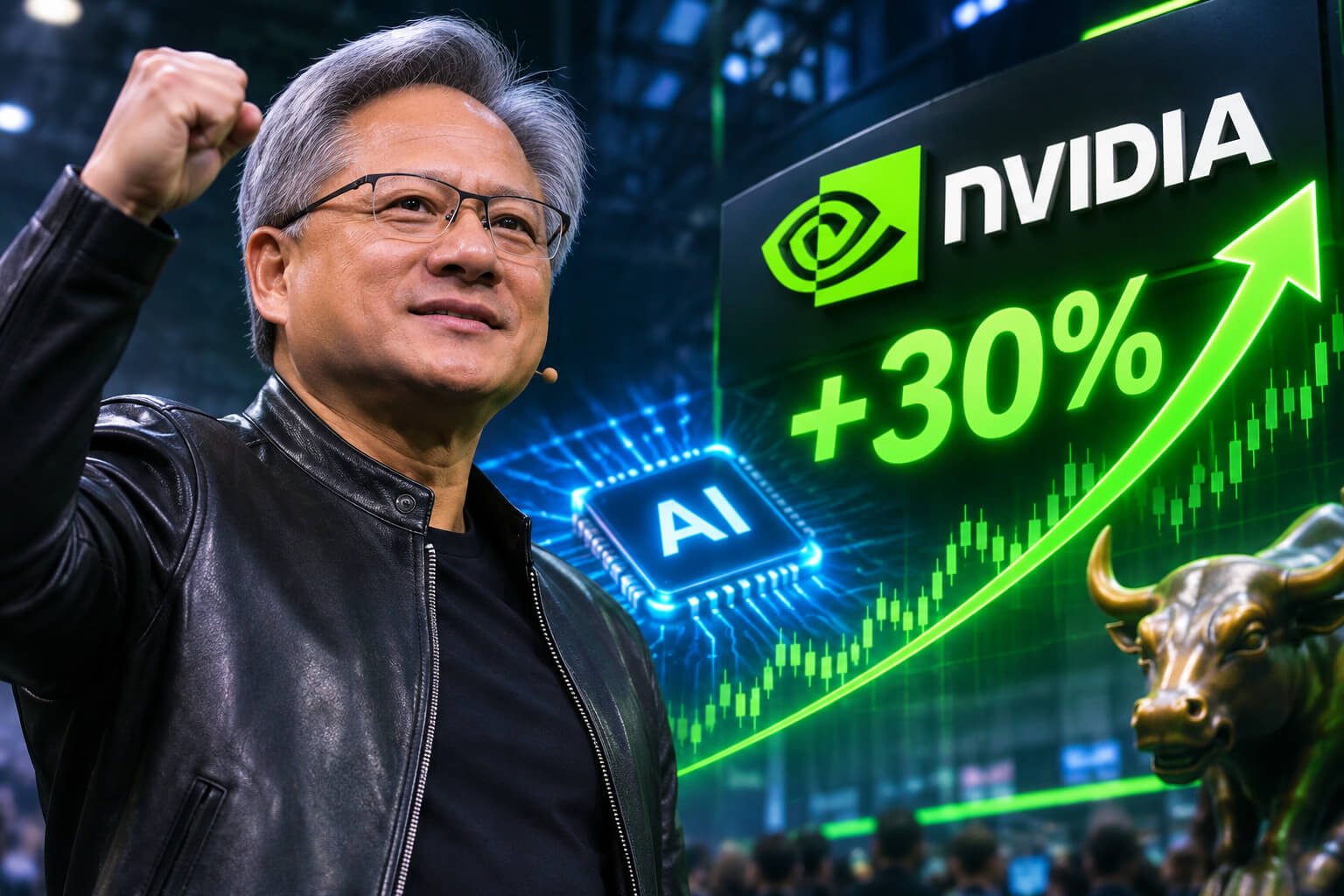
Wall Street staged a dramatic comeback on Monday, November 23, 2026, as Nvidia shares soared in a remarkable Nvidia stock surge following the unexpected return of Jensen Huang as chief executive officer. The announcement brought fresh confidence to investors after a difficult week that saw artificial intelligence stocks suffer heavy losses.
Nvidia’s shares jumped 30.8%, helping lift major U.S. stock indexes and pushing several AI-related companies sharply higher. The rebound came as investors reconsidered their positions in technology businesses that have become central to the global artificial intelligence boom.
The rally was impressive, particularly after the previous week’s selloff. Still, questions surrounding AI valuations, rising infrastructure costs, and regulatory uncertainty haven’t disappeared.
Nvidia Stock Surges Following Jensen Huang’s Return as CEO
Jensen Huang’s return to Nvidia’s leadership became the driving force behind Monday’s market recovery. The company’s board reinstated its co-founder after previously rejecting his offer to return, a decision that surprised investors already unsettled by questions surrounding his departure and an ongoing investigation.
President Donald Trump said his intervention played an important role in convincing Nvidia’s board to bring Huang back. Trump also stated that his administration had found no national security concerns preventing the executive from resuming his position.
Investors responded quickly. Nvidia shares climbed 30.8%, reversing a substantial portion of the nearly 23% decline recorded during the previous week. The company’s recovery reflected renewed confidence in Huang’s leadership and Nvidia’s position as a major supplier of advanced chips used to develop and operate artificial intelligence systems.
Wall Street Rallies as AI Companies Recover From Heavy Losses
The excitement surrounding Nvidia quickly spread across Wall Street, pushing major U.S. stock indexes toward some of their strongest gains in months. The S&P 500 rose 4.6%, while the Nasdaq Composite gained 6.3%. The Dow Jones Industrial Average advanced approximately 3%, ending a seven-day losing streak that had weighed heavily on investor sentiment.
Technology companies closely connected to Nvidia experienced particularly strong gains. CoreWeave, which provides cloud computing services using Nvidia hardware, surged as investors returned to businesses supporting AI development. GE Vernova and Caterpillar also benefited from renewed interest in the infrastructure required to operate large-scale artificial intelligence systems.
The recovery reflected how deeply AI investment has become connected to the wider economy. Demand for advanced computing is creating opportunities not only for semiconductor manufacturers but also for energy providers, construction companies, and businesses involved in building data centers.
Nvidia’s Growing Influence Highlights Wall Street’s Dependence on AI
Nvidia’s extraordinary stock movement demonstrated the company’s enormous influence over the broader financial market. As one of the most valuable publicly traded businesses, Nvidia carries significant weight in major stock indexes, meaning even relatively small changes in its share price can affect millions of investment portfolios.
Before Monday’s rally, a 1% movement in Nvidia shares had a greater impact on the S&P 500 than a similar movement in nearly every other company included in the index. That concentration has made Nvidia a closely watched indicator of investor confidence in artificial intelligence.
The company’s influence extends beyond individual shareholders. Retirement accounts, exchange-traded funds, and institutional investment portfolios frequently hold Nvidia through investments that track major market indexes. When Nvidia performs well, those investments can benefit. When the company struggles, the effects can spread quickly across the financial system.
AI Bubble Concerns Continue Despite the Market Recovery
Monday’s gains provided some relief, but investors remain cautious about the long-term sustainability of the artificial intelligence boom. Technology companies have committed enormous amounts of capital to AI infrastructure, including specialized processors, cloud computing facilities, and energy-intensive data centers.
The financial pressure surrounding those investments has become increasingly difficult to ignore. Higher interest rates make borrowing more expensive, while companies face growing expectations to demonstrate that AI products and services can generate enough revenue to justify their spending.
Regulatory uncertainty has added another layer of concern. Investors are watching potential changes to artificial intelligence oversight in the United States, particularly as political developments could lead to stricter requirements for AI developers and technology companies.
These concerns contributed to the previous week’s market decline, when the S&P 500 fell more than 10% below its recent record. Nvidia’s comeback helped reverse some of those losses, but the broader debate over AI company valuations remains unresolved.
Oracle Gains as OpenAI Infrastructure Funding Reassures Investors
Oracle also attracted investor attention after addressing concerns about its financial commitments to OpenAI, the company behind ChatGPT. The technology giant confirmed that it had secured the funding necessary to fulfill its agreement to provide computing capacity for OpenAI’s expanding artificial intelligence operations.
The announcement helped ease speculation surrounding Oracle’s ability to finance its infrastructure obligations. The company also clarified that additional discussions with vendors were optional arrangements and would not determine whether it could deliver on its existing OpenAI contract.
Oracle shares climbed following the clarification, adding momentum to the broader technology rally. The development highlighted the importance of financial stability within the AI industry, where infrastructure agreements often involve substantial investments and long-term commitments.
As demand for artificial intelligence computing continues to grow, investors are paying closer attention to whether technology companies have the financial resources needed to support their expansion plans.
Strong Corporate Earnings Offer Hope for Continued AI Investment
Despite recent market volatility, corporate earnings have provided investors with reasons to remain optimistic. According to FactSet estimates cited by the Associated Press, companies in the S&P 500 were on track to report nearly 33% year-over-year earnings growth for the summer quarter.
That performance would represent a third consecutive quarter of earnings growth exceeding 25%, suggesting that many major U.S. businesses continue to generate strong profits despite economic uncertainty.
Analysts at Barclays Capital have suggested that challenges facing artificial intelligence investment may slow the pace of infrastructure development rather than bring it to a complete halt. Their assessment reflects the continued demand for computing resources, even as businesses become more selective about where they allocate capital.
For the AI industry, that distinction matters. Companies may delay certain projects or reconsider spending plans without abandoning their long-term artificial intelligence strategies.
What Nvidia’s Comeback Means for the Future of Artificial Intelligence
Nvidia’s dramatic recovery offers a revealing look at the relationship between artificial intelligence and global financial markets. The return of one executive was enough to trigger a substantial rally across companies involved in semiconductors, cloud computing, energy, and industrial infrastructure.
The reaction also exposed how sensitive the market has become to developments involving major AI companies. Investors are no longer evaluating artificial intelligence solely through technological breakthroughs. Leadership decisions, financing arrangements, regulatory developments, and corporate earnings are increasingly shaping the industry’s financial outlook.
For Nvidia, Jensen Huang’s return represents an opportunity to rebuild investor confidence following a turbulent period. The company remains central to the development of advanced AI systems, with its processors supporting many of the world’s largest computing projects.
Whether Monday’s rally marks the beginning of a sustained recovery remains uncertain. AI companies still face pressure to demonstrate that their substantial investments can produce lasting financial returns.
The enthusiasm surrounding artificial intelligence is clearly still alive. The challenge now is turning that enthusiasm into sustainable growth.
Sources
- Associated Press – US Stocks Soar and Recover Roughly Half of Last Week’s Plunge After Jensen Huang Returns to Nvidia
- Nvidia – Official Nvidia Website
- Oracle – Official Oracle Website
- OpenAI – Official OpenAI Website
