


AI agents can search the internet. That doesn’t mean they are particularly good at finding the exact information a business needs.
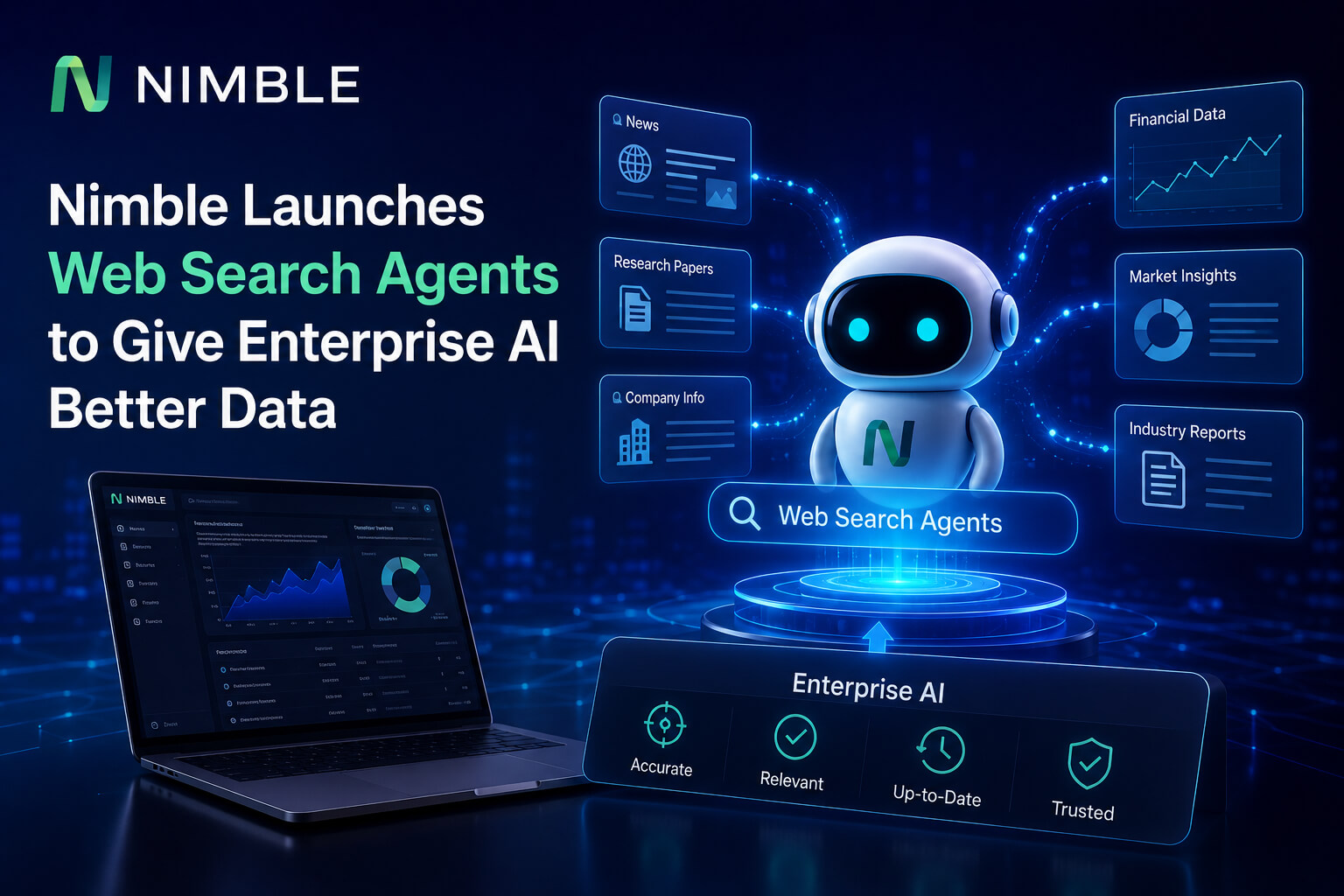
Nimble is taking a swing at that problem with Web Search Agents, a new set of tools designed to learn a company’s domain, search the live web and turn relevant findings into structured data.
The product was announced on July 29, 2026. Nimble says its agents are built for demanding research tasks where generic search results create too much noise, burn through tokens and leave AI systems sorting through piles of loosely related text.
Search That Learns the Assignment
Most search tools handle every request in roughly the same way. A pricing intelligence agent and a lead-enrichment agent may receive different prompts, but the underlying search system still returns a broad collection of pages, snippets and unstructured content. Nimble Web Search Agents are supposed to behave differently.
The agents learn the subject area and adjust how they retrieve information based on the task. Search behavior can become more specialized over time through Nimble’s proprietary index and memory features.
That could matter for businesses monitoring competitor prices, product availability, consumer sentiment, regulatory changes or market activity. These are not one-off Google searches. The information changes constantly, and the output often has to fit directly into an automated workflow. Nimble also says results can include citations and confidence grades, while auditable search plans show what the system searched and why.
Live Web Data, Not Just Cached Results
One part of the pitch is freshness. Nimble uses headless browsers to access current versions of webpages rather than depending entirely on cached search indexes. The agents can navigate websites, retrieve relevant information and convert the findings into structured formats such as tables.
That sounds like web scraping because, underneath the nicer interface, some of the same work is happening. The difference is that companies may not need to build and maintain as many fragile scraping scripts, proxy systems and custom extraction pipelines themselves.
Anyone who has managed a scraping operation knows how quickly those systems break. A website changes its layout. An element gets renamed. A login flow appears. Suddenly, yesterday’s reliable data pipeline is returning empty columns. Nimble is betting that self-learning agents can absorb more of that maintenance burden.
Nimble Claims Better Accuracy With Fewer Tokens
The eye-catching numbers come from benchmark testing cited by the company. According to Nimble, its Web Search Agents delivered a 21-point improvement in answer accuracy and reduced token spending by 51% compared with leading AI search tools.
Those results should come with an asterisk. They were promoted by Nimble and have not been independently verified in the reporting reviewed for this article. Still, the underlying cost problem is real.
Generic search can return long, messy pages that must then be processed by a large language model. Every irrelevant paragraph consumes context-window space. Repeated searches and unnecessary tool calls add another layer of cost.
A search system that retrieves only the useful material could make long-running research agents considerably cheaper to operate. It could also reduce the amount of irrelevant information passed to the model.
The Product Is Entering a Crowded Market
Nimble is not alone here. Companies including Bright Data, Apify, Grepsr, MixRank and Oxylabs already offer tools for collecting and structuring web information. AI-focused search providers are also competing to become the retrieval layer behind enterprise agents.
So this is not a brand-new category appearing from nowhere. Nimble’s possible advantage lies in the combination: live browser-based retrieval, domain-specific learning, repeatable structured outputs and memory that improves with use.
Whether that combination performs better than established scraping platforms or AI-native search APIs remains an open question. Enterprises will want evidence that it provides more complete data with less maintenance—not just an impressive demo.
Why External Context Is Becoming a Bigger Deal
Internal company data explains what is happening inside a business. The web explains what is changing around it.
An inventory database might show that a product is selling faster than expected. External web data could reveal that a competitor has run out of stock, changed its price or suddenly attracted negative customer reviews. AI agents need both sides of that picture to make useful decisions.
This is why data platforms are racing to give enterprise agents better access to trusted, current context. The model itself may be capable, but the final answer still falls apart when the information feeding it is stale, incomplete or irrelevant.
Nimble wants its Web Search Agents to become that external context layer. Not the chatbot. Not the model. The machinery that finds the facts before the model starts talking.
What Comes Next
Nimble plans to expand the product’s self-learning and memory capabilities so agents can understand recurring tasks more deeply and improve after repeated use.
The Web Search Agents are currently available through Nimble’s API, hosted MCP server and supported development platforms and SDKs. Developers can use them for workflows such as company research, consumer sentiment analysis and lead enrichment.
The broader idea is straightforward: AI agents should be able to navigate the web with more purpose and less waste. Pulling that off reliably is the hard part.
