


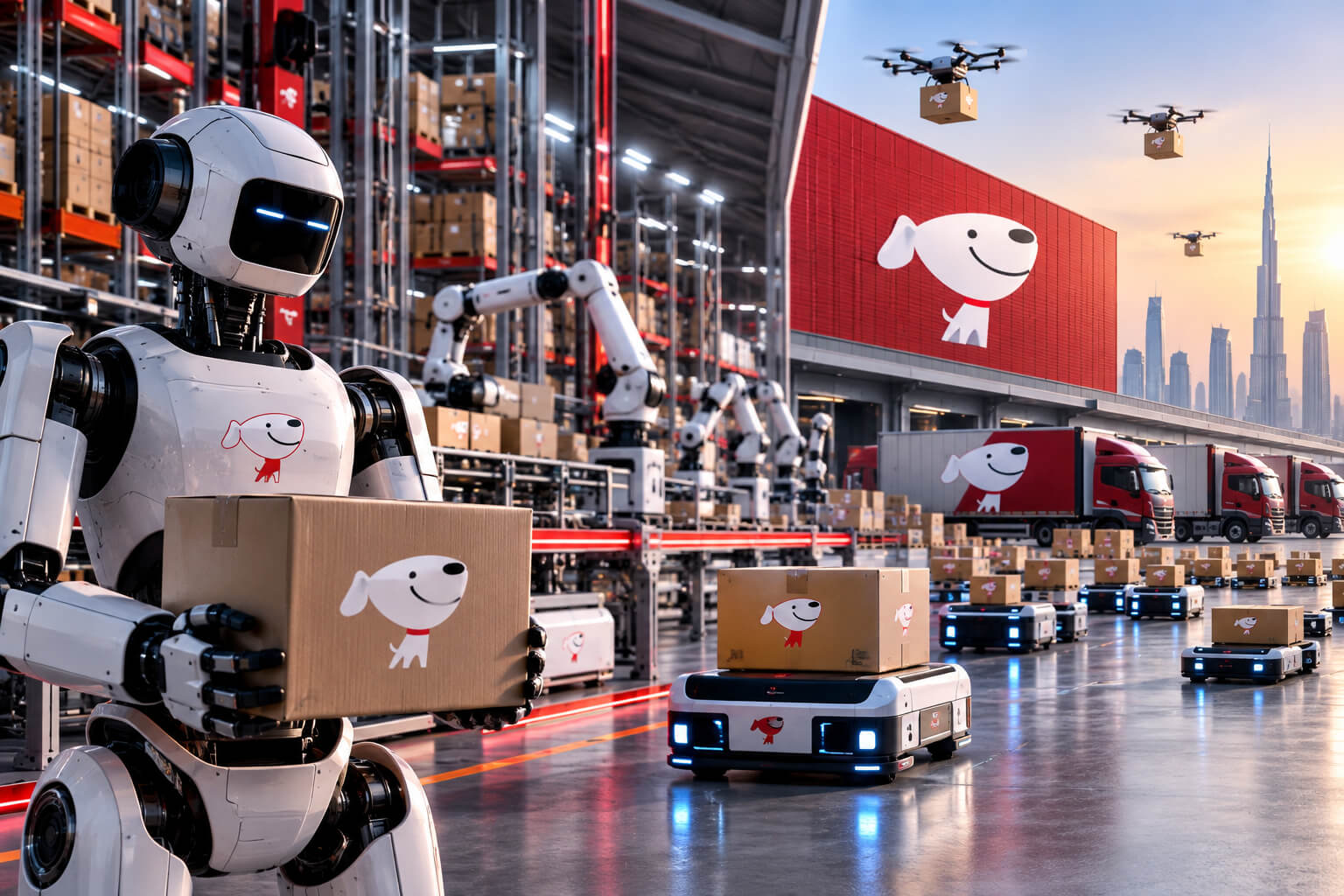
Chinese e-commerce giant JD.com is making a major push into physical AI, with plans to deploy millions of robots, autonomous vehicles, and delivery drones across its logistics operations over the next five years.
The plan reflects a bigger shift in artificial intelligence. Instead of keeping AI inside software, chatbots, and recommendation engines, JD.com wants to place intelligent systems directly into warehouses, delivery networks, and transportation operations.
According to AI News, JD Logistics is targeting the procurement of 3 million robots, 1 million autonomous vehicles, and 100,000 delivery drones under its broader Physical AI Acceleration Plan.
JD.com Pushes AI Beyond Software
JD.com is moving beyond the kind of AI that mainly generates text, images, or recommendations. Its physical AI strategy focuses on machines that can understand their environment, make decisions, and perform tasks in the real world. That includes warehouse robots, robotic arms, autonomous delivery vehicles, and drones working across different stages of the logistics chain.
The company has already introduced its industrial Wolf Robot series for warehousing, sorting, transportation, and delivery operations. Some of these systems are designed for demanding environments, including cold-storage facilities where temperatures can drop well below freezing. This makes JD.com’s strategy less about experimental robotics and more about putting AI-powered machines into everyday commercial operations.
Three Million Robots Is Only Part of the Plan
The planned deployment of 3 million robots is the most eye-catching part of JD.com’s announcement, but the larger strategy goes much further. JD Logistics also plans to acquire 1 million autonomous vehicles and 100,000 delivery drones within five years, creating a logistics ecosystem where machines can handle a growing share of sorting, movement, transportation, and delivery.
JD already has a foundation for this expansion. The company has deployed automated warehouse systems across multiple locations in China and overseas, while thousands of autonomous vehicles are already being used across several Chinese provinces. Its drone operations have also expanded into parcel delivery, food delivery, emergency medicine transport, and disaster-response scenarios.
Meta Brain Connects AI With Real-World Logistics
At the center of JD Logistics’ automation strategy is Meta Brain, an AI system designed to coordinate warehouse, transportation, and delivery operations. Rather than treating each robot or vehicle as an isolated machine, JD wants to use AI to connect physical assets into one coordinated logistics network.
The system can analyze large volumes of parcel and routing data to determine more efficient ways to move goods through JD’s network. JD Logistics has also combined Meta Brain with robotic arms that use multimodal sensors to recognize parcels, determine how to grip them, and position them correctly inside cages or storage areas. This is where physical AI becomes more than basic automation because the machines must adjust their actions based on constantly changing real-world conditions.
JD Wants Millions of Hours of Real-World AI Training Data
Physical AI systems require large amounts of data showing how people, machines, and objects interact in real environments. JD.com has a built-in advantage because its warehouses, delivery stations, retail operations, and logistics centers already generate enormous volumes of physical activity every day.
JD Cloud plans to collect more than 10 million hours of real-world human activity video over the next two years. The company can use this type of data to train embodied AI systems that need to understand movement, object handling, spatial relationships, and real-world decision-making. Instead of relying only on internet text or static images, JD can train its systems using data captured from actual operational environments.
A 100,000-GPU Cluster Will Support the Physical AI Push
JD.com’s physical AI ambitions also require substantial computing power. JD Cloud plans to work with Chinese GPU developer Moore Threads on a computing cluster containing around 100,000 GPUs, supporting large-model training, inference, simulation, and embodied AI workloads.
This infrastructure is important because physical AI systems process far more than language. Robots and autonomous vehicles need to interpret video, sensor data, movement, distance, location, and environmental changes in real time. By investing in its own computing infrastructure, JD.com is building the technical foundation needed to train and operate these systems at a much larger scale.
Autonomous Vehicles Are Already Operating Across China
JD Logistics is not waiting for its long-term physical AI plan to begin experimenting with autonomous delivery. Thousands of its unmanned vehicles are already operating across more than 20 provinces in China, handling delivery routes and other logistics tasks.
The company has also introduced night-time autonomous delivery services in cities such as Shenzhen, extending vehicle operations beyond normal delivery hours. In rural areas, JD has used drones to reach communities that are harder to access by road. These deployments give the company real-world testing environments where autonomous systems must deal with traffic, weather, terrain, pedestrians, and changing delivery conditions.
Automation Raises Questions About the Future of Logistics Jobs
The planned deployment of millions of robots inevitably raises questions about employment. JD.com operates within a logistics ecosystem that supports hundreds of thousands of couriers, warehouse employees, and delivery workers, and greater automation could change many of those roles.
JD has indicated that some employees could shift toward technical positions such as robot servicing, maintenance, monitoring, and operations. The company is already developing robot repair centers and expects the wider robotics ecosystem to create demand for service engineers. Even so, the scale of JD.com’s automation plans means the long-term impact on logistics employment will remain one of the most closely watched parts of its physical AI strategy.
JD.com Is Turning Its Logistics Network Into a Physical AI Laboratory
One of JD.com’s biggest advantages is the size of its logistics infrastructure. The company operates a vast network of warehouses, distribution centers, delivery routes, vehicles, and other physical assets that can serve as testing grounds for AI-powered systems.
Every robot, autonomous vehicle, and drone deployed inside this network can generate fresh operational data. JD can then use that data to improve its models, refine machine behavior, and develop better automation systems. This creates a feedback loop where physical operations help improve AI, and improved AI then makes the physical network more efficient.
Physical AI Could Become the Next Major AI Battleground
Generative AI brought artificial intelligence into offices, browsers, and smartphones. Physical AI could extend the same transformation into factories, warehouses, transportation networks, and delivery systems.
JD.com’s plan shows how quickly that shift could accelerate. The company is combining robotics, autonomous vehicles, drones, AI models, computing infrastructure, and real-world training data into a single strategy. The 3 million robots may attract the headlines, but the bigger story is the ecosystem JD.com is building around them.
If JD succeeds, physical AI could move from experimental robotics projects into routine commercial operations much faster than many expect. In JD.com’s case, that future may arrive through something very ordinary: moving a package from a warehouse shelf to a customer’s door.
Sources
Artificial Intelligence News
https://www.artificialintelligence-news.com/news/jd-com-physical-ai-logistics-3-million-robots/
JD.com Corporate Blog
https://jdcorporateblog.com/
