


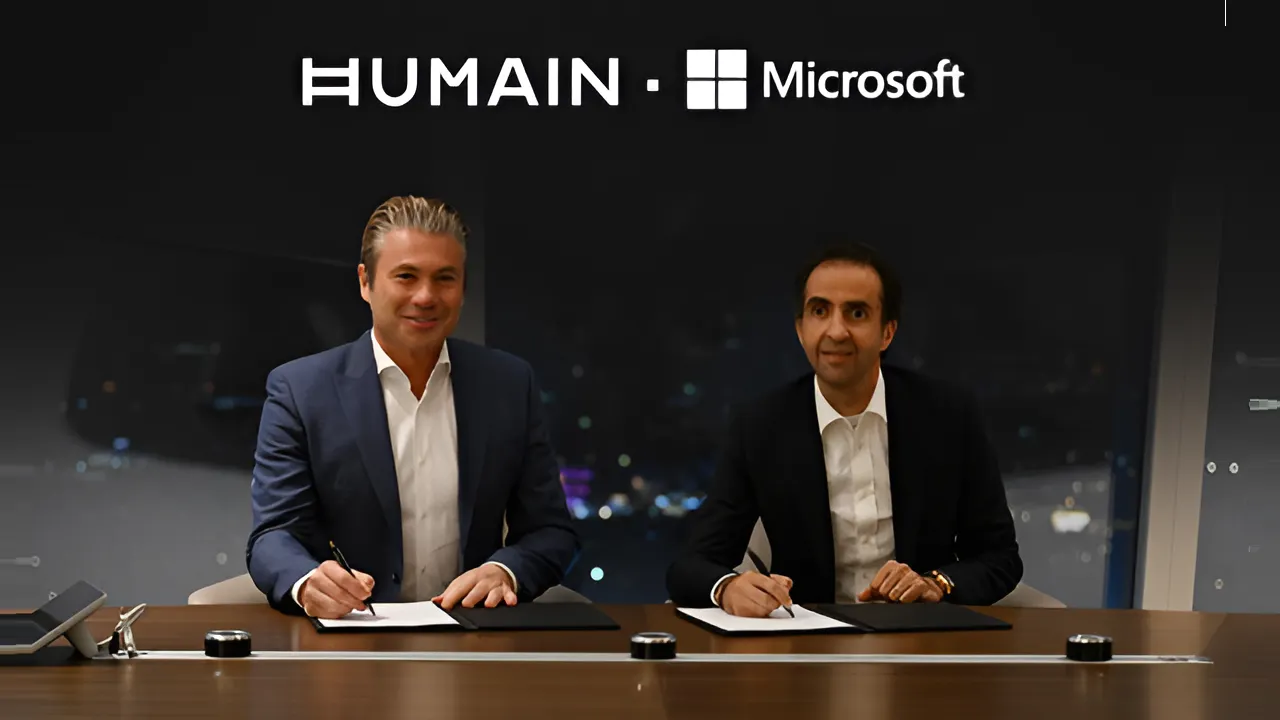
Saudi Arabia’s HUMAIN is taking its Arabic AI models into Microsoft’s enterprise ecosystem.
The two companies announced the first milestone in a long-term strategic collaboration on August 26. The plan centers on bringing HUMAIN’s ALLAM Arabic-language models to Microsoft Foundry. Microsoft 365 Copilot is part of the roadmap too.
There is an important distinction, though. ALLAM isn’t being announced as generally available on those platforms today. HUMAIN and Microsoft say they intend to make the models available. No public launch date or pricing was included in the announcement.
The bigger story is what happens if that integration lands. Arabic-focused AI would move directly into tools already used by enterprises and government organizations.
ALLAM Is Heading Toward Microsoft Foundry
HUMAIN and Microsoft plan to make ALLAM available through Microsoft Foundry. Developers could then use the models inside Microsoft’s AI ecosystem. They could build, customize, and deploy Arabic-language applications and agents. The focus isn’t simply translation. ALLAM is designed around Arabic language and regional requirements. That makes the planned integration especially relevant for organizations operating across Saudi Arabia and the wider Middle East.
Microsoft 365 Copilot Is Part of the Plan
ALLAM could also find its way into everyday workplace tasks. Microsoft and HUMAIN want organizations to create specialized agents through Microsoft 365 Copilot. Those agents could use ALLAM’s Arabic capabilities inside business workflows. Think documents, internal processes, knowledge systems, and other productivity tasks. It puts Arabic AI closer to where employees already work.
The Models Aren’t Publicly Available There Yet
The announcement is forward-looking, and that matters. Microsoft and HUMAIN have not announced a general availability date for ALLAM in Foundry or Copilot. There is also no new pricing information or regional availability list. The companies describe the integration as something they intend to deliver. So this is the start of a rollout, not confirmation that customers can select the new HUMAIN models today.
HUMAIN and Microsoft Engineers Will Work With Customers
The partnership isn’t limited to putting another model in a catalog. HUMAIN’s AI specialists will work with Microsoft’s Forward Deployed Engineers. The teams will help customers identify useful AI projects. They’ll also support integration, configuration, and deployment. The aim is to move projects beyond experiments and into production. That hands-on approach could be important for companies struggling to turn AI pilots into working business systems.
Arabic AI Gets a Much Bigger Enterprise Door
Microsoft’s ecosystem gives HUMAIN a significant distribution opportunity. Businesses already use Microsoft tools for productivity, cloud services, and AI development. Bringing ALLAM into that environment reduces another barrier for Arabic-language deployments. Developers wouldn’t necessarily need a separate ecosystem to use the models. Instead, Arabic AI could sit alongside existing enterprise tools and workflows.
ALLAM Is Built Around Arabic From the Ground Up
HUMAIN positions its current ALLAM 34B model as an Arabic-centric foundation model. The company says it trained the model using more than 500 billion Arabic tokens. Its training resources also include hundreds of thousands of Arabic books. HUMAIN describes the model as culturally aware and grounded in regional history and heritage. The company also hosts and operates it in Saudi Arabia.
That regional focus gives HUMAIN a different pitch from general-purpose global models. Arabic isn’t being treated as an extra language added later. It sits much closer to the center of the product.
ALLAM Already Has Some History With Microsoft
The relationship between Microsoft’s AI ecosystem and the ALLAM family isn’t completely new. An earlier model, SDAIA’s ALLaM-2-7B, was added to Microsoft’s Azure AI model offerings in 2024. That version supported Arabic and English language processing. The newer collaboration goes further. HUMAIN now wants its own ALLAM models integrated more deeply across Microsoft’s enterprise AI platforms.
More HUMAIN and Microsoft AI Products Are Coming
ALLAM is being described as the first technology milestone in a broader partnership. HUMAIN and Microsoft are exploring work across models, productivity, devices, and infrastructure. Joint go-to-market initiatives are also on the table. The geographic ambitions stretch beyond Saudi Arabia into the wider Middle East and Africa. More enterprise AI capabilities are expected to be revealed around LEAP 2026.
HUMAIN Is Building More Than an Arabic LLM Company
HUMAIN was launched by Saudi Arabia’s Public Investment Fund in May 2025. Its mandate covers far more than language models. The company operates across data centers, cloud infrastructure, AI models, and applications. It was created as a full-stack AI company rather than a single-product startup.
The Microsoft collaboration fits neatly into that strategy. HUMAIN can build the model and regional expertise. Microsoft provides an enormous enterprise distribution layer. Put those pieces together, and Saudi-developed AI gets a much shorter route into business environments.
Arabic AI Is Moving Into the Enterprise Mainstream
For years, much of enterprise generative AI developed around English-first systems. Arabic support improved, but regional context remained another challenge.
HUMAIN is betting that this gap is large enough to matter.
Putting ALLAM inside Microsoft Foundry could give developers a more direct route to Arabic-focused applications. Copilot could push the same capabilities into workplace agents.
The deal is still at the planned-integration stage. That’s worth keeping clear. But the direction is difficult to miss.
Arabic AI is moving away from being a specialist side project. It is becoming part of the enterprise AI stack.
Sources
- Middle East AI News — HUMAIN Arabic models coming to Microsoft’s AI platforms
https://www.middleeastainews.com/p/humain-arabic-models-coming-to-microsofts - Microsoft Azure — New models and customization support in Azure AI
https://azure.microsoft.com/en-us/blog/announcing-fine-tuning-for-customization-and-support-for-new-models-in-azure-ai/ - HUMAIN — ALLAM 34B and HUMAIN IQ
https://www.humain.ai/
