


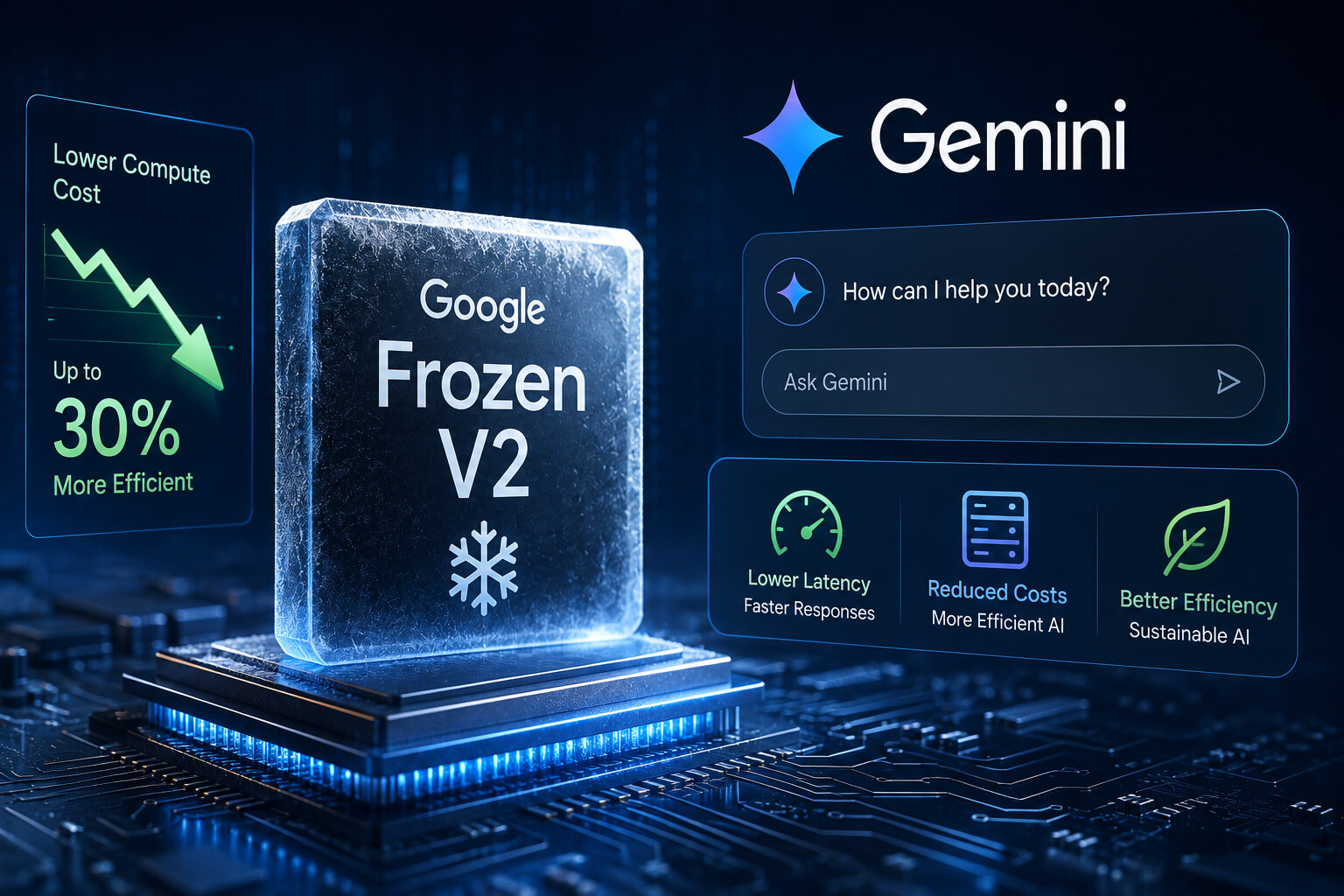
Google may be working on a very different kind of AI chip.
Not just another faster processor. Not just a new Tensor Processing Unit with better numbers on a slide. The reported project, called Frozen V2, is being described as a server chip designed specifically to run Google’s Gemini AI models more efficiently.
That is the important part.
Most AI chips are built to handle many kinds of models. Frozen V2 would be more specialized. Reports say Google wants to place part of Gemini’s architecture directly into the chip itself. In plain terms, the hardware would be shaped around how Gemini works.
That sounds technical because it is. But the business reason is easy to understand. AI is getting expensive to run, and Google needs Gemini to become faster, cheaper, and less dependent on outside chip supply.
What Is Google Frozen V2?
Frozen V2 is reportedly an internal Google chip project focused on AI inference. Inference is the part where an AI model responds to users after training. Every Gemini answer, summary, code request, or image prompt needs computing power.
And when millions of people use AI tools, that cost becomes massive.
According to reports, Frozen V2 would hardwire part of Gemini’s model architecture into silicon. The “frozen” idea comes from locking certain design elements into the chip instead of treating everything as flexible software.
That does not mean Gemini itself would stop improving. The model’s weights and abilities could still change. The chip would simply be optimized around the structure of Gemini so it can process requests with less wasted movement, less energy use, and better efficiency.
That is the promise, anyway.
Why Google Wants a Gemini-Specific Chip
Google already has its own AI chips. Its Tensor Processing Units, or TPUs, have powered many of the company’s machine learning systems for years.
Frozen V2 would go a step further.
Instead of building a general-purpose AI accelerator, Google is reportedly exploring hardware made around its own model family. That could help the company reduce the cost of serving Gemini at scale.
This matters because the AI race is no longer only about who has the smartest model. It is also about who can afford to run that model for billions of prompts.
A model that costs too much to operate becomes a business problem. A model that runs more efficiently can be offered more widely, priced more aggressively, or used inside more Google products without burning through as much infrastructure spending.
Search. Workspace. Android. Cloud. Gemini apps. Ads. Developer tools.
Google has a lot of places where AI could live.
Frozen V2 Could Be 6 to 10 Times More Efficient
Reports say Google engineers expect Frozen V2 to be six to ten times more efficient than current TPUs when measured by tokens generated per unit of power.
That is a big claim.
If it holds up, the chip could help Google serve more Gemini responses with less electricity. It could also reduce pressure on Google’s data center infrastructure at a time when AI demand keeps stretching compute capacity.
This is where the story becomes less about chips and more about survival economics.
AI companies are spending huge amounts on servers, power, cooling, networking, and GPUs. Everyone wants more compute. Nobody has enough. Even companies with deep pockets are trying to avoid becoming permanently trapped by Nvidia supply, power constraints, and rising data center costs.
Google has more experience than most in custom silicon. Still, Frozen V2 would be a bold move because it ties hardware more closely to one model architecture.
That can be powerful. It can also be risky.
The Risk of Hardwiring AI Into Silicon
The obvious risk is that AI models change fast.
A chip takes years to design, test, manufacture, and deploy. AI model architecture can shift much faster than that. If Gemini changes in a major way after Frozen V2 is designed, Google could end up with hardware optimized for yesterday’s model.
That is the uncomfortable trade-off.
General-purpose AI chips are flexible. They may not be perfectly efficient, but they can run different models. A highly specialized chip can be much faster or cheaper for one job, but only if that job stays mostly the same.
Google appears to be betting that at least part of Gemini’s architecture is stable enough to deserve custom hardware.
Maybe that bet works. Maybe the model world changes again before 2028.
That is why Frozen V2 is interesting. It is not just a chip story. It is a bet on what AI architecture will look like a few years from now.
Frozen V2 May Arrive Around 2028
The reported deployment target for Frozen V2 is around 2028. That means users should not expect an immediate Gemini upgrade from this project.
For now, Frozen V2 looks more like a long-term infrastructure play.
Google has not fully confirmed the project in public. In a statement to TechCrunch, the company said its teams are always researching new ways to improve performance and efficiency, while noting that not every project moves into production.
That is corporate language, yes. But it also leaves the door open.
Google does not need to announce every chip experiment early. If Frozen V2 becomes real, it would likely show up first inside Google’s own infrastructure, not as something customers buy directly.
Why This Matters for Nvidia and the AI Chip Market
Frozen V2 also fits into a much larger trend: big AI companies want more control over their hardware.
Nvidia still dominates the AI accelerator market. Its GPUs remain central to training and running many AI models. But Google, Amazon, Microsoft, Meta, OpenAI, and Anthropic are all looking for ways to reduce dependence on outside chip suppliers.
Not because Nvidia is weak. The opposite, actually.
Nvidia became so important to AI that everyone now wants an insurance policy.
For Google, custom chips are not new. But a Gemini-specific chip would send a clearer message: the company wants to design AI systems from model to hardware, not just rent or buy whatever chips are available.
That kind of vertical technology integration could become a serious advantage if AI costs keep rising.
What Frozen V2 Means for Gemini Users
For everyday Gemini users, Frozen V2 probably will not feel dramatic at first.
The chatbot may not suddenly look different. The interface may not change. Users may not even know when Gemini is running on a new chip.
But behind the scenes, the economics could shift.
A cheaper-to-run Gemini could let Google offer more generous usage limits, faster responses, lower enterprise costs, or deeper AI features across its apps. It could also help Google compete harder with OpenAI, Anthropic, Meta, and other AI labs that are all fighting over performance and price.
The real story is not “Google made a chip.”
The real story is that AI companies are now designing hardware around their own models because running AI has become too expensive to treat as a normal cloud workload.
Frozen V2 is Google trying to make Gemini less hungry.
And in the AI race right now, efficiency may matter almost as much as intelligence.
