


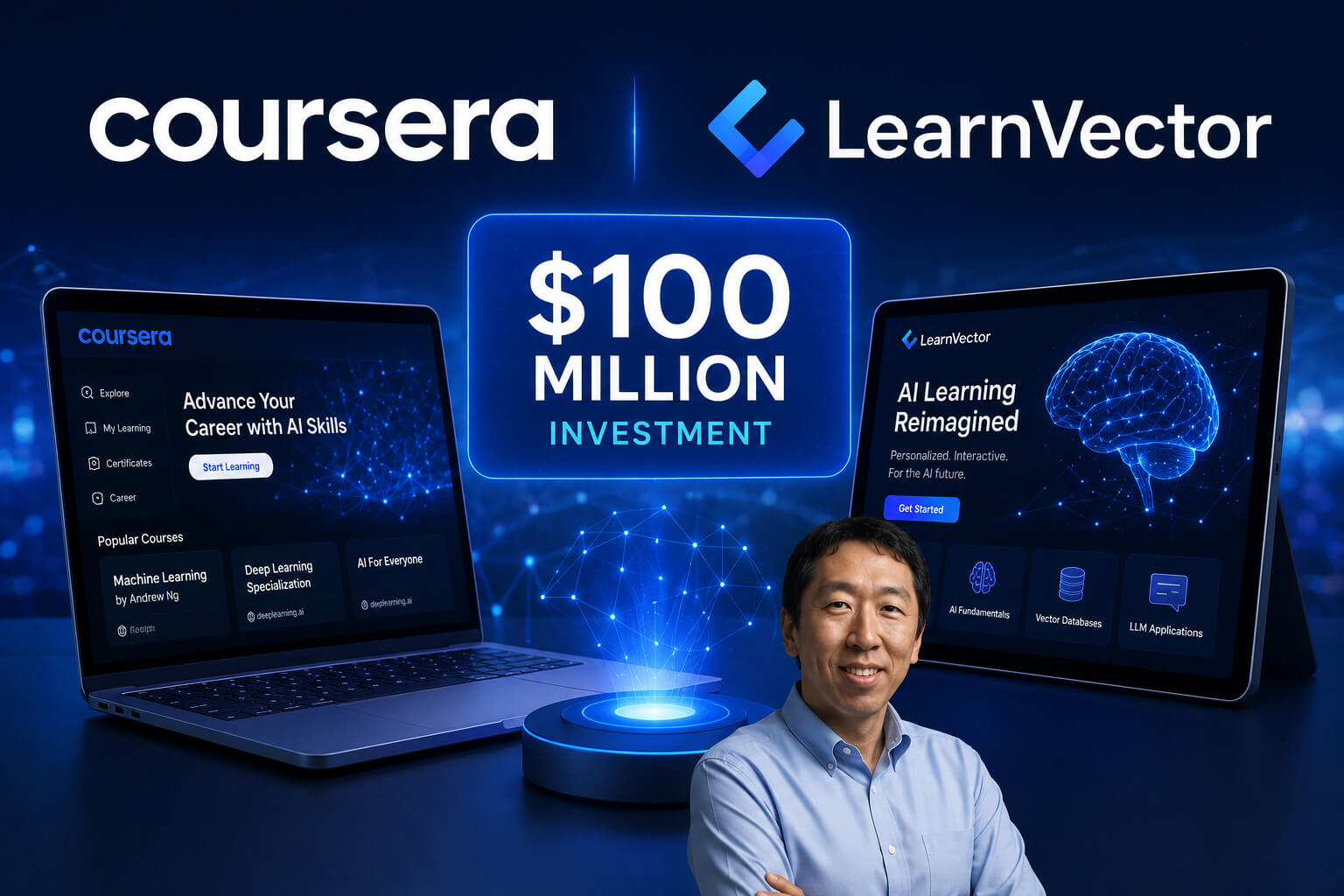
Coursera is placing a large bet on what education could look like after the traditional online course. Recently, the Coursera investment in LearnVector has highlighted this forward-thinking approach.
The learning platform has announced a $100 million strategic equity investment in LearnVector, a newly formed AI-native education company founded and led by Coursera co-founder Andrew Ng.
This is not a small experimental partnership or another chatbot added to a course page. Coursera’s investment gives it roughly a one-third ownership interest in LearnVector on a fully diluted basis. The two companies are also exploring commercial collaborations that could connect LearnVector’s agentic AI technology with Coursera’s course library, enterprise relationships and learner data.
The bigger idea is fairly ambitious: replace the standard one-course-for-everyone format with a learning system that follows each person individually.
LearnVector Wants to Move Beyond the AI Tutor Chatbox
AI tutors are hardly new. Education platforms have spent the past few years adding assistants that explain lessons, generate quizzes or answer questions.
LearnVector is trying to make a distinction between answering and teaching.
The company says it is developing a one-to-one learning experience that can plan a path with the learner, adjust to how that person learns and continue working with them until they have mastered a skill. Its system is expected to rely on AI agents rather than a conventional chatbot that simply responds to isolated prompts.
That difference matters.
A chatbot can finish a calculation, rewrite an essay or hand over the answer to a homework problem. None of that guarantees the person understood what happened. In some cases, an overly helpful AI assistant may even encourage people to avoid the difficult thinking that helps knowledge stick.
LearnVector is positioning itself around the opposite outcome. The company wants to measure whether learners can actually demonstrate a skill, not merely complete a task while an AI system does most of the work.
Andrew Ng Returns to the Online Learning Problem
Andrew Ng has already played a central role in bringing online education into the mainstream.
He co-founded Coursera with Daphne Koller in 2012 after helping launch a Stanford machine learning course that attracted a huge online audience. Ng also founded and led Google Brain, served as Baidu’s chief scientist and later created DeepLearning.AI.
LearnVector brings him back to a familiar problem, though the available technology has changed dramatically.
The first wave of massive open online courses expanded access. A learner no longer needed to live near a major university or attend a physical classroom to study with a respected instructor.
Access improved. Personalisation did not move nearly as far.
Most online courses still present the same videos, readings and assignments to everyone. Some learners move quickly. Others struggle with a concept and receive little individual guidance. The course keeps going either way.
Ng believes AI can change that structure by giving each learner something closer to a private guide. LearnVector says its system will adjust the pace, practice and learning path instead of forcing every user through an identical sequence.
Coursera Sees AI as a Way to Expand Education
Much of the conversation around AI and education has focused on replacement.
Will students stop writing? Will teachers lose control of assessments? Will AI-generated answers make traditional coursework meaningless?
Coursera is presenting a different commercial argument. The company believes AI could increase demand for trusted education by making learning more personal, continuous and useful.
Coursera CEO Greg Hart said the investment reflects the company’s belief that AI will expand the learning market rather than shrink it. The platform wants learning to become something people do more regularly instead of only when they enrol in a formal course or prepare for a career change.
That view also explains the size of the investment.
Coursera is not only backing a startup founded by one of its original creators. It is investing in a possible new interface for its existing education business.
LearnVector could provide the personalised AI layer. Coursera brings recognised educational content, credentials, universities, industry partners and access to a very large learner base.
Together with Udemy, Coursera says its expanded platform reaches more than 300 million learners and around 12,000 enterprise customers worldwide.
The Udemy Combination Gives the Deal More Weight
The LearnVector announcement arrives shortly after Coursera completed its combination with Udemy in May 2026.
That deal created a much broader online skills platform, bringing together Coursera’s university and professional credential programmes with Udemy’s large marketplace of instructor-led courses.
LearnVector now enters that expanded environment.
Coursera and LearnVector have not disclosed exactly how the new products will appear across Coursera or Udemy. For the moment, they are exploring possible commercial arrangements rather than announcing a finished integration.
Still, the direction is easy to see.
An AI system could eventually guide a learner across courses from different providers, recommend a sequence based on a career goal, identify missing knowledge and change the plan when the learner struggles. That would be considerably more involved than suggesting the next popular course.
It could also make Coursera’s enormous catalogue easier to navigate. More content creates more choice, but it can also create confusion. A personalised agent could potentially decide what matters, in what order and at what level of difficulty.
Coursera Is Buying a Strategic Position, Not Just Technology
The financial structure deserves attention.
Coursera’s $100 million investment represents approximately one-third ownership of LearnVector on a fully diluted basis. An independent special committee of Coursera’s board evaluated and unanimously approved the transaction.
That gives Coursera a meaningful stake while allowing LearnVector to operate as a separate company.
The arrangement may provide Ng’s team with more room to build from scratch, without immediately forcing the product into the existing technical and commercial structure of a large public platform.
Coursera, meanwhile, gains early exposure to a company developing technology that could reshape its own core business.
There is risk on both sides. LearnVector still has to prove that agentic AI can produce better learning outcomes at scale. It must also show that users will return consistently, trust its guidance and pay for the experience.
The product cannot simply feel like a more organised chatbot.
The First LearnVector Products Are Expected in 2027
LearnVector is still at an early stage.
The Mountain View-based company says it is building its initial product and expects to show its first experiences in early 2027. It is also recruiting AI engineers, learning scientists, learning engineers, full-stack developers and operations staff.
That timeline means many important details remain unanswered.
LearnVector has not revealed pricing, access models or whether its first product will target individual learners, universities or enterprise customers. It also has not explained how it will verify that someone has genuinely mastered a skill.
Those questions may decide whether the platform becomes a serious education product or another interesting AI demonstration.
Personalisation is appealing. Reliable instruction is harder. A system that adapts perfectly but teaches inaccurate material would be worse than a rigid course written by an expert.
LearnVector appears aware of that tension. The company has repeatedly emphasised trustworthy content, measurable mastery and collaboration with established education platforms.
AI-Native Learning Is Becoming a Serious Business Category
The Coursera investment in LearnVector shows how quickly AI education is moving beyond course recommendations and automated customer support.
The next competitive battle may centre on who controls the learner’s path.
Traditional platforms organise education around courses, certificates and instructors. AI-native systems may organise it around the individual: what the learner knows, what they need next and whether they can prove they understand it.
Coursera already has content and distribution. Andrew Ng has experience across AI research, education and startup development. LearnVector is the attempt to combine those pieces into a learning system designed for the agentic AI era.
Whether it works will depend on something more demanding than generating helpful answers.
The system will need to make people better at doing things without quietly doing everything for them.
