


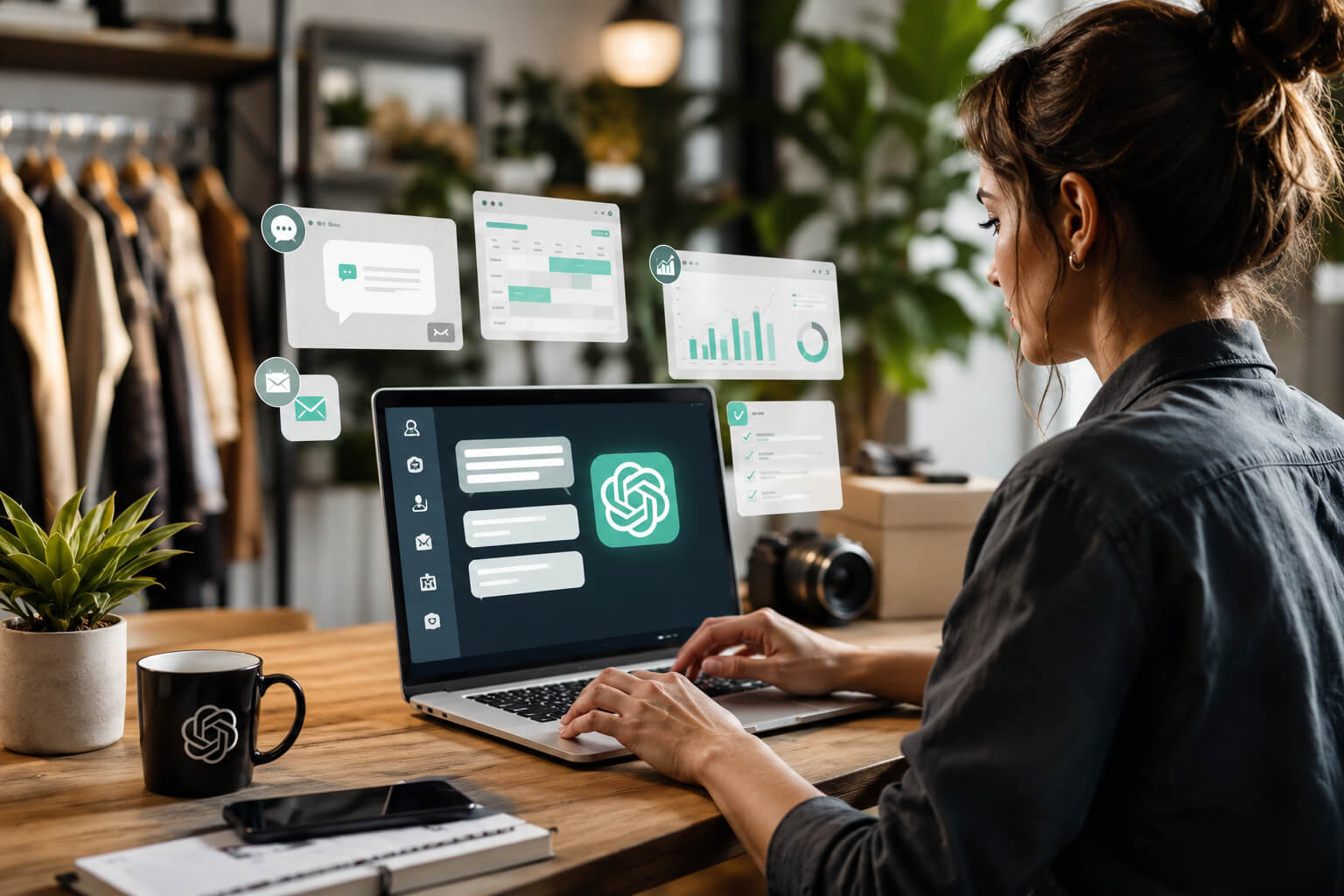
OpenAI is going after small businesses more directly now.
The company has introduced ChatGPT for Small Business, a program built to help owners and lean teams use AI in everyday work. Not in some vague “future of productivity” way. More like customer replies, marketing drafts, accounting help, operations checklists, Shopify workflows, Slack updates, and all the small tasks that quietly eat up a business owner’s day.
The program includes free virtual training, in-person AI academies, guides, partner tools, and workflow examples. OpenAI says the goal is to help small businesses get comfortable with ChatGPT and apply it faster, even if they do not have an AI expert on staff.
That detail matters.
Small businesses do not usually have time to “experiment with AI strategy.” They have invoices, angry customers, stock problems, late suppliers, ads to run, and maybe one person doing the work of five people. So OpenAI is not only selling a chatbot here. It is trying to teach businesses how to actually use one.
ChatGPT for Small Business Is About Training, Not Just Access
The interesting part of ChatGPT for Small Business is that OpenAI is not simply saying, “Here is ChatGPT, good luck.” The program gives business owners training resources, guides, workshops, and practical prompts they can use for common business tasks. OpenAI also points to partner tools and skills from companies such as Dropbox, Shopify, Intuit, Slack, Atlassian, Wix, and others. These are meant to help small businesses connect ChatGPT to tools they may already use.
That makes the program feel more like onboarding than a product launch. For a small retailer, that could mean turning scattered product notes into a cleaner Shopify workflow. A service business might use AI to draft customer emails or organize operations tasks. Small teams could also rely on AI to summarize work, prepare content, or build repeatable processes. Not glamorous. Useful. And for small businesses, useful usually wins.
OpenAI Wants the Next Enterprise Customer Early
There is another layer here. OpenAI is clearly trying to reach companies before they become big companies. A small business using ChatGPT today could become a larger team tomorrow. If that business builds its habits, workflows, and internal documents around ChatGPT early, switching later becomes harder. That is not accidental. It is how software ecosystems grow.
This is why the small business market is suddenly getting so much attention from major AI companies. OpenAI, Anthropic, and Google are not only chasing Fortune 500 contracts. They are trying to become the default AI assistant for the everyday business owner.
That is a bigger market than it looks. Small businesses need help with marketing, bookkeeping, customer support, reporting, hiring, social media, proposals, and planning. They also tend to avoid complicated software unless it solves a problem quickly. So the AI tool that feels easiest may have the advantage.
How ChatGPT Compares With Claude for Small Business
Anthropic is taking a different route with Claude. Claude for Small Business focuses heavily on connecting Claude to apps that small companies already use. Anthropic says Claude works with tools such as Intuit QuickBooks, PayPal, HubSpot, Canva, DocuSign, Google Workspace, and Microsoft 365. The idea is simple: Claude should not just answer questions. It should sit inside business workflows.
That makes Claude feel more operations-focused. It can help with things like payroll planning, month-end close, invoice follow-ups, contract review, campaign work, and sales tasks. Anthropic has also framed the product around approvals, which is important when AI starts touching sensitive business actions.
That is probably where Claude’s pitch is strongest. Less “learn how to use AI.” More “connect AI to the work you already do.” For a small business with multiple tools and a lot of admin work, Claude may feel closer to an AI coworker than a training program.
How Gemini Fits Into the Small Business Race
Google is playing a quieter but dangerous game. It does not need to launch a separate small business program in the same way OpenAI does. Gemini is already being pushed across Google Workspace. Gmail, Docs, Sheets, Slides, Drive, Meet, and Chat are daily work tools for many small companies.
That gives Google a built-in advantage. A business owner writing emails in Gmail, preparing a proposal in Docs, reviewing numbers in Sheets, or joining meetings in Meet may not need to open a separate AI assistant at all. Gemini can appear inside the tools they already use.
This is less dramatic than a big launch. But it may be more powerful. Google’s strategy is not “come to our AI tool.” It is “AI is already inside your workspace.” For small businesses that live in Gmail and Google Docs, that could be enough.
The Real Difference Is Workflow
The comparison is not only about which AI model is smarter. For small businesses, the better question is: where does the AI show up?
ChatGPT for Small Business is strongest as a guided adoption program. It helps owners understand what AI can do and gives them practical ways to start. Claude is leaning into connected business workflows across finance, sales, legal, HR, and marketing tools. Gemini is strongest when the business already runs on Google Workspace.
Different doors. Same room. OpenAI wants to teach small businesses how to use AI. Anthropic wants Claude to work across business apps. Google wants Gemini embedded into the office suite people already open every morning. That is the fight.
Small Businesses Need AI That Does Not Feel Like Another Job
The biggest problem with AI adoption is not always price. Sometimes it is friction. A small business owner may hear that AI can help with marketing, operations, customer support, bookkeeping, hiring, inventory, and strategy. Great. Then what? Which prompt should they use? What app actually fits the job? Where does AI belong in the workflow? And what data can they safely upload?
That confusion slows adoption. OpenAI’s small business program seems built around that gap. It gives people a place to start. Claude tries to solve the same problem by connecting to existing tools. Gemini tries to solve it by living inside Workspace apps.
None of these approaches is perfect. AI still makes mistakes. Business owners still need to check outputs, especially around numbers, contracts, tax-related work, and customer-facing claims. But the direction is clear. AI companies are no longer waiting for small businesses to figure it out alone.
ChatGPT for Small Business Could Make AI More Normal
This launch says something important about where AI is heading. The next phase is not just bigger models or benchmark bragging. It is practical adoption. The boring stuff. The admin work. The repeatable workflows. The emails that need rewriting. The invoices that need chasing. The spreadsheet that needs explaining before lunch.
That is where small businesses feel the pain. ChatGPT for Small Business gives OpenAI a more direct way into that world. Claude is already pushing into connected workflows. Gemini is sitting inside Google Workspace.
The winner may not be the tool with the loudest AI demo. It may be the one that helps a tired business owner finish three tasks before closing time. And honestly, that is probably the right test.
Sources
- Times of AI – OpenAI Launches ChatGPT for Small Business, but Does It Beat Claude and Gemini?
- OpenAI – Introducing the ChatGPT for Small Business Program
- OpenAI – Small Business
- Anthropic – Introducing Claude for Small Business
- Google Workspace Help – Google Workspace with Gemini
- Google Workspace – Pricing
